Physical AI HBM Smart Factory SDV AIoT Power Semicon 특수 가스 정정·반론보도 모음 e4ds plus

Lee Woo-jong, Vice President of Amotech, “SW-armed electric vehicles are the key to the future of cars”

기사입력2022.11.10 15:46


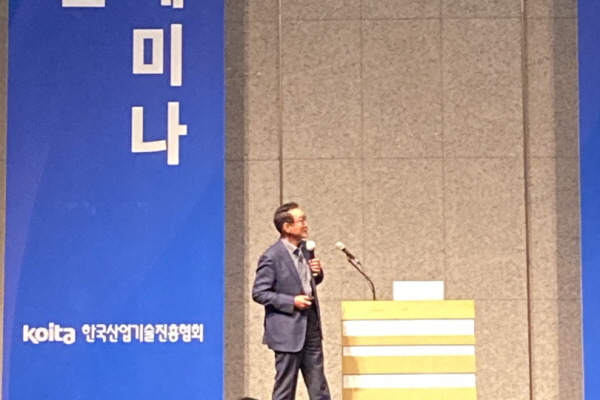
▲ Lee Woo-jong, Vice President of Amotech


Sangkihyeop Breakfast Seminar, 'Game Changer Future Car is Coming'
Tesla and Toyota's vehicle sales volume 9%, market cap 330%


Lee Woo-jong, Vice President of Amotech, said that the core of future cars is electric vehicles armed with software, and explained the trends and importance of the electric vehicle market.

The Korea Industrial Technology Promotion Association held a breakfast seminar at the Yangjae L Tower on the 10th and invited Vice Chairman Lee Woo-jong of Amotech as a speaker to revisit the importance of the electric vehicle market.

This vice chairman is a key figure in the domestic automobile industry, having served as head of vehicle development at Daewoo Motors and head of the VC business division at LG Electronics.

At this seminar, he presented on the topic of ‘Game Changer Future Cars Are Coming’ and said that electric vehicles, which account for only 5.8% of global car sales, are emerging as the future trend.

As of June 2022, Tesla and BYD, which are ranked 1st and 2nd in electric vehicle sales, are ranked 1st and 3rd in terms of market capitalization among automobile manufacturers. Tesla only sells 9% of Toyota's units, but its market capitalization is 3.3 times larger.

Tesla has captivated consumers with future technologies such as OTA and smart UX while satisfying traditional vehicle purchasing needs such as acceleration and ride quality with electric vehicles.

The number of electric vehicles in Korea is also increasing significantly from 135,000 units at the end of 2020 to 231,443 units at the end of 2021, and social acceptance is also increasing.

Although our country does not lead the market centered around the Hyundai Motor Group, we are not falling behind either, and we have established ourselves as a global electric vehicle manufacturer with the Ioniq and EV series.

The reason why companies are focusing on BEVs among various types of eco-friendly vehicles is because the ratio of power delivered to the wheels is overwhelming at 77%, compared to 30% for fuel cell hydrogen vehicles.

In addition, with the environmentally friendly wind blowing, such as the Paris Agreement, the European Union declared that it would ban the sale of new vehicles with internal combustion engines by 2035.

Car manufacturers are also saying goodbye to internal combustion engine vehicles and focusing on electric vehicles.

Hyundai Motor Group will convert all Genesis models to electric vehicles after 2025, BMW will convert all Mini models to electric vehicles in the 2030s, Volkswagen will convert all Mini models to electric vehicles in 2030, and GM will convert all Mini models to electric vehicles in 2035.

The advancement of battery technology is what has enabled electric vehicles to develop so quickly.

In 2008, Japan predicted that electric batteries would be able to drive 200 km by the early 2020s.

On the other hand, the Ioniq 6 Long Range model released this year has achieved technological advancements that far exceed expectations, with a driving range of 524 km.

The vice president said that while the technological advancement and distribution rate of electric vehicles will continue to rise, the biggest obstacle to distribution is the price of batteries.

According to the Korea Institute for Industrial Economics & Trade, 12 million won is invested in the battery alone to manufacture one electric vehicle worth 47 million won.

He predicted that electric vehicles will become more popular as the proportion of batteries decreases and their prices become similar to those of internal combustion engine vehicles, and predicted that the proportion of batteries in the price of electric vehicles will fall to 20% by 2030.

Meanwhile, as autonomous driving intensifies, the importance of system semiconductors is increasing day by day.

When autonomous driving level 3 or higher It is expected that more than 2,000 semiconductors will be installed in a single vehicle.

Amid this trend, the automotive semiconductor market is expected to grow significantly from $45 billion in 2020 to $175 billion in 2040, and competition is fierce, with Intel acquiring Mobileye for $15 billion and Tesla designing its own chipsets.

However, despite the growth of the automotive semiconductor market, many problems are occurring, such as delays in delivery and failure to issue spare car keys due to a shortage of automotive semiconductors.

Automotive semiconductors are characterized by small-volume, multi-variety production and low profitability, but they also have high quality requirements, making it difficult for companies to actively enter the market.

Vice Chairman Lee Woo-jong added, “As software-defined vehicles (SDVs) are becoming a key future car trend, convergence between industries is becoming more important.” He added, “We need to break away from traditional development procedures and change to a development culture that actively utilizes communication and acceptance of change.”