반도체 AI 보안 인더스트리 4.0 SDV 스마트 IoT 컴퓨터 통신 특수 가스 소재 및 장비 유통 e4ds plus

ETRI, Drone Communication Network Standards Established

기사입력2023.04.06 15:45

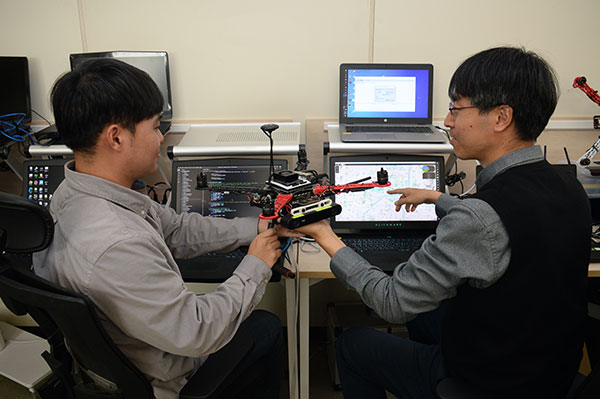
▲ETRI research team discussing the Unmanned Aerial Vehicle Network (UAAN) standard

Establishment of four international standards for drone communication networks
Preventing collisions between drones and simultaneous operation of large-scale drones

Domestic researchers have established a drone communication network standard, enabling information exchange among drone manufacturers using a common communication standard.

The Electronics and Telecommunications Research Institute (ETRI) announced on the 22nd of last month that four contributions related to ‘drone (unmanned aerial vehicle) communication networks’ were established as international standards at the International Organization for Standardization (ISO) meeting held in Vienna, Austria.

The technology established as this international standard is a standard for the Unmanned Aerial Network (UAAN), and consists of four detailed technologies: △Unmanned Aerial Network (UAAN) communication model and requirements, △Shared communication, △Control communication, and △Video communication.

In particular, the core technology of this international drone communication standard is the 'Evolved Wireless Ad Hoc Network (EVAN)' technology. This enables information sharing between drones, collision prevention of large-scale drones, and collision prevention with ground-based obstacles.

For example, drones from different manufacturers could fly simultaneously to spray pesticides over large areas of farmland, or multiple drones could fly simultaneously over a fire zone when a large fire breaks out.

The recognition service communication distance of this standard is approximately 5 km. Unlike on the ground, the mobile communication network is very frequently disconnected in the air, but this standard can compensate for this. In addition, it is explained that drones or drones and helicopters can recognize each other, so that the flight safety of manned and unmanned aircraft can be secured at the same time.

The research team also said, “Compared to heavy and expensive drone recognition radar, the communication modem of the ‘drone communication network’ standard can be manufactured cheaply and lightly for tens of thousands of won, making it suitable for drone recognition services.” It is expected that the communication modem can be used for autonomous drone flight when mounted on a moving obstacle that is not shown on the map.

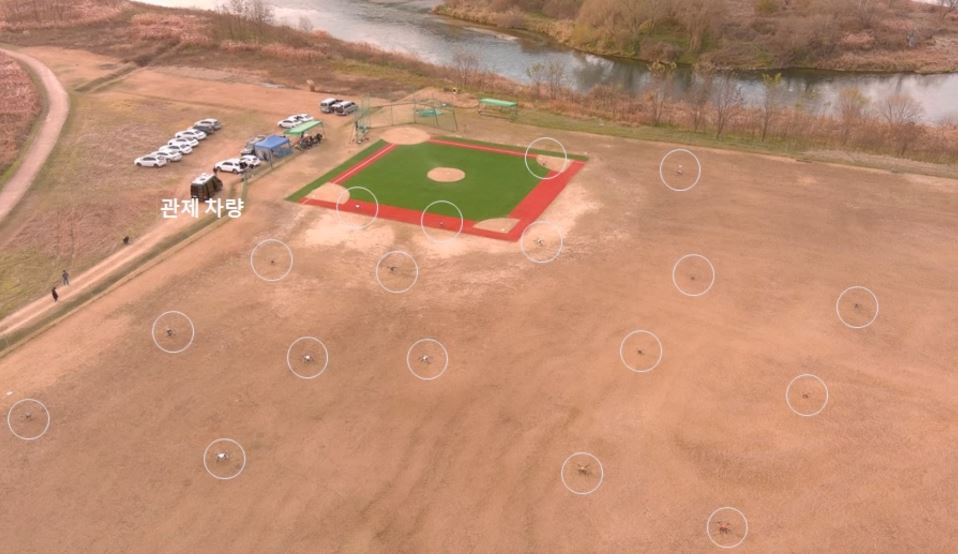
Multiple drone swarm mission flight (Data = ETRI)

This standard technology enables interconnection between not only drones but also related devices. In addition to drone control, drone-related services such as ▲ mutual recognition between drones ▲ autonomous collision avoidance ▲ illegal drone detection ▲ moving obstacle recognition ▲ communication with takeoff and landing pads can be provided through a single, integrated communication platform.

It is expected that by utilizing the 'Low-altitude drone detection and avoidance application layer technology' standard of the Telecommunications Technology Association (TTA) of Korea, we will be able to get one step closer to securing autonomous collision avoidance technology between drones.

In addition, it supports services such as △vertiport communication △providing flight priority during bridge pier maintenance or building surveying (dynamic geofencing), and △if applied to defense drones, it can also overcome North Korea's radio interference.

He explained that since the drone transmits a password (trust field) that changes with each signal transmission after applying the technology, it will be possible to automatically determine from the ground whether the drone is a legal or illegal drone.

It can also be used for communications for PAVs (Personal Air Vehicles), such as drone taxis. Urban Air Mobility (UAM) requires communication redundancy by using multiple communication systems simultaneously to operate safely in dense urban areas, and this technology can supplement this.

ETRI's Lim Chae-deok, head of the Air Mobility Research Center, said, "This international standardization will not only secure the stability of drone operation, which is essential for servicing commercial drones, but its core, EVAN, is easy to configure as an adaptive communication network and has high transmission efficiency compared to mobile communications such as LTE and 5G and Wi-Fi, so it will be of great help in leading the fast and convenient future air mobility service."

The ETRI research team said that in the future, it can be expanded into a platform that interconnects all objects, buildings, people, vehicles, and drones, and provides numerous services within the home, home appliances, and vehicle control, as well as social safety nets. The market outlook is also bright, as the technologies developed in the future are expected to lead to a large number of international standard patents.