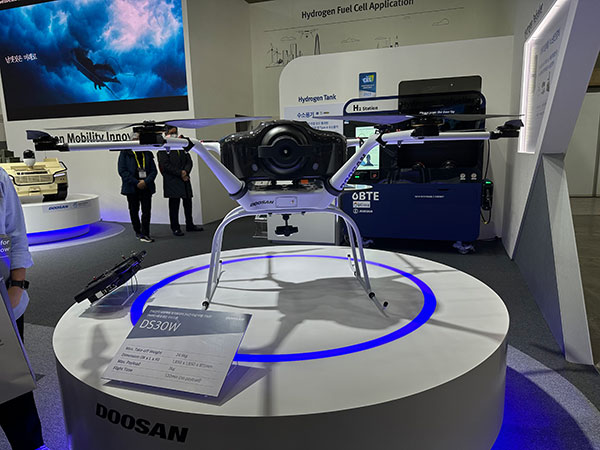
▲ Hydrogen drone DS30W displayed at the 2023 Drone Show Korea
Eco-friendly hydrogen drone, flight time↑ compared to battery
Multipurpose integrated hydrogen charging equipment targeting overseas markets
As interest in next-generation mobility such as UAM and AAM grows, hydrogen has emerged as an eco-friendly energy source for the drone industry.
Doosan Mobility Innovation has unveiled a lightweight and highly stable hydrogen drone, revealing its ambitions as a leading hydrogen fuel cell company.
Doosan Mobility Innovation (hereinafter referred to as DMI) unveiled a drone using hydrogen fuel cell technology, a hydrogen charging station, and an unmanned mobile robot at the '2023 Drone Show Korea' held until the 25th. The main items include △DM15 △DS30W △DT30X △UGV (Unmanned Ground Vehicles).
Hydrogen is the lightest and safest element on Earth, and is attracting attention as an eco-friendly energy source because it is produced from oxygen, which is easy to obtain in the atmosphere.
Fuel cells, also known as tertiary batteries, are an eco-friendly hydrogen power generation technology that produces electricity using the chemical reaction of oxygen and hydrogen. If a lithium-ion battery is an energy storage device with chemical energy stored inside, a fuel cell is an energy conversion device that can continuously produce electricity.
Hydrogen drones are drones that use hydrogen fuel cells, and they have the advantage of a flight time of more than an hour longer than battery drones, a four-times longer inspection distance per flight, and an eight-times wider area. Although hydrogen cars have issues such as cost and insufficient charging infrastructure, at a time when these are also being presented as solvable, hydrogen drones are described as the next-generation drones that will overcome the limitations of engine drones and battery drones and bring about innovation in terms of durability and convenience.
▲Fuel cell power module 'DM15' exhibited at the 2023 Drone Show Korea The 'DM15' exhibited at the event is a lightweight and highly safe hydrogen fuel cell power pack module that is easy to customize, fits well with any aircraft, and can be applied to various ground mobility. It is designed for temperature stability.
DMI Manager Kwak Byeong-cheol said, “Fuel cells have high energy density, so as the amount of hydrogen increases, the amount of energy also increases, enabling long-term flight,” and “Hydrogen fuel cells are suitable for medium- to large-sized drones.”
DMI's power pack consists of a battery and hybrid system to respond to high power during takeoff and landing of the drone. In case of a problem with the drone, the hybrid battery can help with an emergency landing, ensuring stability.
The 'DS30W' is a hydrogen drone developed by DMI that can fly for more than 2 hours and up to 80km. It is an optimized airframe for installing a hydrogen fuel cell power pack, and compared to existing products, its wind resistance has been strengthened to withstand an average wind speed of 12m/s and an instantaneous wind speed of 15m/s, and it has acquired an IP43 rating for waterproofing and dustproofing.
To address the issue of hydrogen drones having heavier fuel cells than batteries, DMI designed the DS30W in an octocopter shape optimized for powerpacks.
The 'DT30X' is an integrated hydrogen drone that has a smaller body size than existing products, has high flight efficiency, and is durable, waterproof, and dustproof. This drone is scheduled to be domestically produced and released in the domestic market in the second half of this year.
■ DMI Hydrogen Solution, Hydrogen Order Delivery via Website
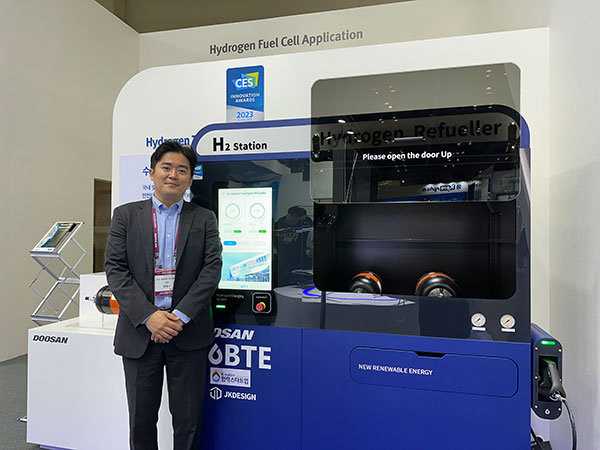
▲DMI Manager Kwak Byeong-cheol introducing hydrogen charging equipment at the 2023 Drone Show Korea At the event, DMI also introduced lightweight and durable hydrogen tanks (7L, 10.8L) and multipurpose integrated charging equipment.
DMI's hydrogen tank is an ultra-light Type 4 hydrogen tank with high storage efficiency, which is a proven method used in hydrogen cars. It is the first in Korea to receive certification, and uses hydrogen with different components from general hydrogen. It has passed safety tests, flame tests, etc.
DMI has hydrogen supply facilities through cooperation with hydrogen companies around the world. When a customer orders hydrogen, a filled hydrogen tank is delivered to the customer site, and the empty hydrogen tank is collected. It is easy to transport and replace, so you can receive a filled hydrogen tank and change it yourself. DMI has SK E&S as its main hydrogen supplier.
“A hydrogen ecosystem is not built just by producing hydrogen fuel cells,” said Director Kwak. “In order to enable self-charging and use of hydrogen, we have distributed over 800 hydrogen cylinders and established an ordering system for businesses that need them.”
DMI also showcased a multipurpose integrated hydrogen charging equipment. The hydrogen charging equipment is a facility that can charge hydrogen on its own in areas where delivery services are insufficient, such as the Middle East, Turkey, and Europe, or in wartime situations, such as for the domestic military, where hydrogen delivery is difficult.
However, hydrogen cars cannot be charged with the charging facility. Although it is about to be distributed like an electric charger, the legal distinction is different. Since the drone charging facility is a mobile container, it is subject to the High-Pressure Mobile Hydrogen Container Act, while in the case of Nexo, it is subject to the Automobile Act and the Non-Moveable Fixed Hydrogen Container Act.
In conclusion, although charging hydrogen cars is theoretically possible, it is illegal in Korea. A company official said that they are currently discussing with the Korea Gas Safety Corporation to resolve legal regulations.
At the 2023 Drone Show Korea, DMI said, “We will gradually expand our hydrogen mobility business area by introducing various solutions such as drones and UGVs utilizing hydrogen fuel cell power packs and discovering business cooperation partners.”