6 R&D projects including living labs with a budget of 100 billion won launched
A new project to integrate and verify various autonomous driving technologies on a city-by-city basis has been launched, raising expectations that autonomous driving will become a reality in the future.
The Ministry of Land, Infrastructure and Transport (Minister Won Hee-ryong) announced on the 20th the results of the selection of research institutes for the new projects (6 projects) for 2023 of the 'Autonomous Driving Technology Development Innovation Project (hereinafter referred to as the 'Inter-ministerial Project')' being jointly carried out by relevant ministries, along with the autonomous driving technology verification plan through the establishment of a Living Lab.
The inter-ministerial project is a multi-ministerial (Ministry of Land, Infrastructure and Transport, Ministry of Trade, Industry and Energy, Ministry of Science and ICT, and National Police Agency) R&D project worth 1.1 trillion won that was launched in 2021. It is being promoted with the goal of commercializing convergence-type Level 4/4+ autonomous driving by 2027, including basic technologies such as vehicles and parts, as well as infrastructure, laws and systems, and services.
The Ministry of Land, Infrastructure and Transport has 22 tasks within the inter-ministerial project (total of 88 tasks), and 16 tasks (13 in 2021 and 3 in 2022) are currently being promoted from 2021, and 6 tasks including the 'Autonomous Driving Living Lab' task will begin from 2023.
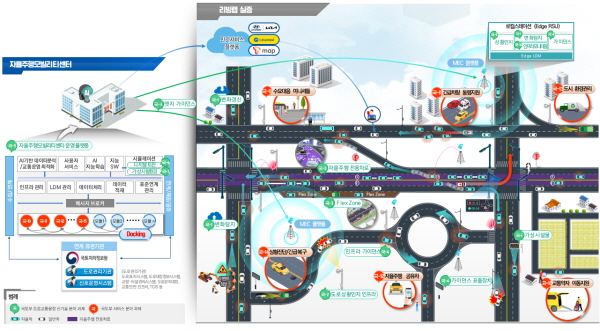
In particular, the Living Lab research project is a technology development project to comprehensively integrate and verify technologies and services developed through inter-ministerial R&D, such as mobility support for the transportation disadvantaged and demand-responsive mini-shuttles, and a total budget of KRW 45 billion will be invested from April 2023 to 2027.br />
In Korea, autonomous driving technology has been researched and developed at autonomous driving test beds such as K-City and C-Track, and autonomous driving services such as cargo and passenger transport have been tested in a limited manner only in some sections of local governments selected as pilot operation zones.
The autonomous driving living lab being established this time will significantly expand the demonstration area to the city level, comprehensively demonstrating autonomous driving core technologies, infrastructure, and public services, etc., thereby providing citizens with diverse experiential opportunities. Through this, a systematic review of the effectiveness and commercialization potential of the results developed in the inter-ministerial project process will also be conducted.
The Ministry of Land, Infrastructure and Transport plans to derive urban conditions suitable for establishing living labs, evaluation criteria for selecting target cities, and verification methodologies over the next six months after the start of the research, and select target cities through a public offering in September 2023 based on these.
In particular, in cities selected as living labs, we plan to promote open living lab demonstrations so that not only research results but also technologies and services from autonomous driving small and medium-sized companies and start-ups that did not participate in the project can be freely introduced.
The city is expected to become a leading autonomous driving city that will play a pivotal role in the commercialization and activation of autonomous driving in the country in the future.
Meanwhile, in addition to the Living Lab project, the Ministry of Land, Infrastructure and Transport is also pursuing projects such as developing a next-generation autonomous driving mobility center operation platform, establishing a metaverse-based virtual test environment, and public services (urban environment management, emergency vehicle traffic support).
The Ministry of Land, Infrastructure and Transport expects that this Living Lab project will serve as an opportunity to expand and activate the autonomous driving mobility market and increase public acceptance of autonomous driving by providing autonomous driving services as one of the daily transportation methods for citizens.
Minister of Land, Infrastructure and Transport Won Hee-ryong said, “The world “The establishment of the first city-level autonomous driving living lab will serve as a stepping stone for the popularization of autonomous driving and for our country’s autonomous driving technology to leap to the level of leading countries,” he said. “The Ministry of Land, Infrastructure and Transport will take the lead so that autonomous driving services, a core business of future mobility, can become part of our people’s daily lives.”