반도체 AI 보안 인더스트리 4.0 SDV 스마트 IoT 컴퓨터 통신 특수 가스 소재 및 장비 유통 e4ds plus

Electric Vehicle Energy Efficiency Grades Divided… Only 6 Out of 278 Models Get Grade 1

기사입력2024.04.01 16:29


Energy efficiency rating system applied to 278 domestic electric vehicle models from the 1st
3 Hyundai Motors, 2 Teslas, 1 Smart Solutions model 1st grade

According to the electric vehicle energy efficiency rating system introduced by the Ministry of Trade, Industry and Energy (MOTIE), only six models from Hyundai Motors, Tesla, and Smart Solutions received Grade 1, while 62 models, including the electric Porter and Porsche Taycan, received the lowest Grade 5.

As the Ministry of Trade, Industry and Energy fully implemented the electric vehicle energy efficiency rating system starting Monday, April 1, all electric vehicles (278 models) registered in Korea and currently on the market will be labeled with an electric vehicle rating divided into five levels.

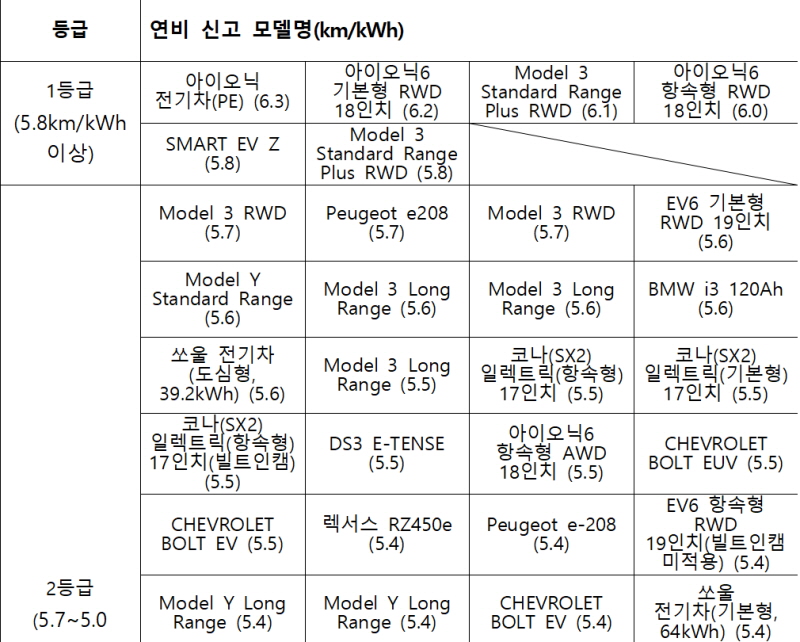
There are 6 electric vehicle models (2.2%) that are rated 1st in electric vehicle energy efficiency, including Hyundai and Tesla, followed by 54 models (19.4%) in 2nd grade, 73 models (26.3%) in 3rd grade, 83 models (29.8%) in 4th grade, and 62 models (22.3%) in 5th grade.

▲Current status of electric vehicle models by grade (Image source: Ministry of Trade, Industry and Energy)

The grade criteria are: △Grade 1: 5.8 km/kWh or more, △Grade 2: 5.7 to 5.0 km/kWh, △Grade 3: 4.9 to 4.2 km/kWh, △Grade 4: 4.1 to 3.4 km/kWh, and △Grade 5: 3.3 km/kWh or less.

With the number of electric vehicle registrations (89,000 units in 2019 → 544,000 units in 2023) and registered models (27 models in 2019 → 278 models in 2024) rapidly increasing, the implementation of the rating system is expected to increase the competitiveness of high-efficiency electric vehicles by allowing consumers to easily compare the efficiency of electric vehicles.

The annual charging cost of the Ioniq 6, which corresponds to the 1st grade energy efficiency electric vehicle, is approximately 780,000 won, which is approximately 840,000 won cheaper than the charging cost of a 5th grade electric vehicle (approximately 1.62 million won), and is expected to be less than half of the annual fuel cost of an internal combustion engine vehicle (approximately 2.03 million won) and a hybrid vehicle (approximately 1.56 million won).

* Assuming an average annual driving distance of 13,323 km, slow charging fee of 364.5 won/kWh, gasoline price of 1,642.98 won/L, and average fuel efficiency of internal combustion engine vehicles (10.8 km/L) and hybrid vehicles (14 km/L)

The Ministry of Trade, Industry and Energy said, “We expect that the implementation of this system will promote the industry’s technological development and increase consumer preference for high-efficiency electric vehicles. We also plan to analyze future trends in the electric vehicle market and the performance of the system implementation to make improvements.”