China to invest 1 trillion yuan to achieve 50% self-sufficiency in semiconductors
Korea must maintain memory gap and focus on system In 1986, the global semiconductor market leadership shifted from the United States to Japan. In 1988, the world's largest semiconductor company in terms of sales was Japan's NEC, and the second was Toshiba. At that time, Intel's sales were only half of NEC's, and Samsung Electronics' were less than a quarter.
In 2018, 30 years later, Samsung Electronics and SK Hynix ranked first and third in global sales, respectively. The only Japanese company that remains in the top 10 is Toshiba, and even that is less than 1/6 of Samsung Electronics. There is no eternal powerhouse.
On October 11, the '2019 Semiconductor Component Material Trends and Issue Technology Seminar' was held at COEX in Seoul, hosted by the Korea Semiconductor Industry Association and My Forum. Here, Professor Lee Geon-jae of the Department of Materials Science and Engineering at KAIST gave a lecture on the topic of 'Future Flexible Semiconductors and Next-Generation Memory Technology.'
In his lecture, the professor first presented the current issues facing the Korean semiconductor industry and its future direction.
Strengths of the Korean Semiconductor Industry The semiconductor sector where Korea is strong is memory. The global DRAM market is dominated by three companies, and the NAND market by five to six companies. If you combine the market shares of Samsung Electronics and SK Hynix, the Korean companies’ respective market shares amount to 72.2% and 49.7%.
However, while the memory semiconductor market accounts for 30.7% of the overall semiconductor market, the non-memory semiconductor market accounts for 69.3%. Moreover, the rapid development and spread of 5G, IoT, AI, and autonomous vehicles are further accelerating the increase in demand for non-memory semiconductors.

▲ With the development of 5G and IoT, semiconductors are now
Not only devices used by humans,
It will be installed in all areas where humans live.
With the development of 5G and IoT, there are increasing cases of pursuing connectivity by installing non-memory semiconductors in objects that were not previously equipped with sensors and SoCs. As demand for AI processing expands from the cloud to the edge, more and more terminal manufacturers are looking for processors optimized for AI. Automobiles are emerging as a new food source for the semiconductor industry.
To follow this trend, the government announced its plan to foster the system semiconductor industry early this year. System semiconductors are a term used in Korea to refer to non-memory semiconductors, and are also called system LSIs.
China's semiconductor boom is taking shape When the moon is full, it wanes, and when it wanes, it becomes full again. Rankings and superiority can be reversed at any time. As has been the case throughout history. In this respect, China is the competitor we must be most wary of.
China is the world's largest electronics producer and consumer. Sixty percent of the semiconductors produced worldwide are consumed in China each year. Semiconductors have been China's largest import item since 2015, and China's semiconductor trade deficit is growing every year. China cannot be pleased with this situation.
China aims to achieve a 50% self-sufficiency rate in semiconductors by 2025, and invested 1 trillion yuan, or about 166.3 trillion won in our currency, in the semiconductor industry in 2017 alone. Based on its ample financial resources, it is also actively pursuing global M&As. It is already producing results in the non-memory semiconductor market.
The demand for semiconductors from Chinese companies is far greater than that of any other country. There are only a few places in Korea that can supply semiconductors. The few places that do use famous foreign non-memory semiconductors. They also produce and use non-memory semiconductors on their own. China is not like that.
First, there are more companies that produce finished products such as home appliances, mobile phones, automobiles, and wearables than in Korea. The authority to organize the supply chain within finished product companies is also lower than in Korea, so when choosing semiconductors to use, they choose practicality over reputation. The number of fabless companies in China doubled from 736 in 2015 to 1,658 in 2018.
Another advantage is that Taiwan, which has strong foundry capabilities, is right next door. Taiwanese foundry companies such as TSMC and UMC have already established design houses in China and are collaborating with fabless companies. The situation is different from that of domestic fabless companies, which are mostly small in scale, except for large companies such as Samsung Electronics and SK Hynix or their affiliates.
What I can't do, I'll do from now on, and what I'm good at, I'll continue to do According to Gartner, the United States ranked first in the global non-memory semiconductor market share in 2018 with 63%. Korea had about 3.4%. It is an overwhelming situation, but if you look at it another way, there is an opportunity for expansion.
On the 12th, Arm, a representative fabless company, held the 'Tech Symposia 2019' event. Here, Arm emphasized its new contract model, 'Arm Flexible Access', which only requires payment of IP costs used at the production stage, not at the development stage.
This contract model was released last July, and Hwang Sun-wook, the CEO of Arm Korea, said, “In Korea, 10 well-known companies are currently using Arm Flexible Access.” Small and medium-sized fabless companies are not yet using this model.
The government should not spare its support so that the slogan of growing the system semiconductor industry and merging it with manufacturing is not in vain. If it implements policies that match demand rather than money, it can expand the market. China's global non-memory semiconductor market share is still 4%.

▲ As machine learning spreads, memory-centric computing is gaining attention. Memory-centric computing is a method to improve computational performance by reducing bottlenecks between CPU and memory, and is to transform the computer structure from the existing CPU-memory-storage to CPU-storage class memory.
The memory semiconductor market is also growing, although not as much as the non-memory semiconductor market. The rapid growth of unstructured data is continuously increasing the demand for storage and memory, and the paradigm is changing to memory-centric computing for machine learning.
Korea is still strong in the memory semiconductor sector. The industry estimates that Korea’s DRAM technology is five years ahead of China’s, and its NAND technology is four years ahead. For DRAM, fine processes are important, and for NAND, stacking processes are important, but in China's case, fine processes are more vulnerable than stacking processes.
Korea still has an advantage over China, and as the growth momentum of the memory semiconductor market continues, it must maintain this huge gap. To do so, it must secure and domesticate technologies in basic areas such as semiconductor materials, equipment, and design, and research and develop next-generation memory to take the lead in the market.
Representative next-generation memories include phase-change memory (PCRAM), resistance memory (ReRAM), and magnetoresistive memory (MRAM). In addition, we must engage in research and development of memory devices that will be used in the future, such as AI, neuromorphic, and flexible semiconductors.
Various attempts to create new semiconductors In the latter half of the lecture, the professor shared his insights by introducing semiconductor technologies that were developed in the past but not commercialized or are currently under development. This article will introduce two cases.
The first shared case is a 3D transistor (Surrounding Gate Transistor; SGT) in which the gate is wrapped around the drain and source in a circular manner. As semiconductor devices become smaller, this concept was developed to prevent current from ignoring the gate and flowing between the source and drain. If the drain and source are wrapped in a circular manner, the current has nowhere to escape.
Recently, in order to increase the operation speed of semiconductors, the focus has been on reducing the length of wires between components within the package. As components become smaller, wires also become smaller, which leads to narrower wire widths and higher resistance. Also, as the spacing between wires decreases, parasitic elements occur between wires, slowing down the speed.
The speed of the CPU is 1/RC. Here, R is the metal resistance and C is the parasitic component between metals. If the chip size can be reduced and the wire length can be reduced to 1/3, R and C will also be 1/3, and the CPU speed will be about 10 times faster. It is 1/3 of the 3D transistor and the planar transistor. However, it is not commercialized due to problems such as materials.
The second shared case is flexible semiconductors. Flexible electronic devices are expected to have steady demand in areas such as biotechnology. However, due to the limited performance and scalability of organic materials, it has been difficult to develop products that integrate displays, processors, memory, and power. This is because the fundamental thermal instability of polymer materials has made it impossible to withstand the high-temperature processes essential for high-performance electronic devices.

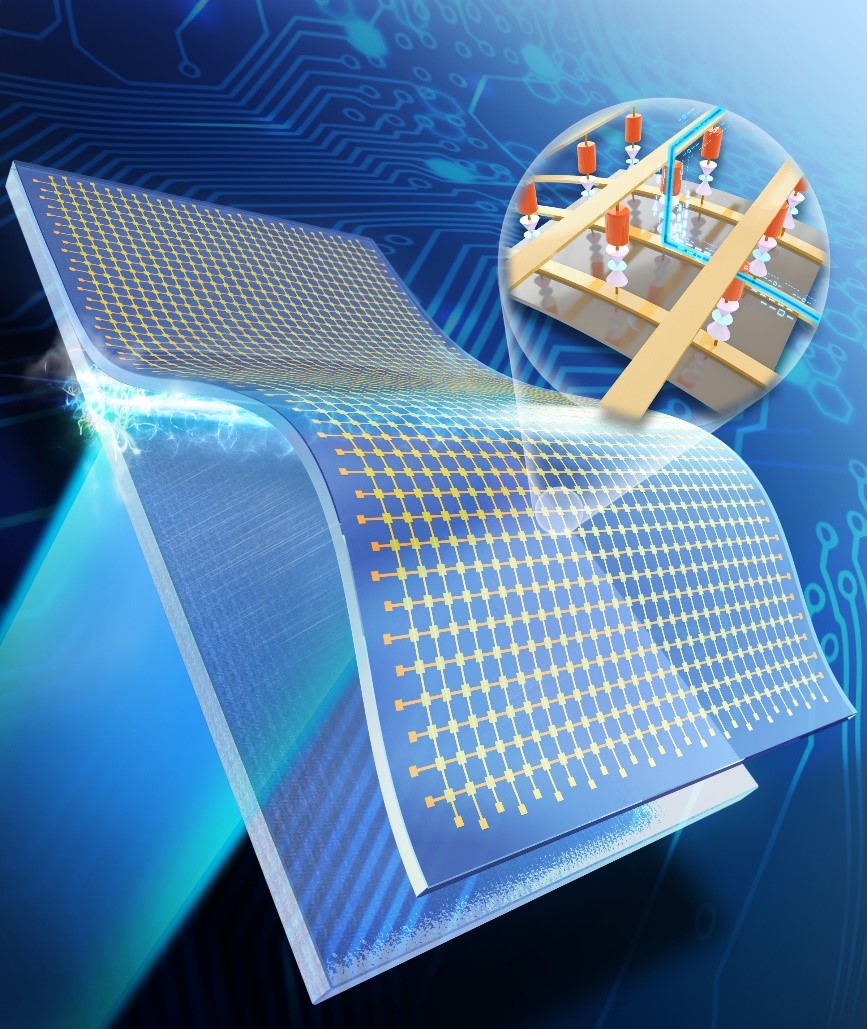
▲ Flexible crossbar memory developed through the ILLO process
(Image = KAIST)
This problem can be solved by using the Inorganic-based Laser Lift-off (ILLO) process, which deposits a laser-responsive exfoliation layer on a rigid substrate and then fabricates ultra-thin inorganic electronic components, such as high-density crossbar memristive memories, on top of the exfoliation layer. And when a laser is shined on the back of the substrate, a reaction occurs between the laser and the exfoliating layer, peeling only the ultra-thin inorganic electronic component layer from the substrate and transferring it to plastic, paper, or even fabric.
The professor explained that the ILLO process enables high-temperature processes that were difficult to achieve on plastic substrates. In addition, the transferred 100-nanometer-thick element can perform RAM operations on a flexible substrate even under severe bending. The healthcare market is growing and attempts to apply IoT to bio are increasing. Flexible semiconductors can be the answer to those attempts.
When flexibility and adaptability are required depending on the situation Apple and Samsung Electronics are often called rivals, but the two companies often work together. In particular, Apple has indirectly contributed to making Samsung Electronics the world's top semiconductor company by sales today.
Since 1962, when it came to computers, IBM's mainframes were the answer. These mainframe computers, still used in the financial sector, are large, expensive, and durable. Since they can be used for decades after purchase, Japanese semiconductors made with craftsmanship were used extensively. However, in 1977, Steve Jobs released the Apple II, and a new computer market began to form. In 1981, IBM released the personal computer, or PC. Since PCs were for personal use, they did not need to be as durable as mainframes. The replacement cycle was also fast.
Samsung Electronics entered the semiconductor market in earnest in July 1983. It became what it is today by producing semiconductors that were suitable for use in PCs at low prices, although their performance and durability were inferior to those of Japanese semiconductors and could not be used in mainframes. Japan, on the other hand, could not do that. Japan made things that were good to make, and Korea made things that sold well.
The current Chinese semiconductor industry is following the path of Korea in the past. They are making things that sell well and even making places that buy them well. In order to stand up to China, as mentioned above, we need to develop a memory super gap and next-generation semiconductors. And the emergence of new players other than Samsung Electronics and SK Hynix is also urgent.
100번 동감 합니다