SMPS power supply, easy to implement with various ICs commercialized
Advances in noise removal technology lead to advances in electronic technology
Need to be interested in pattern design techniques according to signal flow Last December, e4ds News conducted the '2019 Engineer of the Year Evaluation' targeting electronic engineers in eight categories including development leadership, global capabilities, and technology diffusion. As a result, five people were selected in five categories and awarded the '2019 Engineer of the Year Award'.

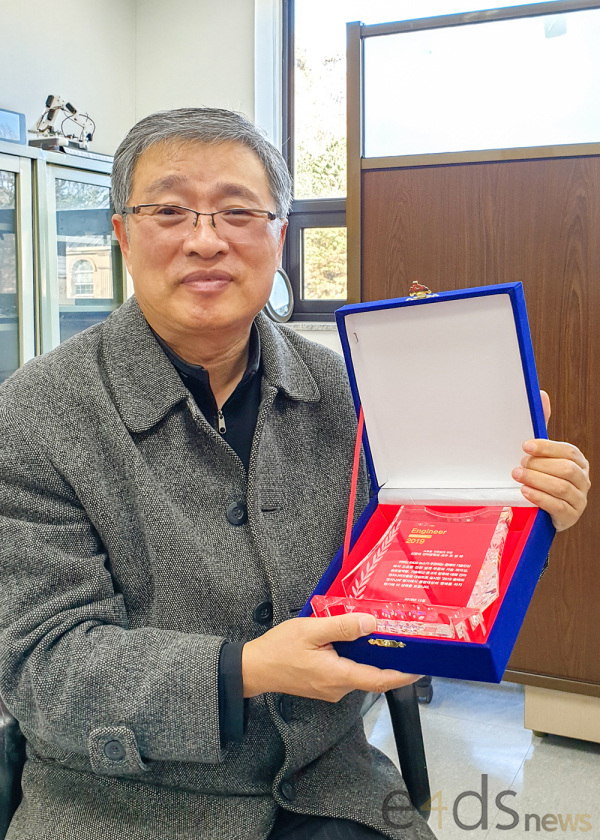
▲ Jo Seong-jae, Professor of Electronic Engineering at Shinhan University
(Photo = Reporter Myung Se-hwan)
Professor Sungjae Cho, winner of the High-Efficiency Power Design category, has been a professor in the Department of Electronic Engineering at Shinhan University since 1993, and previously worked at Samsung Electronics Research Institute from 1983 to 1993.
e4ds News asked him about his thoughts on the award and the present and future of high-efficiency power design.
Q. I would like to hear how you feel about receiving the award. A. It has been almost 10 years since I started giving special lectures to people working in the industry based on my experience in projects, technical consulting, and technical guidance while working as a professor.
At this point, I am delighted and honored to receive the '2019 Technician of the Year Award' from e4ds News, which recognizes my hard work in giving special lectures.
I would also like to thank the industrial workers who gave positive evaluations of my special lectures, including ‘Low-power/low-noise circuit and pattern design techniques’ at the ‘2019 Noise Reduction and Power-efficient Power Design Seminar’ held by e4ds.
Q. Are there any notable issues in the field of power design in 2019? A. In all electronic devices and electrical fields, power is essential to supply the voltage that operates the circuit. There are various methods such as charge pump method and voltage multiplication method, but they can be broadly divided into two types: linear regulator method and SMPS (Switching Mode Power Supply) method.
The linear regulator method has been widely used in the past, where AC power is lowered to voltage using a transformer, rectified through a rectifier, and then a linear regulator is used.
It has the advantages of small input fluctuations (line regulation) and static load fluctuations (load regulation) and low noise, but has the disadvantages of large size and low power conversion efficiency. Therefore, although they are large in size and have low power conversion efficiency, they are used in medical devices and precision measuring instruments that require low noise and high precision.
SMPS, on the other hand, has the advantages of being small in size, high power conversion efficiency, and being able to implement both low and high voltages regardless of the input voltage range, so SMPS power supplies are widely used in modern electrical and electronic equipment.
However, SMPS has a large switching noise due to switching, and has various circuit types such as step-up, step-down, flyback, and negative converter, so the circuit implementation is complex and difficult to understand.
However, as various ICs are commercialized domestically and internationally, implementation is becoming easier. Therefore, the use of SMPS is expected to increase further.
Q. What is the future direction of SMPS power research? A. Domestic and foreign semiconductor manufacturers will likely strive to use higher switching frequencies to reduce the size of SMPS, and will likely continue research to increase power conversion efficiency accordingly.
However, as the switching frequency increases, the problem of increased high-frequency noise occurs. Various methods will be explored to reduce this high-frequency noise, and recently, ICs that apply these measures are being commercialized.
In addition, in order to increase the switching frequency, the speed of switching elements such as internal or external transistors or FETs must be increased, and research will continue to reduce the resulting heat consumption.
Recently, many ICs that can output large currents using SMPS with high power conversion efficiency have been released, and such attempts will continue.
Q. What additional considerations should I take to reduce power noise? A. Even if power is supplied using linear regulator and SMPS methods, which each have their own advantages and disadvantages, noise is another problem when designing circuits and PCB boards. Therefore, research on pattern design techniques should continue.
Power noise is caused by a complex mix of factors, so special care must be taken in designing the power pattern. Power noise is largely divided into noise from the power source itself and noise caused by external factors.
Power supply noise itself includes switching noise of SMPS, linear ripple noise, and noise caused by output voltage fluctuations due to input voltage fluctuations and current consumption. Noise caused by external factors includes noise caused by signal flow, circuit layout, current path, power and GND separation, and layout.
Power noise itself is noise that depends on the type and design of the power supply, but power noise due to external factors is influenced by the pattern design, so it is very important to understand the signal flow and design the pattern. However, I feel it is unfortunate that many engineers in Korea outsource the design of circuit boards and do not pay attention to pattern design techniques according to signal flow.
Q. Do you think there will ever be a day when noise is completely conquered? A. As the switching frequency of SMPS and the clock frequency of CPU increase, the influence of noise is bound to increase. Therefore, countermeasures against this will continue to be necessary.
In addition, electronic devices are becoming smaller and smaller. As they become smaller, the pattern spacing becomes narrower, which increases interference between circuits. In addition, the influence of noise will increase further due to the increasing switching frequency of SMPS and CPU clock.
Ultimately, it is impossible to completely conquer noise, and as noise increases, noise removal technologies to deal with it will also improve, and I think that electronic technology will continue to advance.