인피니언 StrongIRFET™
반도체 AI 보안 인더스트리 4.0 SDV 스마트 IoT 컴퓨터 통신 특수 가스 소재 및 장비 유통 e4ds plus

Chemical Research Institute Discovery of First Photo-Avalanche Nanoparticles That Will Increase Solar Cell Efficiency

기사입력2021.01.16 14:06

The joint research team of Chemical Research Institute-US/Paul, the phenomenon of avalanche
Discovery of Thulium-Based Photoavalanche-Causing Nanoparticles
Wide range of applications in light utilization industries and technologies


A 'photon avalanche' phenomenon, in which a small amount of light energy is shone on a nanomaterial, causing a chain amplification reaction of light within the material, releasing a large amount of larger light energy, has been discovered for the first time in the world by a domestic research team.

On the 15th, the research team led by Dr. Seo Young-deok and Dr. Nam Sang-hwan of the Korea Research Institute of Chemical Technology (KRICT), together with research teams from the U.S. and Poland, discovered that if the element called 'thulium (Tm)' is synthesized into nanoparticles with a specific atomic lattice structure, even if light of small energy is irradiated at a weak intensity, the light causes a chain amplification reaction inside the material, emitting light of greater energy at a strong intensity.
▲ Research results on the discovery of avalanche phenomena and induced nano particles
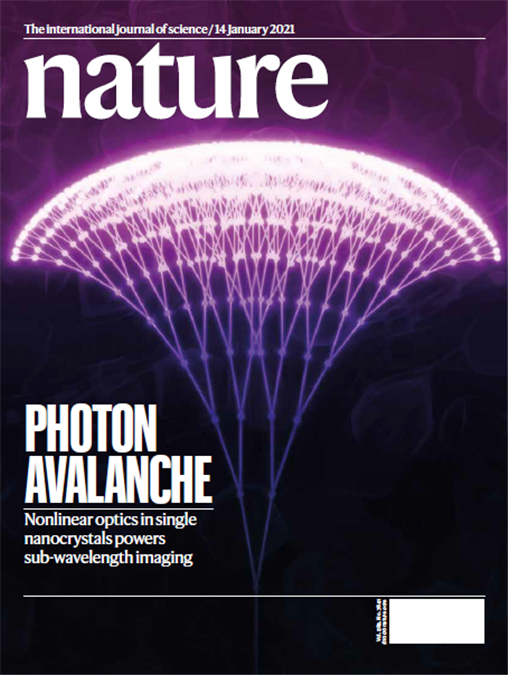
Selected papers for the cover of Nature magazine on January 14 [Image = Nature]

The research team named the nanoparticle that causes the optical chain amplification reaction 'Avalanching Nano Particle (ANP)' because it resembles an avalanche. The content is titled 'Giant Nonlinear Optical Responses from Photon-Avalanching Nanoparticles' and was selected as the cover paper of the Nature journal on January 14 (UK time).

It is expected that ANP will be widely used in the bio-medical field such as virus diagnosis, the IoT field such as self-driving cars, and the renewable energy field such as solar cells.

◇ ANP, overcoming the limitations of UCNP with low photoconversion efficiency

Nanomaterials generally absorb light energy, dissipate some of it as heat energy, and emit the rest as light of lower energy than the light they initially absorbed. Unlike most materials, which undergo downward conversion, some elements of nanomaterials undergo upward conversion, absorbing light of lower energy and emitting light of higher energy.

UpConversion Nano Particles (UCNPs) can be used as a light source using low-energy infrared rays, so the light does not reach foreign substances other than the sample to be measured, resulting in less noise. In addition, since they use low energy, they do not damage the sample. With these advantages, upconversion materials have great potential for use in next-generation biomedical technology, IoT technology, and renewable energy technology.

However, UCNPs have not been commercialized to date because their photoconversion efficiency is very low, less than 1%. ANP, a special UCNP that can overcome this obstacle, has been discovered for the first time. The ANP discovered by the research team can increase the photoconversion efficiency by up to 40%, which is higher than the existing UCNP.

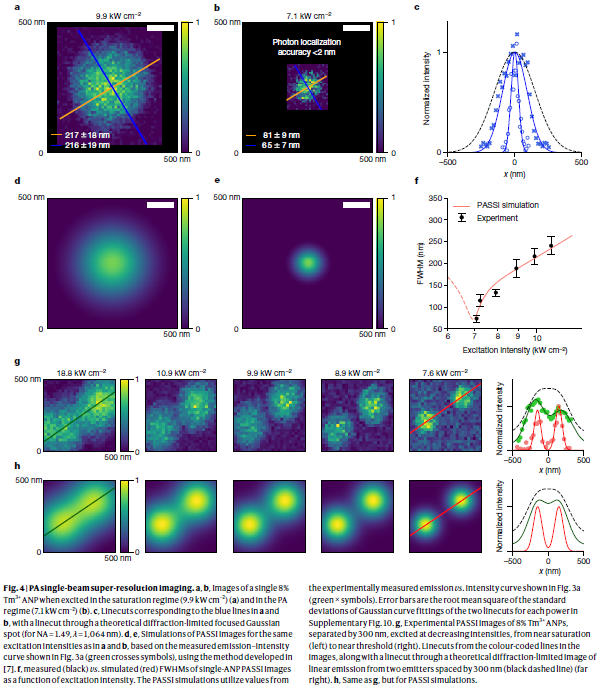
The avalanche phenomenon is an optical phenomenon in which, when light is absorbed multiple times by nanoparticles, a chain amplification reaction of light occurs in the atomic lattice structure that constitutes the nanoparticles, and light with greater energy is emitted again at a strong intensity. Even if only a weak light of the laser pointer intensity is shined on ANP, it can emit very strong light. Through this, the research team succeeded in high-resolution observation of materials with a size of 25 nm (nanometers).
▲ ANP-based single-beam super-resolution imaging [Image = Chemical Research Institute]

The resolution of materials that can be seen with light is limited. It is very difficult to see materials with a size of 400 nm to 700 nm or less, which is the wavelength of visible light, with high resolution. The research team used ANP to simply implement super-resolution nanoscopy imaging that allows even sizes of 400 nm or less to be seen with light, and announced this in this paper.

◇ Prospects for use in virus diagnosis, micro lasers, and next-generation batteries

The research team plans to conduct applied research to increase the efficiency of cells in the future together with the chemical perovskite solar cell research team. ANP can absorb light with a longer wavelength than the range of light that existing batteries can absorb and utilize, thereby increasing battery efficiency.

In addition, the research team plans to develop biomedical technologies for in vitro diagnosis, such as a virus diagnostic kit in the form of a pregnancy diagnostic kit using ANP, optical sensor application technologies such as laser surgical equipment and endoscopes, and micro laser technologies for insertion into the body for use in cancer treatment and skin care. To this end, the research team is conducting follow-up research to induce a photoavalanche phenomenon with LED light of a weaker intensity than a laser pointer.

Dr. Seo Young-deok of the Chemical Research Institute said, “The results of this research can be widely used in all industries and technologies that utilize light, so there is a high possibility that they will be utilized as a new technology in the future,” and added, “We will increase the possibility of commercialization through follow-up research.”
이수민 기자
기사 전체보기