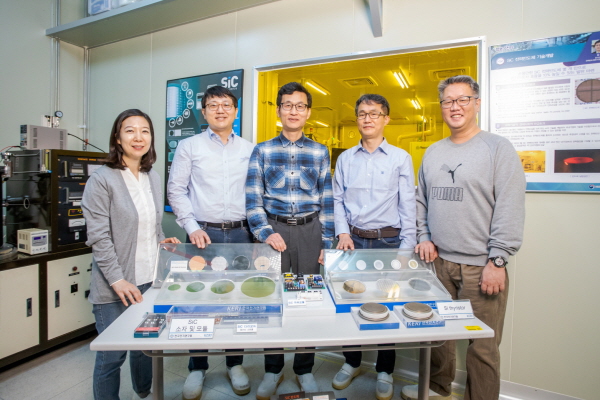
▲Korea Electrotechnology Research Institute Power Semiconductor Research Center (from left) Na Moon-kyung, Moon Jeong-hyeon, Bang Wook, Kang In-ho, and Dr. Kim Hyeong-woo
Technology to reduce chip size helps resolve supply shortage
Original technology Yespower Technics 2 billion technology transfer
A technology has been developed domestically that can significantly increase the performance and price competitiveness of SiC (Silicon Carbide) power semiconductors while also increasing chip supply.
The Korea Electrotechnology Research Institute (KERI, Acting President Dong-wook Yoo), a government-funded research institute under the National Research Council of Science and Technology of the Ministry of Science and ICT, announced on the 21st that it has developed a ‘trench structure MOSFET,’ a cutting-edge technology for SiC power semiconductor devices, and signed a technology transfer contract worth 2 billion won with a specialized manufacturer.
Power semiconductors (also called power semiconductors) are semiconductors that control electricity and are essential to all electrical and electronic products, including home appliances and lighting.
A representative example is the power semiconductor, which is a core component of the inverter that changes the direct current of an electric vehicle battery into alternating current and supplies it to the motor.
The power semiconductor industry has been growing rapidly in recent years due to the emergence of new demand sources for power semiconductors, such as electric vehicles, renewable energy generation, and energy storage devices.
If an electric vehicle inverter is made with SiC power semiconductors, it will be much more efficient than the silicon (It is optimal for e-mobility as it increases energy efficiency by up to 10% compared to when using a Si) semiconductor inverter and reduces the volume and weight of the inverter.
For this reason, SiC power semiconductors have been in short supply for the past year or so due to the rapidly increasing demand for electric vehicles. In addition, SiC semiconductor materials are included in the list of items banned from importing from China by U.S. companies, making them a target of the U.S.-China technology war.
The performance of SiC power semiconductors is far superior to that of silicon semiconductors. This is due to differences in material properties; SiC power semiconductors can withstand voltages 10 times higher than silicon semiconductors, operate at high temperatures of hundreds of degrees Celsius, and consume less power, which can improve energy efficiency.
The success of domestic technology in developing SiC trench MOSFETs means that Korea, a latecomer, has joined the first league of SiC technology.
The SiC trench structure has many challenges to overcome, such as ensuring stable operation and long-term durability, and the technological barrier is so high that only Germany and Japan have succeeded in mass production worldwide.
KERI Power Semiconductor Research Center Director Bang Wook said, “Trench MOSFET technology is the culmination of SiC material and component technologies that our research center has steadily accumulated over the past 20 years,” and “The fact that trench MOSFETs, which will become a key player in the SiC market within a few years, have been domestically produced is the most significant.”
SiC trench MOSFET technology creates narrow and deep trenches in a SiC wafer and arranges channels, which are current passages, in a vertical direction along the walls of these trenches, differentiating it from the horizontally arranged channel structures used up to now. By arranging horizontal channels vertically, the area occupied by the channels can be saved, so the area of the power device can be reduced by up to several tens of percent.
When SiC power semiconductors are applied to electric vehicles, the effect is so great that power efficiency can be expected to improve by up to 10%. However, compared to the explosively increasing demand for electric vehicles, SiC power semiconductors are monopolized by only a few advanced countries, and there is a global supply shortage. The developed trench technology is drawing attention as it can increase the production of SiC power semiconductors and alleviate the supply shortage.
Dr. Jeong-Hyeon Moon of KERI, who developed the core technology, said, “If this technology, which is the most difficult in SiC power devices, is applied, more chips can be produced per wafer, which increases the supply and lowers the price of the devices.”
Therefore, if this technology is commercialized, it is expected to ultimately lead to lowering the price of electric vehicles.
KERI recently transferred a comprehensive technology package, including the original technology for manufacturing the ‘trench structure SiC power semiconductor MOSFET’ it developed, as well as various measurement and analysis technologies for product commercialization, to Yes Power Technics Co., Ltd. (CEO Do-ha Kim), a SiC power semiconductor specialist.
The technology transfer amount is a large contract worth a total of 2 billion won, including the task assignment contract. The research team plans to actively support the domestic production and mass production of SiC power semiconductors, which have previously been heavily dependent on imports, by supporting the entire process from equipment purchase to mass production line construction.
“I understand that advanced manufacturers have also recently released products using the trench MOSFET technology,” said Eunsik Jeong, CTO of Yespower Technics, the recipient of the technology. “We will release products using the trench MOSFET technology this year and introduce them to electric vehicle and home appliance customers.”
Regarding the recent shortage of automotive semiconductors and the US-China semiconductor conflict, KERI Center Director Bang Wook said, “SiC wafers have been on the list of items banned from export to China by US companies since the Trump administration, which is evidence of their high industrial importance.” He also predicted, “With the advent of the electric vehicle era and a global shortage of SiC power semiconductors, the advancement of SiC technology and securing of mass production capabilities will lead to enhanced national competitiveness.”
Meanwhile, according to European market research firm IHS Markit, the SiC power semiconductor market is expected to show a high average annual growth rate of 32% from approximately $700 million (approximately KRW 780 billion) last year to approximately $10 billion (approximately KRW 11.14 trillion) in 2030.