Expanding RF foundry for 5G communications
Samsung Electronics is developing the next-generation '8nm RF (Radio Frequency) process technology' and strengthening its semiconductor foundry services for 5G mobile communications.
Samsung Electronics announced on the 9th that it plans to actively target the 5G communication semiconductor market from sub-6 GHz to millimeter wave (mmWave) by providing a single-chip solution for 5G communication RF chips that support multi-channel and multi-antenna with an 8nm RF foundry.
Samsung Electronics began its 28nm 12-inch RF process foundry service in 2015, and has since expanded its RF foundry solutions to 8nm, including 14nm, which began full-scale mass production for the first time in the industry in 2017.
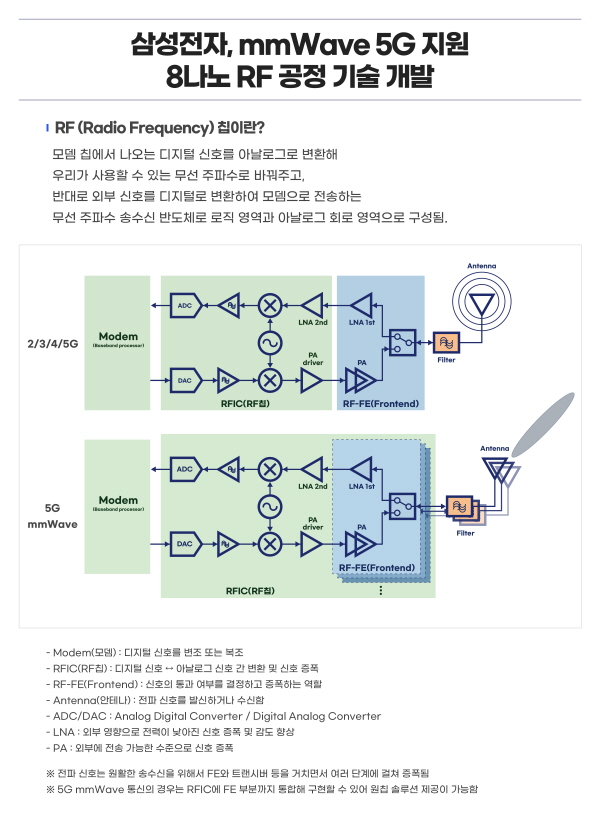
An RF chip is a radio frequency transceiver semiconductor that converts digital signals from a modem chip into analog, changes them into radio frequencies that we can use, and transmits them back to the modem chip. It consists of a logic circuit area that changes the frequency band and converts digital-to-analog signals, and an analog circuit area that plays a role in frequency reception and amplification.
Samsung Electronics has maintained its market leadership by shipping more than 500 million mobile RF chips, mainly for premium smartphones, since 2017.
Samsung Electronics' 8nm RF process can reduce the RF chip area by about 35% compared to the previous 14nm process, and also improve power efficiency by about 35%.
As semiconductor processes become more refined, performance in the logic domain improves, but in the analog domain, resistance increases due to narrow line widths, amplification performance of the receiving frequency deteriorates, and power consumption increases.
Samsung Electronics has developed a technology that can greatly amplify signals while using less power. We developed a semiconductor device dedicated to RF, 'RFeFET™ (RF extremeFET),' and applied it to the 8-nanometer RF process.
In particular, Samsung Electronics applied specific materials to the periphery of the channel, which is the passage through which electrons flow in RFeFET™, and maximized the electron movement characteristics through physical stimulation.
The performance of RFeFET™ has been greatly improved, which allows the overall number of transistors in the RF chip to be reduced, reducing power consumption and reducing the area of analog circuits.
“Samsung Electronics’ 8nm-based RF foundry, which simultaneously implements process miniaturization and RF performance improvement, will provide customers with the optimal solution with the advantages of small size, low power, and high-quality communication,” said Lee Hyung-jin, Master of Technology Development at Samsung Electronics’ Foundry Business Division. “Based on its cutting-edge RF foundry competitiveness, Samsung Electronics will actively respond to the next-generation wireless communication market, including 5G.”
Samsung Electronics plans to accelerate the achievement of its ‘Semiconductor Vision 2030’ through ultra-fine process technology, stable mass production system, and expansion of the foundry ecosystem.