The thinner the line width, the higher the semiconductor performance "5nm is already commercialized"
IBS Research Group Implements Conductive Channel with Line Width of 0.43nm
Proof that basic device structure can be formed at 2nm or less As semiconductors make their circuit lines thinner, they can integrate more elements per unit area, which improves their performance. Recently, the industry has entered the commercialization of semiconductors with line widths of around 5 nm (nanometers), and TSMC, Samsung Electronics, Intel, etc. are working on further miniaturization.
On the 30th, a research team led by Professor Jong-Hoon Lee (UNIST) and Professor Feng Ding (UNIST) of the Center for Multidimensional Carbon Materials at the Institute for Basic Science (IBS) implemented a conductive channel with a line width of 4.3Å (0.43nm) using two-dimensional black phosphorus. This experimentally suggested the possibility of an ultra-fine semiconductor device with a line width of angstroms (Å, 0.1nm), overcoming the nanometer limit.

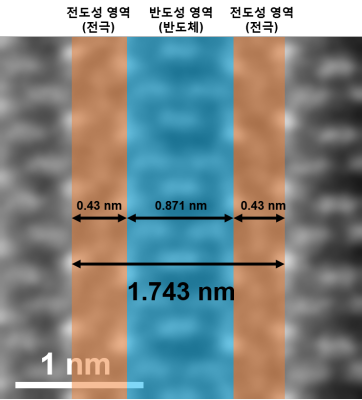
▲ Semiconductor elements at the 1 nanometer level [Photo = IBS]
This study was conducted jointly with Ulsan National Institute of Science and Technology (UNIST) and Pohang University of Science and Technology (POSECH).
2D black phosphorus is considered a key semiconductor element of the post-graphene era. It is about one atomic layer thick and can be used for flexible and transparent elements that are difficult to implement with silicon-based semiconductors. It also has the highest electron mobility among 2D semiconductor elements. Unlike graphene, it has a band gap, making it easy to control whether it conducts electricity or not.
There have been many attempts to utilize two-dimensional materials such as black phosphorus as semiconductor devices. However, research on defects that occur during the actual device manufacturing process has been insufficient.
The research team inserted copper atoms between each layer of two-dimensional black phosphorus to create a conductive channel that could be used as an electrode. At this time, a simple process of depositing a thin copper film on the black phosphorus and then heat-treating it was performed. Then, due to the anisotropic atomic structure of the black phosphorus, the copper atoms were inserted into the two-dimensional black phosphorus while maintaining a fine width of 0.43 nm.
The 0.43 nm thick conductive channel can be used as an electrode for semiconductor devices. The research team also demonstrated using an atomic-resolution transmission electron microscope (TEM) that the basic semiconductor device structure consisting of conductor-semiconductor-conductor can be formed at a level of less than 2 nm.
Researcher Lee Seok-woo, the first author, said about this achievement, “We have shown the possibility of realizing ultra-fine semiconductor devices using black phosphorus,” and explained, “Because we used a solid-state diffusion method that can be used in current semiconductor processes, the actual application effect will be great.”
Group leader Lee Jong-hoon said, “Black phosphorus is a material that will surpass graphene in the field of two-dimensional semiconductor devices,” and “We have confirmed its potential for use as an ultra-fine device.” The research results were published as the cover paper in Nano Letters (IF 11.189) on July 29.