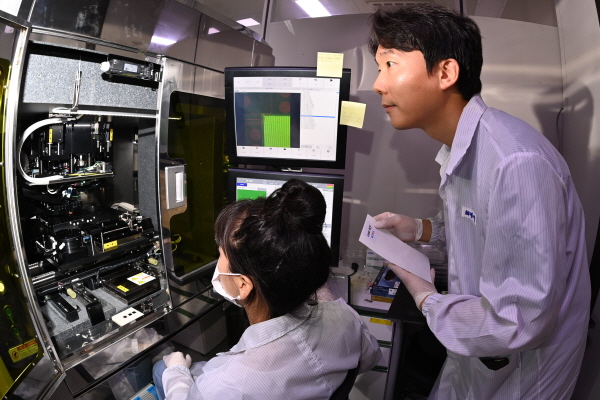
▲ETRI researchers discussing the chiplet integration process (from left: Researcher Chan-mi Lee and Senior Researcher Gwang-moon Choi)
Reduced the existing 9-step process to 3 steps, first development of new film material
Fairness and reliability evaluation expected to be commercialized within the next 3 years
Domestic researchers have succeeded in developing a new material technology that is a key source in the packaging field, which holds the key to cutting-edge semiconductor development, giving the green light to continue writing the myth of a semiconductor powerhouse.
In the future, this technology is expected to be used as a core material technology for manufacturing AI semiconductors that require high performance, such as autonomous driving and data centers.
The Electronics and Telecommunications Research Institute (ETRI) has developed a new material essential to the semiconductor process for the first time in the world using its own nano-material technology.
In particular, this technology is a groundbreaking semiconductor chiplet packaging technology that can reduce power by 95% compared to existing Japanese technology.
The number of process steps was also significantly reduced from the previous nine to three.
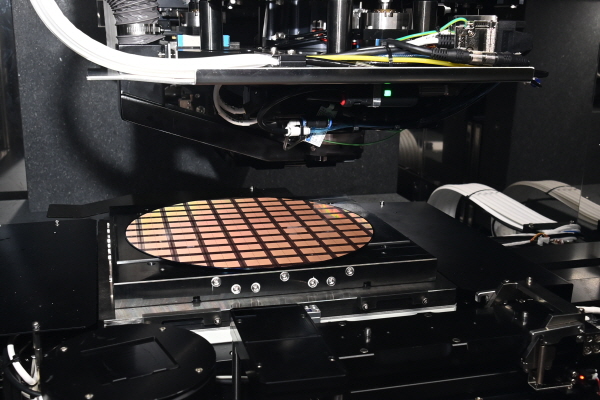
The 95% power-saving advanced semiconductor chiplet packaging technology developed by the research team is comprised of three steps: attaching a non-conductive film (NCF), a new material developed by the researchers, to a semiconductor wafer, and then irradiating the tile-shaped chiplets with a surface laser to harden them.
Until now, the semiconductor industry has mainly used Japanese materials in advanced semiconductor packaging processes.
On the other hand, the process is complex and diverse, with a total of 9 steps.The major disadvantages of using rainwater include high power consumption, clean room maintenance costs, and emission of hazardous substances.
In addition, global semiconductor companies such as Taiwan Semiconductor Manufacturing Company (TSMC), Intel, and Samsung Electronics are accelerating the development of new integration technologies for high-density chips made with advanced semiconductor technology of several nanometers (㎚).
Existing technologies also had disadvantages in that they were difficult to apply, such as the inability to clean the joints, which are interconnecting passages between chips measuring tens of micrometers (㎛) in size required by chiplet integration technology, and the need for jointing at room temperature.
The technology developed by the research team was independently developed after 20 years of core original technology research using the company's own nanomaterial design technology and new nanomaterials.
The developed process applies the developed nano new material to an advanced semiconductor wafer substrate, then creates tiles with chiplets manufactured from various wafers, completes the bonding process by shooting a surface laser for about 1 second, and is completed with a post-curing process.
The core new material that the research team succeeded in developing was made of a polymer film.
It is a nanomaterial with a thickness of 10-20㎛ and an epoxy series material with a reducing agent added to it.
When a laser is fired at this material, all stages of the semiconductor post-processing (packaging) process, including washing, drying, coating, and curing, are resolved.
Therefore, the new nano material that ETRI successfully developed has the special properties of a material that serves as a bonding material necessary for semiconductor post-processing and has the material characteristics for each stage.
In addition, previously, chips were separated from the wafer and attached to the board, and then cut out one by one to use.
This method, which allows the research team to directly attach chiplets to a wafer substrate like tiles, has also become possible thanks to the new nano materials.
In this way, the technology is simple in process and the entire production line is longer than the existing 20 meters (M). It can be reduced by 4 meters, or 20%.
It also has the advantage of not requiring nitrogen gas and thus not producing any harmful substances.
It also features a high-precision process that can be applied to advanced chiplet packages.
In particular, it is characterized by being the world's first integrated process at room temperature (25℃) to develop high-precision processes.
All existing processes had problems such as increased power consumption, increased errors due to thermal expansion, and decreased reliability because the stage temperature was heated to 100℃.
The ETRI research team explained that they have developed a new material and new method that enables a bonding process even at room temperature without generating fume (smoke) due to temperature rise for the first time in the world by using nanomaterial design technology that is activated above the characteristic temperature change.
In particular, this technology is being evaluated for fairness and reliability by not only US micro LED startups but also global foundry companies in the advanced semiconductor field, and if it receives an excellent evaluation, it is expected to be commercialized within three years.
ETRI researchers concluded that this technology could provide an answer to the low-power, eco-friendly methods that semiconductor display companies will need in the future.
We plan to expand the scalability and applicability of the technology by applying it to advanced chiplet integration and micro LED transfer and bonding processes.
ETRI's Il-min Lee, head of the Creative Core Research Division, said, "Recently, ESG management has been a hot topic in the semiconductor display industry, and who will be the first to develop a low-power new technology that is friendly to the industry is a matter of life and death. This technology is one that will have a huge ripple effect."
ETRI Director Kwang-Seong Choi also said, “Until now, the advanced semiconductor packaging and micro LED display fields have been highly dependent on Japanese materials and equipment technology. “The technology gap was so large that it was difficult to become self-reliant, but the research team’s achievements are expected to meet the new market demands for low power and eco-friendliness, and commercialization of the original technology is expected,” he said.
According to Yole Development, a global market research firm, the chiplet packaging market size is expected to reach $23.9 billion in 2027.
This research is being conducted with the support of the Ministry of Science and ICT's 'Material Innovation Leading Project', and KIST, Korea Institute of Ceramic Engineering and Technology, and Korea Institute of Industrial Technology are participating as joint research institutes in the Material Innovation Leading Project.
The research team was selected as a cutting-edge technology paper at the '2023 SID Display Week', the world's largest display conference, and was recognized for its excellence when they presented this result at the '2023 IEEE ECTC' academic conference, the world's largest advanced semiconductor packaging conference.
In 2021, the research team developed SITRAB, a new material technology that combined the world's first LED transfer and bonding processes, and is actively negotiating technology transfer with related companies.
ETRI has obtained 23 SCI papers and domestic and foreign patent applications and registrations through research on process technology and materials that apply new materials to simultaneous transcription-bonding technology and lasers.

▲Performance of chiplet chip-making process using a surface laser