반도체 AI 인더스트리 4.0 SDV 스마트 IoT 컴퓨터 통신 특수 가스 소재 및 장비 e4ds plus

Designing High-Efficiency, High-Performance Home Appliances with BLDC Motors

기사입력2018.08.12 07:00

Increasing demand for efficiency and reduced electromagnetic interference in home appliances
It is important to select a driver control technique that suits the characteristics of the product being developed.


The awareness of environmental protection and energy conservation is higher than ever. Recently, large home appliances such as refrigerators, washing machines, and air conditioners have been faced with the market's demand for increased efficiency and reduced electromagnetic interference. In order to quickly accept changes in the target market and significantly shorten product development time, system flexibility must be high. At the same time, developers are given the task of reducing system costs.

In terms of cost and efficiency, brushless DC (BLDC) motors are increasingly used in home appliances. These motors are commonly used in refrigerators, washing machines, air conditioners, etc. Unlike brushed DC motors and AC motors, BLDC motors can be driven in a variety of ways. Let’s take a closer look at the pros and cons of each method.

BLDC driver control technique
The electronic commutator of the BLDC motor sequentially supplies energy to the stator coils by becoming U phase, V phase, and W phase, which generates a rotating electric field, which attracts the nearby rotor. For efficient operation, the coils must be supplied with energy accurately according to the relative positions of the stator and rotor. BLDC motors use sensors or sensorless feedback for rotor position feedback.

In the sensor design, three Hall effect sensor ICs are mounted close to the motor stator. The transition timing of the Hall sensor IC corresponds to the zero crossing of the back electromotive force (BEMF). The sensorless method uses the motor BEMF zero voltage crossing timing.

Many applications are moving to sensorless drivers. This is because the circuitry associated with the Hall effect sensor IC can be eliminated from the motor design. BEMF is a function of speed where BEMF is zero at startup. Sensorless designs require complex open-loop startup algorithms to accelerate the motor to a speed where BEMF can be detected. Hall commutation drivers can always detect the rotor position, so startup is reliable. Instead, they add cost to the motor assembly.

There are three control methods available for electronic commutation:

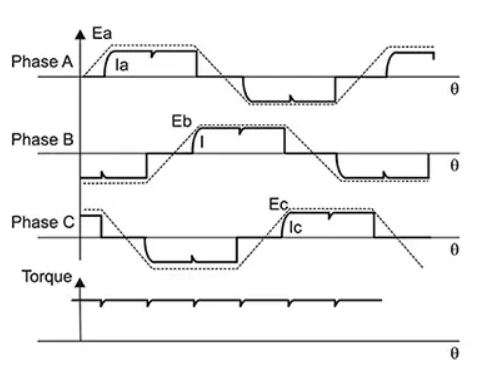
• Trapezoidal: The trapezoidal technique supplies energy in two phases. One phase supplies current to the motor, and the other provides a current return path. The remaining phase is not driven. To supply energy to the two active coils, two switches of the three-phase driver are controlled positively or negatively. As the motor rotates, the current supplied to the motor terminals is commutated every 60 degrees of rotation.

Figure 1: Trapezoidal control and torque ripple

The advantage of the trapezoidal technique is that it is easy to implement. The disadvantage is that this step-wise commutation causes torque ripples. Torque ripples cause speed changes, which can cause vibrations or audible noise.

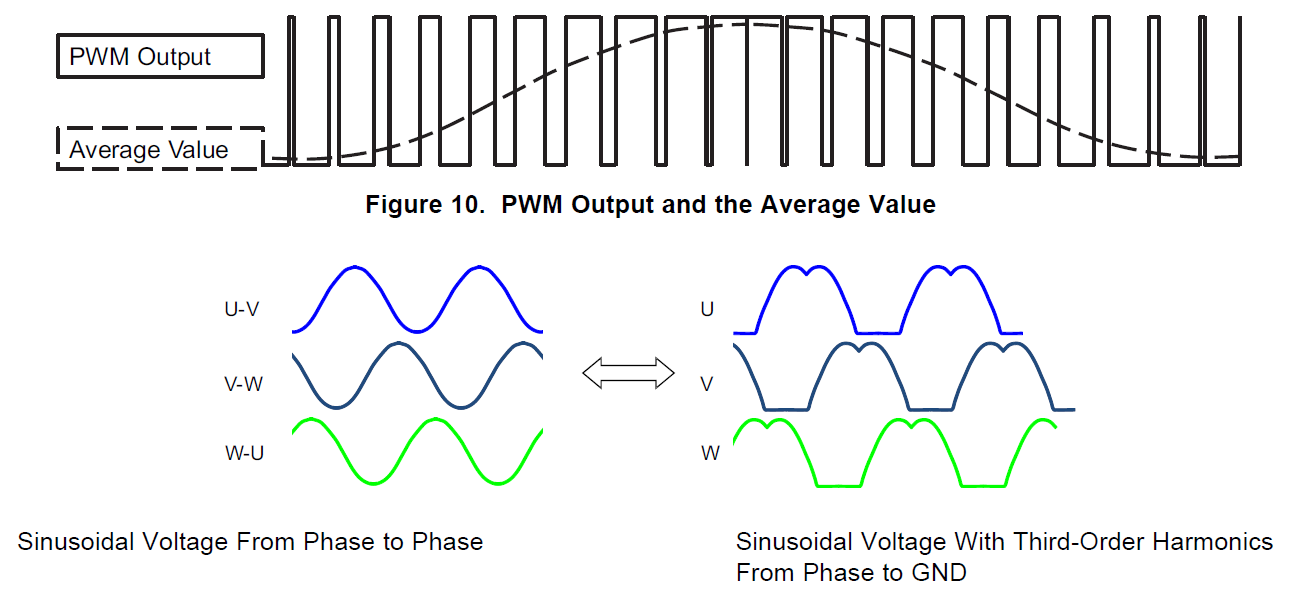
• Sinusoidal: Pure sine wave drive voltages are rarely used in practical designs, as they do not provide sufficient voltage to each motor terminal relative to ground. A better way is to use a “saddle” profile with a 120 degree phase shift for commutation, varying the PWM duty cycle with respect to ground and varying the drive voltage to generate a sinusoidal differential voltage between the phases.

Figure 2: Sine wave control using the “birds” profile

As a result, the phase current to drive the motor follows the pure sinusoidal shape of the phase-to-phase voltage. The advantage of the “saddle” profile technique is twofold. First, the maximum differential voltage is higher than what a pure sinusoidal signal can produce, which provides higher torque and speed for a given input. Second, since each terminal output is zero for one-third of the time, the switching losses in the power stage can be reduced.

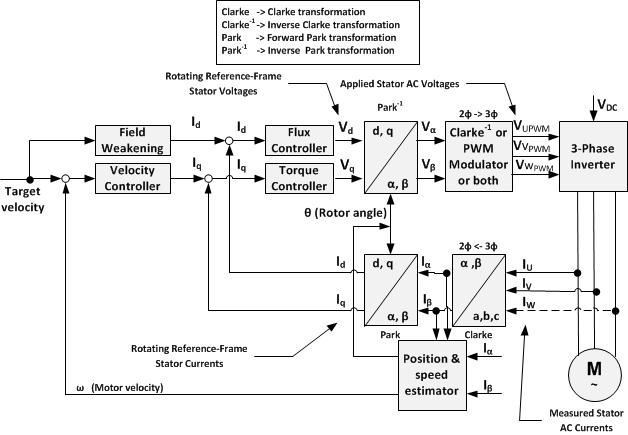
• FOC(field-oriented control): The FOC control technique determines the stator current of a three-phase AC electric motor as two orthogonal components that can be visualized as vectors, as shown in Figure 3. This is visualized in Figure 3.

Figure 3: FOC control principle

One component determines the motor's flux, and the other component determines the torque. The drive's control system calculates the corresponding current value from the flux and torque values given by the drive's speed control. Controls the driver's PWM output using the current proportional integral (PI) control technique.

We have looked at three control techniques above. FOC performs complex arithmetic operations to track the motor torque and requires a high-performance microcontroller (MCU). Trapezoidal control can be easily implemented with BEMF detection analog circuits, but it generates torque ripple and noise at each commutation. Sinusoidal control calculates BEMF at commutation, but the calculation fails when the load changes suddenly. Table 1 compares the three techniques.
Control method Arithmetic Cost Torque ripple Audible noise Load response
Trapezoidal Easy Low High High Middle
Sinusoidal Middle Low Low Low Low
FOC Complex High Low Low High
Table 1: Comparison of BLDC motor control techniques

Home appliances have stable loads of drain pumps and fans. Therefore, a sine wave control technique with low price range, low torque ripple and audible noise, and short response time is suitable. TI's DRV10987 BLDC motor driver is a single-chip sine wave solution for 50W BLDC motors used in washing machine drain pumps and dryer fans. Sine wave control reduces noise by up to 13 dB and improves efficiency by up to 10%. ( See the video "DC Motor - Drain Pump Demo")

The DRV10987 integrates control logic and MOSFETs. The motor can be controlled via analog voltage, PWM, or I2C interface. The DRV10987 allows for compact driver designs in a small form factor.

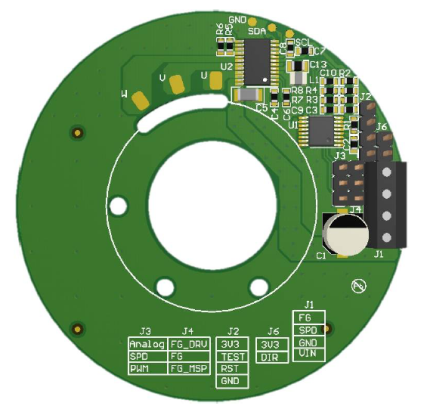
Figure 4: 24V 36W Sensorless BLDC Motor Drive Reference Design with Closed-Loop Speed Control

Figure 4 is a 24V 36W sensorless BLDC sinusoidal motor drive reference design with closed-loop speed control, showing the implementation of closed-loop speed control using the DRV10987.

The DRV10987 includes comprehensive protection logic required to achieve robust motor driver control in home appliances such as washing machines and refrigerators. The overcurrent protection circuit performs phase-to-phase, phase-to-GND, and phase-to-VCC short-circuit protection. It also includes current limiting logic to limit the phase current within the peak current capability (3A) of the MOSFET. The rotor-lock detection function can quickly and accurately detect position loss and rotor-lock conditions. Voltage surge suppression (AVS), overvoltage, and undervoltage protection functions prevent damage to the chip due to DC bus faults. It also includes overtemperature protection to prevent damage due to overheating. By using the DRV10987, you can easily develop a motor driver board required for a specific home appliance in a short period of time.

We have seen how to easily design a high-efficiency, high-performance BLDC motor driver board. Using a sinusoidal sensorless BLDC motor driver, you can achieve excellent home appliance applications that solve torque ripple or audible noise problems.

This article is based on a contribution from Texas Instruments.
이수민 기자
기사 전체보기

1 Comments:

  1. 주*규

    감사합니다.