Physical AI HBM Smart Factory SDV AIoT Power Semicon 특수 가스 정정·반론보도 모음 e4ds plus

SKT-Samsung Electronics Develop Cloud Core Network Using SCP

Google 우선 소스 기사입력2020.11.23 08:50

The world's first core network that complies with international standard Rel.16
By applying SCP technology based on cloud native
Providing ultra-fast, ultra-low latency, and hyper-connected services on time


SK Telecom and Samsung Electronics announced on the 22nd that they have developed a next-generation cloud core network.
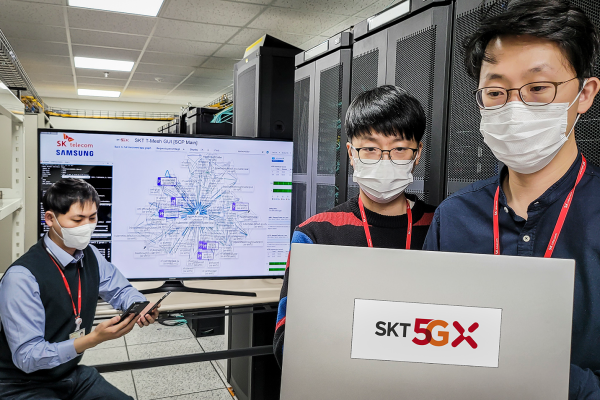
▲ SKT-Samsung Electronics, based on cloud native method
Development of a core network using service control point technology [Photo = SKT]

The next-generation cloud core network is a cellular infrastructure that provides terminal authentication, customer service, and QoS management for Internet connection of data traffic of mobile devices such as smartphones, and is the first core network to meet the international standard Rel.16.

With this core network development, users will be able to use Internet services at faster speeds. Additionally, companies can now quickly develop and provide customized products and services that customers demand.

◇ SCP-based cloud native technology expected to expand 5G ecosystem

The next-generation cloud core network developed by SKT and Samsung Electronics through two years of collaboration is characterized by providing services based on 5G characteristics (ultra-high speed, ultra-low latency, hyper-connectivity) in a timely manner without quality degradation by applying Service Control Point (SCP) technology based on a cloud-native method.

The cloud native approach allows application functions to be distributed and operated in modular units, accelerating the development and launch of 5G products and providing stable services.

SKT's SCP technology, 'T-Mesh', is a next-generation standard technology that manages traffic between application modules. It not only improves communication speed by 30%, but also maintains stable traffic through immediate resource allocation in situations where traffic is concentrated at once. It is expected to improve network stability and reduce the burden of expanding base stations such as mobile base stations in situations where localized traffic surges, such as during festivals.

Accordingly, the related ecosystem is expected to grow with the improvement of quality in 'AR, VR, and cloud games', which are attracting attention as 5G services, and the activation of services of the 4th industrial revolution era such as 'autonomous driving, smart factories, and smart farms'.

Meanwhile, the two companies signed a business agreement in early 2020 to promote joint research on 5G advanced and 6G evolution technologies. Accordingly, they plan to promote joint development and commercialization of 5G-related ▲network technology ▲innovative terminals and software ▲smart solutions.
이수민 기자
기사 전체보기