반도체 AI 인더스트리 4.0 SDV 스마트 IoT 컴퓨터 통신 특수 가스 소재 및 장비 e4ds plus

Will a Korean supercomputer ranked in the top 5 in the world be developed within 10 years?

기사입력2021.05.31 10:30

World's 21st No. 5 NuRion reactor replaced with No. 6 and No. 7 reactors in the top 5
Support for expansion of more than 10 related infrastructures by 2030
20% of national supercomputing resources to be provided to enterprises first


Ultra-high-performance computers, better known as supercomputers, have recently been gaining attention as essential infrastructure for processing the rapid increase in data and advancement of AI technology. They are also recognized as a measure of national competitiveness in the era of the 4th Industrial Revolution. On the 28th, the Ministry of Science and ICT announced the ‘National Ultra-High-Performance Computing Innovation Strategy’ at the 36th Central Disaster and Safety Countermeasures Headquarters Meeting and began full-scale promotion.

This strategy contains a 10-year mid- to long-term implementation strategy to overcome the gap with leading countries and secure growth opportunities in response to domestic and international paradigm shifts, such as the transition to an exascale computing era that performs 1018 calculations per second, strengthening of technological security in each country, and the surge in domestic demand.

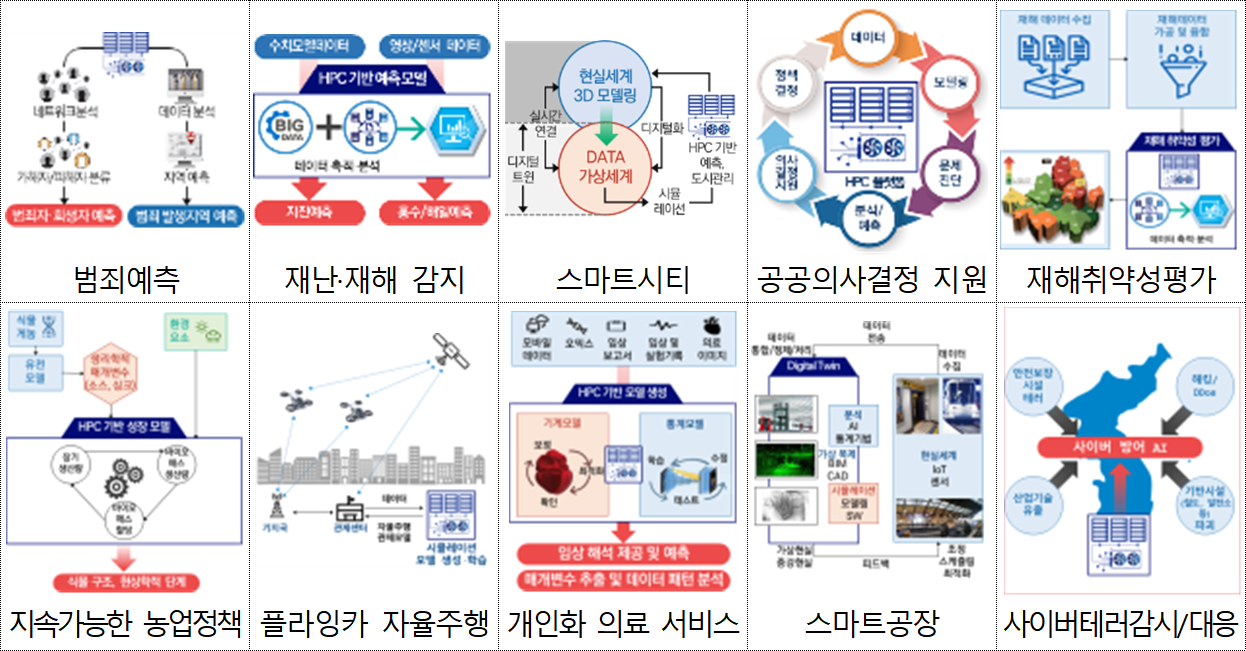
Specifically, by 2030, the government has set 10 strategic areas to foster the use of supercomputing, including materials, nano, autonomous driving, and national defense and security, with the goals of becoming △5th in computing power, △expanding 24 leading technologies, and △creating 10 new services. In addition, it has presented three policy directions to expand infrastructure, secure independent technological capabilities, and activate innovative use centered on this.

◇ Infrastructure expansion with the 6th and 7th national centers ranked in the top 5 in the world

First, in response to the rapidly increasing demand for supercomputing, the plan is to sequentially replace and operate the National Center 5, the ‘Nurion’ supercomputer, which is currently ranked 21st in the world, with the world’s 5th-ranked supercomputers 6 (2023) and 7 (2028). In addition, we will support the expansion of related infrastructure by designating more than 10 specialized centers in fields such as meteorology and national defense by 2030, and strengthen joint utilization by establishing a linkage system between national supercomputing resources such as national centers and specialized centers.
▲ Example of new service based on supercomputing [Image = Ministry of Science and ICT]

◇ Securing independent technology by developing an exascale supercomputer from the CPU

The government has selected 24 core technologies with high strategic importance, including CPUs, as strategic technologies. In the future, they will be grouped into four major areas: △processor technology, △platform technology, △data-intensive technology, and △utilization-based technology, and they will be focused on R&D investments to increase the current technological prowess from 60-70% of the best technology to over 80%.

With these core technologies, we will independently design, manufacture, and install an exascale supercomputer by 2030 to complete our system capabilities. We also plan to enter the finished product market. In addition, we plan to have related companies participate in government R&D projects from the beginning so that these achievements can be passed on to the domestic industry, and to expand support for creating initial markets for technology commercialization and providing technology.

◇ Providing corporate-only supercomputing resources and training specialized professionals

To ensure that potential demand from researchers and industry can be translated into actual use, 50% of the nation's supercomputing resources will be provided to 10 strategic fields, and 20% will be provided to companies first. As of 2020, this ratio is at 1.2%. In addition, we will strengthen customized support for each user in the industry, academia, research and public sectors, including strengthening the security system, expanding supercomputing utilization projects and discovering service models.

It also provides specialized application software development and sharing services. It also plans to foster R&D service companies and professional manpower specializing in supercomputing and build an open utilization ecosystem. Minister of Science and ICT Lim Hye-sook said, “We will work to create changes that the public can feel, such as securing independent supercomputing technology and creating new services.”
이수민 기자
기사 전체보기