반도체 AI 보안 인더스트리 4.0 SDV 스마트 IoT 컴퓨터 통신 특수 가스 소재 및 장비 유통 e4ds plus

Ministry of Science and ICT to invest 220 billion won by 2025 to secure 6G technology

기사입력2021.06.24 08:55

Investing 220 billion won by 2025 to secure 6G technology and standards
Promoting joint R&D as a follow-up measure to the Korea-US summit
Designation of 3 university research centers, full-scale training of human resources


Mobile communication technology usually changes every 10 years. 6G commercialization is expected between 2028 and 2030. Next-generation technology is the foundation for digital transformation and future industries, so preemptive technology development and standardization efforts are necessary to secure leadership in the international market.

On the 23rd, the Ministry of Science and ICT held a joint public-private 6G strategy meeting as a follow-up to the Korea-US summit, established a '6G R&D implementation plan', and established a 6G partnership with the US.
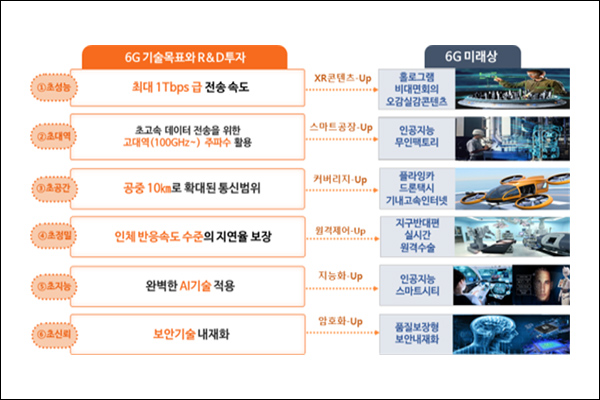
▲ The future achieved with 6G [Image = Ministry of Science and ICT]

The United States has recently been strengthening its cooperation with major allies on 6G technology since it began long-term 6G R&D led by the Defense Advanced Research Projects Agency (DARPA) under the Department of Defense. China also launched a dedicated organization in 2019, and Japan is also operating the public-private joint '5G Beyond Consortium' in 2020.

The meeting discussed ways to expand exchanges, such as joint 6G R&D, by leveraging the outcomes of the Korea-US summit. The Institute for Information and Communications Technology Planning (IITP) and the U.S. National Science Foundation (NSF) signed a joint R&D cooperation agreement, and joint 6G R&D between the two countries will be promoted within this year.

The meeting was attended by Deputy U.S. Ambassador to Korea Robert Rapson to promote cooperation between Korea and the U.S., and the two sides agreed to cooperate in expanding cooperation on 6G technology in the future. The following meeting discussed the 6G R&D implementation plan and 6G standard leadership measures.

The 6G R&D implementation plan contains detailed implementation plans for three major strategic areas: ① securing next-generation core source technologies, ② preemptive securing of international standards and patents, and ③ establishment of research and industrial infrastructure.
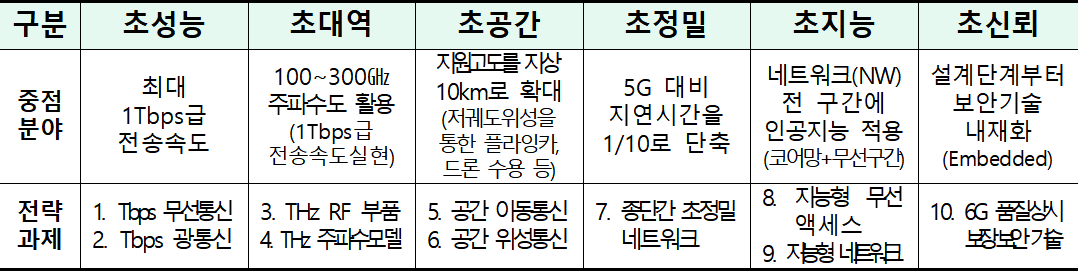
▲ 6G R&D 6 major fields, 10 major tasks [Table = Ministry of Science and ICT]

First, in order to secure next-generation core original technologies, a total of KRW 200 billion will be invested by 2025, and a total of KRW 17.9 billion (12 projects) as of 2021, in 10 strategic technologies in 6 key areas where it is difficult for the private sector to actively invest, such as low-orbit communication satellites and ultra-precision network technology.
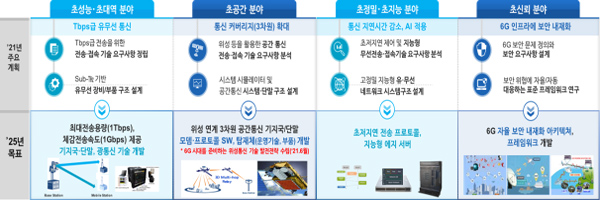
▲ 6G R&D 6 Major Fields 2021 Plan and Goals [Table = Ministry of Science and ICT]

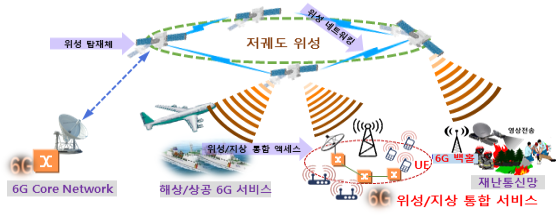
In the 6G era, we will pursue the integration of satellite and terrestrial networks to enable Gbps-level communications in moving aircraft such as flying cars and drones, as well as in maritime and disaster areas. To this end, the 'Satellite Communication Technology Development Strategy' will be pursued in parallel to develop integrated access technology between satellites and the ground, and launch a total of 14 verification and demonstration low-orbit satellites by 2031.
▲ Satellite communication using low-orbit satellites [Image = Ministry of Science and ICT]

This year is the first year of 6G R&D, so we will establish technical requirements for each 6G field, design element technologies, and lay the groundwork for securing original technologies, as well as establish the foundation for domestic production of key equipment and components. Stabilization and optimization of key technologies are scheduled for 2025.

In order to establish a cooperative system with major countries overseas, we will promote joint research and international cooperation on 6G frequencies with countries such as the United States (NSF), China (CAICT), and Finland (University of Oulu), which are conducting state-led 6G research. We have also signed a business agreement for joint cooperation between international 6G private organizations such as the US Next G Alliance and domestic 5G forums, and will also hold the international event '6G Global' in November.

◇ Promoting standard leadership and talent development

In relation to the international standardization of 6G, we shared the achievements of Korea advancing to the ITU and 3GPP chairmanship, and included measures for Korea to play a more proactive role from the stage of establishing the 6G vision, which is the blueprint for standardization, in order to lead future international standards.

Currently, the 6G Vision Working Group under the WP5D (Working Party 5D) within the ITU-R has been established, and in March, Samsung Electronics’ Senior Vice President Choi Hyung-jin was elected as the chairman. In May, Samsung Electronics’ Master Kim Yoon-sun was elected as the chairman of the 3GPP RAN1 (physical layer), and in June, LG Electronics’ Lee Ki-dong was elected as the chairman of the US NextG Alliance APP Working Group.

In addition, in cooperation with the Korean Intellectual Property Office, we will support R&D funding and patent acquisition strategy maps as a package starting this year for 6G core technologies (spatial networking, intelligent ultra-precision networks) with a high possibility of securing standard patents. In addition, we have decided to select additional technology fields for package support in 2022 and establish a strategy map in advance.

To establish a research and industrial base, we will designate and operate 6G research centers in three universities this year and encourage the training of master's and doctoral level human resources. We have decided to expand the form in which domestic small and medium-sized enterprises, universities, and research institutes jointly participate in R&D and promote the strengthening of 6G capabilities of working-level personnel.
▲ 2021 Selected 6G University Research Centers [Table = Ministry of Science and ICT]

In order to share global trends in 6G R&D with domestic industries and promote domestic technology overseas, we are also promoting reports and an English website to support 6G exchanges between global specialized organizations.

The Ministry of Science and ICT plans to establish three major subcommittees, including Technology and Standardization, Satellite and Frequency, and Global, to secure future 6G core technologies and continue public-private cooperation activities.

5G technology was first commercialized in Korea. However, it is being criticized for not being able to realize its potential due to limitations in its use. 6G technology needs to move beyond the mindset of just making it, and establish usage scenarios and steadily develop the necessary basic technologies.
이수민 기자
기사 전체보기