Samsung Electronics SW capabilities highlighted at GSMA 'M360'
5G Virtualized Base Station...Efficient Network Operation
Samsung Electronics emphasized its software capabilities for building next-generation networks.
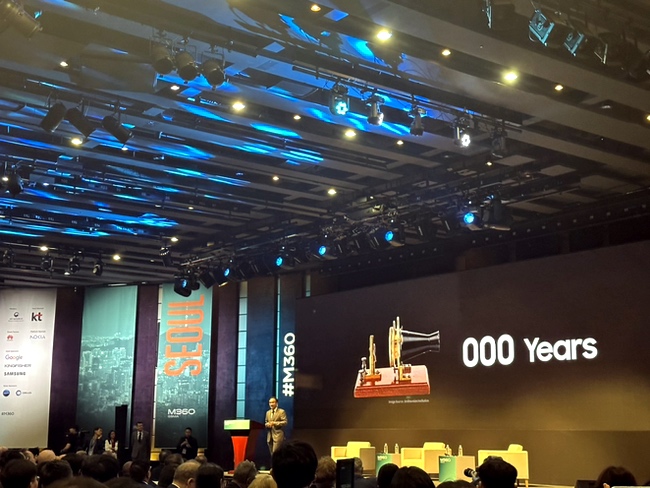
Samsung Electronics President and Head of Network Business Division Woo-Joon Kim shared Samsung Electronics' next-generation network strategy in a keynote speech at the 'GSMA Mobile 360 Asia Pacific M360 APAC' held at the Westin Chosun Hotel in Seoul on the 7th.
Samsung Electronics President Kim Woo-joon asserted, “Based on 40 years of proven expertise, Samsung Electronics is a company that can stably provide and operate software-based networks.”
Recently, the concept of network has expanded from the existing concept of communication between people to the connection between people and objects, and objects and objects.
To achieve this, various types of networks are needed, but as it is difficult to build all the infrastructure, efficient network construction and operation are being emphasized.
President Kim said, "5G will be a universal platform, not a network, and it will allow mobile carriers to efficiently manage their networks.“The strategy for running a network will determine its future,” he said, adding that “it must be able to build networks on demand, as needed.”
Samsung Electronics found a solution in software. President Kim said, “As the capabilities of Samsung Electronics’ terminals have grown, so has its software capabilities.”
In the past, hardware such as routers and switches were separated, but now, functions can be operated on each server through software.
Samsung Electronics has been proving the importance of SW-centric networks. For example, in January 2022, it commercialized a 5G virtualized base station in the UK for the first time in Europe. In addition, it completed the launch of a 5G initial network with DISH Network, the fourth largest mobile carrier in the US, in February.
Samsung Electronics emphasizes that in 5G virtualized base stations, software can be installed on general servers to support flexible and efficient communication network construction and operation.
“Hardware deployment is important, but ultimately, core networks will operate with software at their core,” said Kim. “Samsung Electronics is continuously investing in virtualized networks to proactively respond to long-term trends.”