| Mdigo, a company specializing in medical information analysis using AI
| Mdigo AI algorithm generates injury reports
| Report, forward to nearby hospitals and ambulances Hyundai Motor Company is making a strategic investment in MDGo, a startup specializing in vehicle occupant trauma analysis, and will collaborate to develop medical services for future connected cars.

Hyundai Motors joins hands with Israel's Mdigo
Development of technology to predict the level of injury to passengers in accident vehicles
Hyundai Motor Company announced on the 10th that it has decided to develop a service in collaboration with MDGO that will predict the extent of injuries suffered by passengers in the event of a car accident and provide accurate early medical services.
In the event of an unexpected car accident, what is just as important as the quick arrival of medical staff to the scene is accurately assessing the injuries of the injured and providing appropriate initial on-site medical response.
Mdigo, located in Israel, is a company specializing in medical information analysis using AI.
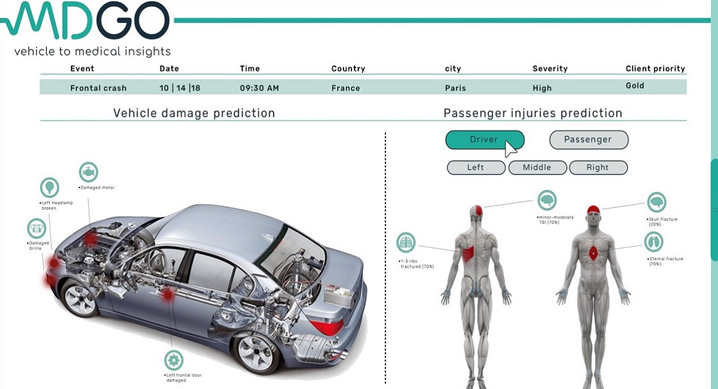
When a collision occurs, Mdigo's AI algorithm analyzes data collected from various sensors in the vehicle and generates a report showing the location of passengers' injuries and the severity of their trauma in real time.
This report is immediately relayed to nearby hospitals and ambulances transporting the patient, helping to provide optimal emergency treatment at the scene of the accident.
MdigoSince last year, we have been collaborating with local insurance companies in Israel to conduct verification projects for the technology and to advance our services.
We are also exploring new business opportunities to provide customized medical services using driver health diagnostic sensors that will be installed in future vehicles.
In addition to Hyundai Motors, Volvo and others participated in this round of funding for MDGO.
Hyundai Motor Company has decided to continue its collaboration with MDGO to incorporate the service into Hyundai Motor Company's connected car services, following its strategic investment in the company.
Hyundai Motor Company is focusing its capabilities on developing advanced technologies for medical services utilizing IoT.
Currently, Hyundai Motor Company is providing subscribers to its connected car service Blue Link with a function that automatically reports the location of the vehicle involved in an accident to the emergency center in the event of an airbag deployment.
In addition, the Nexo autonomous vehicle, which successfully demonstrated autonomous driving on the Seoul-Pyeongchang highway early last year, was equipped with technology that allows passengers to receive real-time health diagnosis from medical staff by transmitting information such as blood pressure and heart rate to a specialist.
Hyundai Motor plans to develop passenger trauma analysis technology optimized for its vehicles through this collaboration with MDGO, creating a new opportunity to dramatically improve customer safety.
The two companies began working around April to verify an algorithm that predicts the level of injury to passengers based on Hyundai Motor Company's major vehicle crash test data.
In order to analyze the severity of injuries suffered by accident victims using MDGO, information such as passenger location, vehicle speed at the time of the accident, impact site, and seat belt fastening must be transmitted in real time to the AI analysis server.
To this end, Hyundai Motor Company is rapidly transmitting various vehicle data at the time of an accident through a connected car system, enabling more accurate analysis.We plan to collaborate with MDGO to do so.
It is also expected that preemptive safety technologies such as vehicle design with safety in mind and optimal safety system layout configuration will be improved by utilizing MDGO's passenger trauma analysis system.
In particular, if this technology is commercialized, it is expected to be an opportunity to innovate the insurance claim process and reduce social costs by minimizing mutual disputes.
In the future, as the environment evolves to secure passengers' health information, it is expected that it will be possible to provide customers with an end-to-end solution related to healthcare from the vehicle to the hospital.
“Starting with our collaboration to improve vehicle emergency medical services, we expect to be able to provide innovative customer experiences in passenger safety, such as health monitoring using new in-vehicle technologies, in the long term,” said Hyundai Motor Company Strategy and Technology Division President Young-cho Chi.
“We are delighted to be partnering with Hyundai,” said Itai Vanguard, CEO of Mdigo. “We share Hyundai’s vision of providing life-saving services through technology.”