인피니언 Dec
반도체 AI 보안 인더스트리 4.0 SDV 스마트 IoT 컴퓨터 통신 특수 가스 소재 및 장비 유통 e4ds plus

“Display Shipment Area to Increase 4% in 2023”

기사입력2023.03.15 15:34


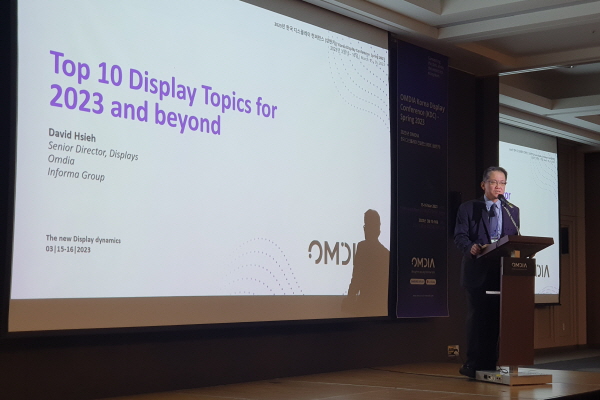
▲David Hsieh, Omdia's Senior Research Director, is giving a keynote speech on the topic of 'Top 10 Display Industry Topics in 2023'.

Omdia to hold display conference in the first half of 2023
Large area market transformation, long-term supply shortage without LCD investment

It is projected that the display market, which showed negative growth in 2022, will be able to grow based on new demand from 2024 based on a recovery in area-based demand in 2023.

OMDIA held the '2023 First Half Korea Display Conference' from March 15th to 16th.

This two-day event, where display researchers from Omdia around the world shared global display industry trends and market outlook, covered the top 10 topics of the display industry in 2023, the outlook for the large display industry, the latest outlook for the mid- to long-term display market, the industrial display market, and use cases.

David Hsieh, Senior Research Director at Omdia, who was in charge of the first presentation on the first day, gave a keynote speech on the topic of 'Top 10 Display Industry Topics in 2023'.

David See said that 2022 will be the first year in display history where display shipments will experience a decline in area.

The area of shipment decreased by 4% year-on-year to 249.76 million m2 in 2022.However, it is expected to increase by 4% year-on-year to 260.17 million m2 in 2023, and by 7% year-on-year to 279 million m2 in 2024.

In particular, it is changing into a market led by large areas. Despite the decrease in sales of set products such as TVs and monitors during the COVID period, the area per sales volume increased. This is analyzed to be due to a change in consumer behavior patterns to support large screens.

Accordingly, panel makers are establishing strategies to reduce small screens and switch to large screens, and he mentioned that the poor demand for TVs should be reexamined in terms of area rather than the number of sets sold.

In particular, this behavioral pattern is also shown by price, and the analysis shows that the price difference between small and large models is not that big, which is the reason why consumers' TV shopping behavior is shifting to large models.

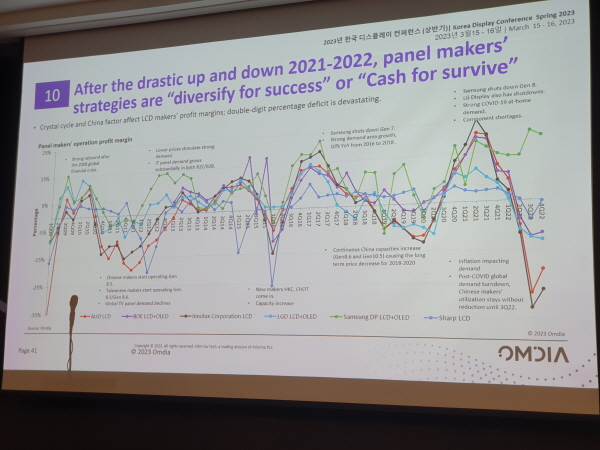
In terms of supply, he said there is no longer an oversupply because panel makers are reducing production and are currently losing money on the more panels they produce. Meanwhile, it was pointed out that in the long term, a supply shortage may occur as construction of new factories in China is being suspended and some manufacturers are giving up LCD production.

In particular, Chinese TV companies are actively purchasing panels, unlike Korean or Japanese companies. This can be seen as a behavior to secure quantity as they believe that the current situation is the cheapest for panels, and to prepare for or sell off price increases. In addition, since most LCD panels are produced in China, Chinese companies want prices to rise, so this phenomenon is occurring, it was reported.

In terms of investment, it is reported that there was no new construction of LCD fabs in 2022, and that investments were centered on IT and OLED.

Recently, display companies have been actively seeking to discover new industrial display demands, such as vehicle displays, kiosks, and human-machine interfaces.

In particular, Taiwanese companies are actively seeking to exploit this demand, as most Taiwanese production facilities are 6th generation facilities that are over 20 years old and are targeting niche markets such as industrial demand as markets that can operate this equipment.

For 8.5 generation companies, industrial demand was suggested to be met by customizing cutting panels or producing panels by dividing them using new photomask technology.

In terms of large areas, the average size was analyzed to be 55 inches or larger, and for sizes over 60 inches, consumers were found to be looking for products that incorporate cutting-edge technology.

As people become more dependent on IT after COVID-19, the demand for new types of products is increasing, and as a result, demand for curved products, high-frequency products, mini LEDs, and OLEDs has grown.

Especially in China, the 15.3-inch 8.5-generation display is cut into 70 pieces. It is being analyzed that this is an attempt to create a new market based on the Chinese domestic market by launching products, etc.

In terms of mobile OLED, although Korean products currently hold a high market share, China's market share is expected to increase as local OLED adoption increases, especially among Chinese smartphone companies.

However, it is expected that it will take considerable time for China to enter this market as its technological prowess in foldable or rollable products is still lacking.

In relation to the automotive market, demand is increasing due to the emergence of electric vehicles, and products with high power consumption and high contrast ratio are considered important factors in the automotive market.

This field is particularly characterized by its diverse form factors and sizes, as well as a variety of emerging concepts.

David Seeye finally advised that with the 2022 recession approaching, display companies' strategies are divided into two trends: 'diversification for success' or 'securing funds for survival', and that sales are the most important thing for companies to survive.