마이크로칩7월
Physical AI HBM Smart Factory SDV AIoT Power Semicon 특수 가스 정정·반론보도 모음 e4ds plus

[모빌리티 그랑프리] Professor Kim Yun-su of GIST, “Development of power demand control and management technology is essential”

Google 우선 소스 기사입력2023.05.31 12:21

Volatility and uncertainty are abundant… Electricity demand control and management are important
“We must respond sensitively to changes in demand and provide appropriate power supply.”

Professor Kim Yun-su of the Energy Convergence Graduate School at Gwangju Institute of Science and Technology spoke about the relationship between the power grid and energy prices, and said that we need to develop and utilize technologies to control and manage power demand.

On the 17th, Professor Kim Yun-su gave a special lecture on the topic of 'Understanding the Relationship between Low-Carbon Power System Operation Technology and Energy Prices' at the 'Mouser Power Seminar 2023' hosted by Mouser and organized by e4ds.

Today, as resources with high volatility and uncertainty multiply, the concept that carbon emissions are converted into costs and that demand must be adjusted to balance supply and demand has become established, and this change is creating a market and environment in which demand adjustment can generate profits.

Professor Kim's opinion is that we need to develop and utilize technologies to control and manage electricity demand in order to supply electricity at the right level of demand.

He explained the definition of the power grid, the process of determining electricity prices, the formulas and techniques of energy management systems, and the use of AI.

The entire process from electricity production to consumption is called the power system.

Electricity is generated at power plants, transmitted through transmission lines, then the voltage is stepped down through substations and delivered to us through the distribution system.

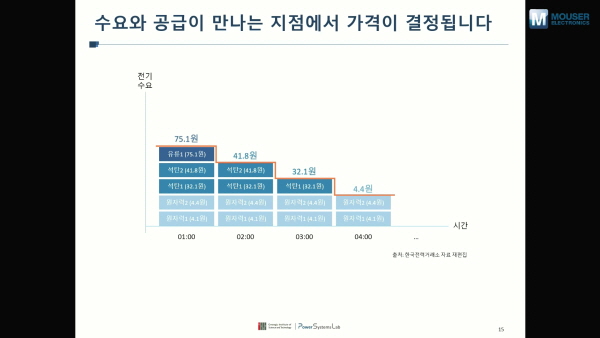
As with most products, electricity's price is determined at the point where supply and demand meet.
r;">

Korea Power Exchange, the power system operator, predicts demand by time zone for the next day and then stacks generators that can be used during that time zone in order of lowest price.

The price of electricity for a time period is determined based on the unit cost of the generator in the highest position that must be running to meet demand at that time.

During the early morning hours, nuclear power can meet the demand, but during the day, thermal power must also be operated, which creates a difference in electricity rates.

The most commonly used fuels in our country's power system are coal, nuclear power, LNG, renewable energy, and hydroelectric power, in that order.

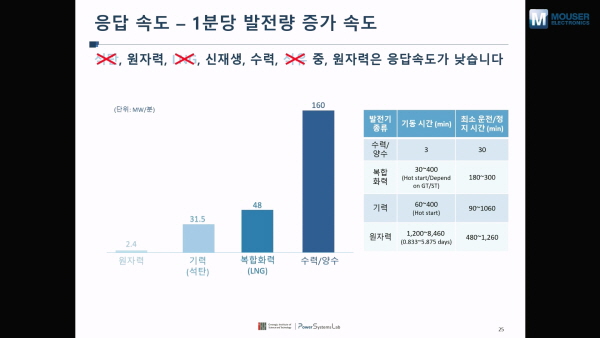
Fuels such as coal and oil will no longer be usable in the future due to their high carbon dioxide emissions, and nuclear power has a slow response time, making it difficult to meet demand in real time.

The analysis is that since the power generation of solar power, which has been widely distributed, decreases rapidly after sunset, it is very important to keep up with the rate of change in solar power generation between the hours of sunrise and sunset, and therefore nuclear power, which has a relatively slow response time, also has limitations.

Professor Kim said that in order to solve the problem, it is very important to develop and utilize power demand control and management technologies that respond sensitively to changes in demand and supply appropriate power.

In the pastwas relatively less concerned about carbon emissions, and the concept of demand energy management was to save energy, so it adjusted the amount of power generation to balance supply and demand.

Today’s shift to converting carbon emissions into a cost is creating markets and environments where demand regulation can generate profits.

Unlike in the past when consumers only had to pay for the amount of electricity they used, a situation is being created where electricity produced by solar energy and other sources is being sold to small-scale power brokers.

This leads to an increase in the importance of energy management systems, and the most important part of the system is the composition of formulas, called modeling.

By applying optimization techniques to leverage models, you can reduce costs and increase profits.

The models need to be made solvable by optimization techniques, but they need to be made in a convex shape to be solvable by optimization techniques.

If it is not convex, it has the disadvantage that it can be calculated as a local optimum rather than a global optimum.

AI is also used when modeling seems difficult or impossible.

It is not easy to accurately know detailed information inside the power grid, so one example is to train AI with accumulated data and make estimates.

Professor Kim emphasized the importance of mathematics, saying, “Using mathematical expressions and techniques to solve problems in the energy sector is ultimately energy management technology and the path to carbon neutrality.” He concluded the special lecture by emphasizing: