2026 Physical AI Conference
반도체 AI 인더스트리 4.0 SDV 스마트 IoT 컴퓨터 통신 특수 가스 소재 및 장비 e4ds plus

Korea Electric Power Corporation (KEPCO) accelerates development of aerial wind power generation.

기사입력2021.05.06 08:39


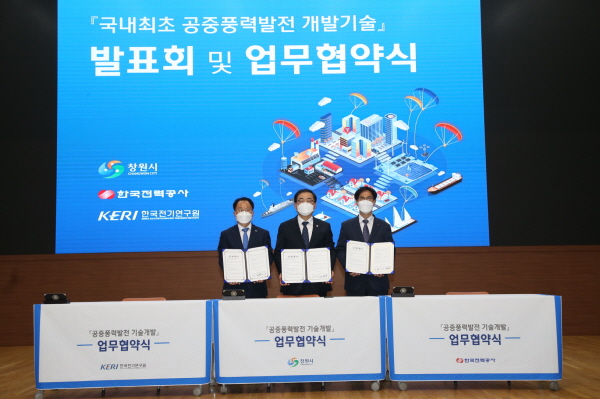
▲(From left) KERI Testing Division Director Kim Jong-wook, Changwon City Mayor Heo Seong-mu, and KEPCO Technology Innovation Headquarters Director Kim Suk-cheol pose for a commemorative photo after signing the MOU.


Generating electricity on the ground by pulling a string on a flying object in the wind

The Korea Electrotechnology Research Institute (KERI), Korea Electric Power Corporation (KEPCO), which represents the Korean electrical technology and industry sectors, and Changwon City in South Gyeongsang Province, which is considered a leader in the Green New Deal through various eco-friendly policies, are accelerating the domestic development of 'airborne wind power generation,' which is attracting attention as a future renewable energy source.

On the 4th, KERI, KEPCO, and Changwon City held an aerial wind power research and development performance presentation at the Changwon City Hall Citizens' Hall and signed an MoU for continued business cooperation.

The signing ceremony was attended by approximately 30 key figures leading the research project, including Changwon City Mayor Heo Seong-mu, KERI Testing Division Director Kim Jong-wook, and KEPCO Technology Innovation Division Director Kim Suk-cheol.

Aerial wind power generation is a type of 'flying power plant' that generates electricity by flying kites and other devices at high altitudes. Aerial wind power generation is divided into the 'airborne power generation' method, which generates electricity in the sky by mounting propellers and generators on airplanes or drones and transmits it to the ground, and the 'ground power generation' method, which generates electricity by pulling a rope in the air with a kite or glider, and rotating a drum on the ground with the rope wound on it, driving a generator.

Currently, three organizations are developing ground-based aerial wind power generation using purely domestic technology. Korea Electric Power Corporation (KEPCO) is funding the research and development at KERI, and Changwon City is supporting the use of the Masan Marine City site as a test bed.

The advantages of airborne wind power include its high potential as a source of energy and its limited location. Theoretically, the total potential energy that existing tower-type wind turbines can capture from wind on Earth is 400 TW.

On the other hand, due to various geographical, economic, and natural environmental issues, such as the limitations of wind resources that can only be secured in certain regions and the limitations of water depth that affect the basic cost of power plants in the case of offshore wind power, the cumulative installed capacity of tower-type wind turbines installed worldwide to date is only 743 GW, which is less than 0.2% of the total potential (400 TW).

However, the theoretical total potential energy harvested by airborne wind power from high-altitude winds is 1,800 TW. This is 4.5 times that of tower-type wind turbines and 90 times the global energy demand (approximately 20 TW). Because high-altitude wind energy is both stronger and more widely distributed, airborne wind power can generate electricity by harnessing the high-altitude, strong winds in areas where weak winds previously precluded the commercial viability of tower-type wind turbines. Furthermore, when built offshore, it is largely unaffected by water depth, which often dictates the initial cost. In fact, power generation is possible in most areas of the globe.

It is also very economical and environmentally friendly. Compared to tower-type wind turbines, annual power generation per unit area is more than six times higher. Furthermore, components (foundations, towers, blades, etc.) are reduced to one-tenth, significantly reducing materials and costs. This, in turn, can reduce carbon dioxide emissions by more than half. Another advantage is that it minimizes environmental damage, noise, vibration, and landscape issues that hinder public acceptance of power plant installation.

Based on these advantages, developed countries like the US and Europe have long been interested in aerial wind power generation, conducting feasibility studies and steadily developing related technologies for commercialization and large-scale deployment. Korea also needed research to secure this technology, and KERI, the only specialized electrical research institute in the country, is independently developing the first domestic technology with support from Changwon City and the Korea Electric Power Corporation (KEPCO).

Since 2017, KEPCO has been implementing an open R&D program to develop convergent new technologies essential to the industry and strengthen competitiveness in the electric power and energy sectors. "Airborne wind power generation" is one such project, and KEPCO and KERI have been conducting research and development on this project since 2018.

Meanwhile, the development test site for this study was crucial. Favorable wind conditions and a wide, flat area were essential. Above all, as this was the first study of its kind in Korea, a safe space was crucial for the testing process. Therefore, Changwon City actively supported the use of the "Masan Marine City," an artificial island created by reclaiming Masan Bay. Building on this foundation, KERI was able to secure numerous proprietary source system technologies, design patents, manufacturing technologies, control and operation technologies, etc. in the field of airborne wind power generation, which is a convergence of technologies from various fields.

“Aerial wind power generation has a high degree of applicability as it can be built with various capacities, from mobile to large-scale power generation, depending on the purpose and location of use,” said KERI Energy System Control Technology Team Leader Lee Ju-hoon, who led the research. “In the future, we plan to realize autonomous driving technology using artificial intelligence (AI) and build a demonstration complex where we can work with around 300 electricity-related companies in the Changwon area.”

Changwon Mayor Heo Seong-moo said, “Today’s agreement will be remembered as a symbolic day in which Changwon City, KERI, and KEPCO take the first step on the ‘road not taken’ of aerial wind power generation and lay the foundation for achieving carbon neutrality in Korea.” He added, “I promise to spare no effort in supporting the success of the aerial wind power generation system development test.”

Going forward, KERI aims to advance the commercialization of aerial wind power generation through continued collaboration with Changwon City and KEPCO, thereby contributing to the realization of the government's Green New Deal policy and global efforts to reduce greenhouse gases.