Microchip _ Nov 25
반도체 AI 보안 인더스트리 4.0 SDV 스마트 IoT 컴퓨터 통신 특수 가스 소재 및 장비 유통 e4ds plus

ETRI develops secondary battery cathode structure without solid electrolyte

기사입력2021.07.14 09:21

ETRI develops secondary battery anode without solid electrolyte
Proposal of anode composition using only TiS2 active material and binder
Identifying Diffusion Characteristics with DIGIST Digital Twin Analysis


The Electronics and Telecommunications Research Institute (ETRI) announced on the 13th that it has developed a new electrode structure that uses only titanium disulfide (TiS2) as an active material without a solid electrolyte to form the anode. Following the development of the anode structure for an all-solid-state secondary battery last year, it has also succeeded in developing the anode structure. This achievement was published online in June in the journal 'Energy Storage Materials.
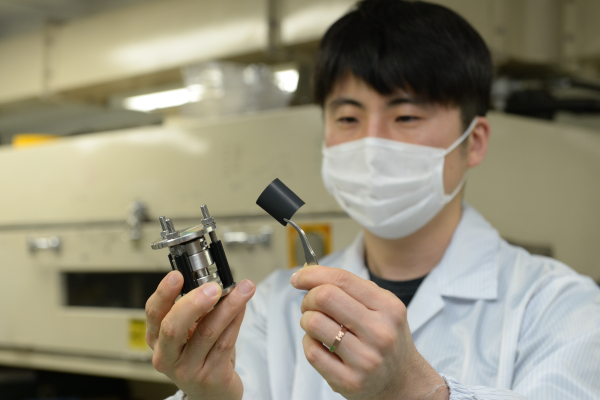
▲ Showing the TiS2 cathode for all-solid-state secondary batteries
ETRI Senior Researcher Kim Joo-young [Photo = ETRI]

All-solid-state secondary batteries are next-generation batteries that use solid electrolytes to transfer ions in the battery. Solid electrolytes are safer from fire than liquid electrolytes, and can create bipolar secondary batteries that cannot be implemented in lithium-ion batteries, so they also have high energy density.

The positive electrode of an all-solid-state secondary battery is mainly composed of a conductive material responsible for electronic conduction, a solid electrolyte responsible for ion conduction, an active material responsible for energy storage, and a binder that physically and chemically holds them together. In order to allow lithium ions to move smoothly within the electrode, a solid electrolyte that forms an ion transfer path within the electrode is essential.

As the solid electrolyte composition ratio increases, the amount of active material is relatively small, which limits the improvement in energy density. In addition, in the case of composite electrodes containing sulfide-based solid electrolytes, the manufacturing process is difficult due to the high chemical reactivity, such as the generation of hydrogen sulfide gas when reacting with moisture (H2O), which requires difficult solvent and binder selection and extreme moisture control.

The ETRI research team proposed a battery structure that consists of an anode composed only of active material and binder that pressurizes titanium disulfide (TiS2) particles to eliminate gaps between particles without a solid electrolyte. Through a digital twin virtual structure analysis with a joint research team at the Daegu Gyeongbuk Institute of Science and Technology (DGIST), the research team confirmed that lithium ions diffuse directly through titanium disulfide particles.
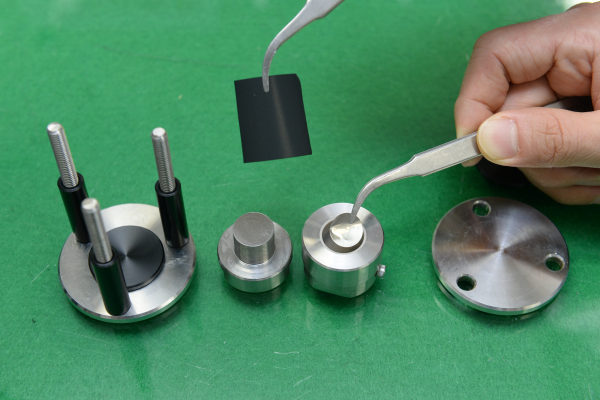
▲ TiS2 for all-solid-state secondary batteries developed by ETRI-DGIST researchers
Pressurized test cell structure for bipolar and performance measurements [Photo = ETRI]

Since the active material content can be increased by not using a solid electrolyte, it was confirmed that the energy density can be increased by more than 1.3 times compared to when a solid electrolyte is used for the same capacity. In addition, since the solvent and binder can be freely selected and the existing lithium-ion battery electrode manufacturing process can be utilized as is, the performance and price competitiveness of all-solid-state secondary batteries can be improved.

ETRI’s Young-ki Lee, a senior researcher at the Intelligent Sensor Lab, said, “We have confirmed for the first time that ion diffusion is possible with only active materials at both the cathode and the anode,” and added, “Based on this technology, we will secure basic technologies to further improve energy density and contribute to commercialization.”

Based on this achievement, which confirmed the possibility of significantly increasing the energy density of each cathode and anode, the research team plans to conduct follow-up research on all-solid-state batteries. In addition, they plan to conduct research that can improve output characteristics while synthesizing the battery structure.

This study was conducted jointly with Professor Lee Yong-min's team at DGIST, led by ETRI. The first author of the paper is Dr. Kim Joo-young of ETRI and Dr. Park Joo-nam of DGIST. The study was conducted with the support of the Climate Change Response Technology Development Project of the National Research Foundation of Korea, Ministry of Science and ICT, and the ETRI Basic Project.

이수민 기자
기사 전체보기