Physical AI HBM Smart Factory SDV AIoT Power Semicon 특수 가스 정정·반론보도 모음 e4ds plus

[Interview] Kim Hwi-jun, Senior Researcher, Korea Institute of Industrial Technology - “AI Utilization, Excellent Prediction and Improved Accuracy”

Google 우선 소스 기사입력2021.11.22 11:27

“AI utilization, excellent prediction and improved accuracy”
Ti-6Al-4V powder recovery rate improved to 95%, 150,000 won/kg possible
Learned AI Agent Derived 1 Billion Process Conditions in 1 Hour

[Editor's Note] On November 18, the Technology Innovation Center of the Small and Medium Business Technology Information Promotion Agency held the 4th Joint Technology Exchange Meeting. This technology exchange meeting featured various presentations on the topic of 'Big Data, AI, and Smart Manufacturing.' Among them, Senior Researcher Kim Hwi-jun from the Korea Institute of Industrial Technology presented technology for real-time big data collection and application of artificial intelligence models during the metal powder preparation process, such as VIGA and EIGA, to predict and optimize the characteristics of particle size distribution, shape, and flow diagram of high value-added metal powders for additive manufacturing (3D Printing) and MIM, such as Ti and Ti alloy, Ni-based superalloy, and STS alloy powders. Accordingly, our magazine arranged an interview with Kim Hwi-jun, a senior researcher at the Korea Institute of Industrial Technology who announced this technology, to learn about the related technology.


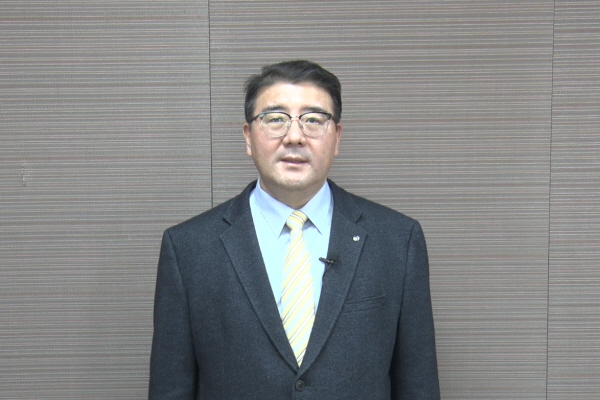
▲Kim Hwi-jun, Senior Researcher, Korea Institute of Industrial Technology

■ Please introduce the Smart Liquid Forming Research Department of the Korea Institute of Industrial Technology.

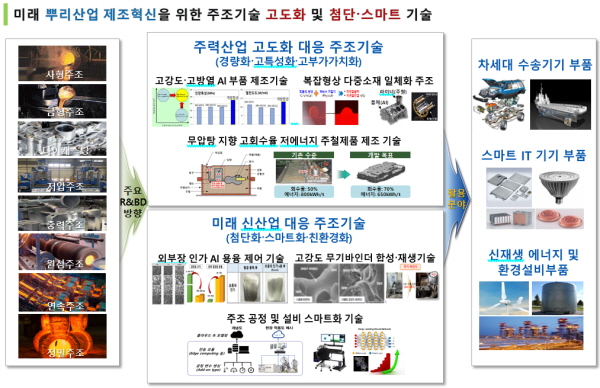
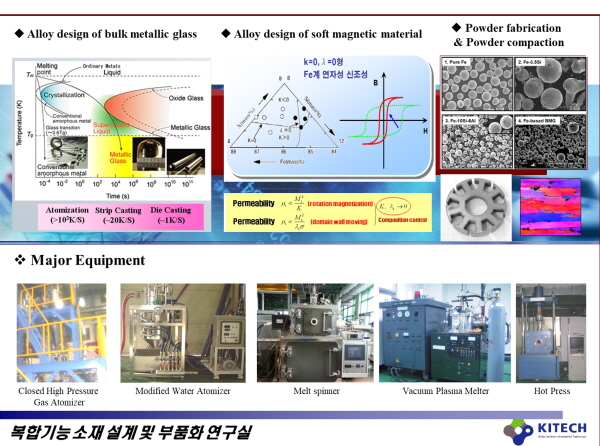
The Smart Liquid Forming Research Division is researching the following: △metal alloy design, △process design and optimization technology utilizing the liquid-to-solid solidification phenomenon, △computer simulation technology for flow and solidification phenomena, and the Composite Functional Material Design and Component Manufacturing Laboratory is researching the following: △metal alloy design, △metal powder manufacturing process design and optimization technology, △special casting technology, and △core forming process technology for soft magnetic powder materials.


■ Please introduce the 'Prediction and optimization technology of high value-added metal powder manufacturing technology process using real-time big data collection technology and artificial intelligence model' announced this time.

Laminated molding such as Ti and Ti alloy, Ni-based super heat-resistant alloy, and STS alloy powderThis is a technology that applies big data real-time collection technology and artificial intelligence models to metal powder manufacturing processes such as VIGA and EIGA to predict and optimize the characteristics such as particle size distribution, shape, and flow diagram of high value-added metal powder for (3D Printing) and MIM.

To achieve this, the following technologies must be secured: △metal powder manufacturing technology for additive manufacturing, △big data collection technology, and △artificial intelligence utilization technology.

The metal powder manufacturing technology for additive manufacturing is the EIGA (Electrode Induction Melt Gas Atomization) process technology and VIGA (Vacuum Induction Gas Atomization) technology that can manufacture high-purity/high-value-added powder without oxide contamination from high-melting-point/high-activity metal powders such as Ti, STS, Ni-superalloys, and Ni-Cr alloys used in metal additive manufacturing.

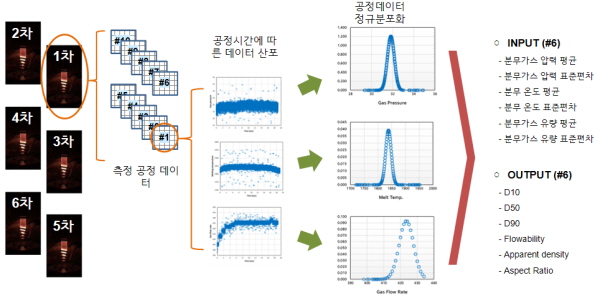
Big Data collection technology is a technology that measures and collects in real time the changes in the temperature of molten metal, the pressure of the spray gas, and the flow rate of the spray gas, which are the main variables in the high-melting-point/high-activity metal powder manufacturing process, and a technology that collects and classifies the powder being manufactured over time, and then links the characteristic changes to the main variables.

The technology utilizing artificial intelligence is a technology that changes the existing field empirical process optimization method into an AI-based optimization system (ANN, DNN) suitable for the 4th industrial revolution by utilizing real-time measured process variables and powder characteristics (average particle size, particle size distribution, sphericity, apparent density) through machine learning.

In order to obtain big data even with a small number of experiments in the metal powder manufacturing process, we built H/W and S/W that collects real-time input data on manufacturing variables at a speed of 1,000 sets/sec and captures and classifies metal powder in real time to create big data.

Big data and artificial intelligence (AI) technologies are being rapidly introduced into all fields recently. This is a technology that can maximize powder properties and productivity by using it as a model to predict and verify optimal process control conditions applied to various metal powder manufacturing processes for additive manufacturing.

■ In the case of metal material processes, collecting big data is expected to be quite difficult, so I wonder how big data collection can be made possible.

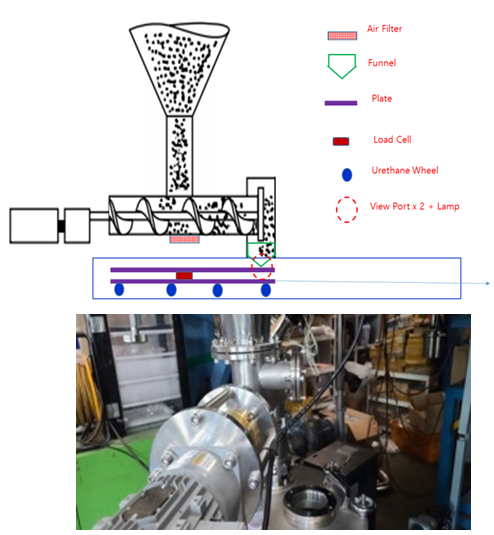
The Input Data Acquisition System is a technology that measures and collects changes in the main variables of the metal powder manufacturing process, such as the temperature of the molten metal, the pressure of the atomizing gas, and the flow rate of the atomizing gas, in real time at a speed of 1,000 sets/sec, such as EIGA and VIGA.


The Output Data Acquisition System has developed a system capable of collecting and classifying manufactured powder in real time and has applied for a patent (Multi-step cyclone device for precise collection of fine powder and precise collection method of fine powder using the same (Application No.: 10-2020-0167960). Using this, it has established the world's first system capable of collecting big data in the metal powder manufacturing process by obtaining up to 20 sets of target values per powder manufacturing.


■ I want to know how the artificial intelligence process for predicting the characteristics of metal powder using collected big data proceeds.

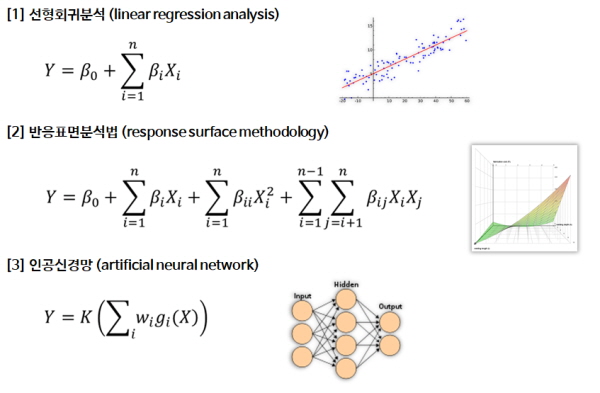
In this study, the EIGA and VIGA processes were used to determine the metal powderThe effects of process factors on the properties of powder (Ti-6Al-4V alloy, Al-Cu alloy) were investigated and optimized by applying response surface methodology (RSM) and artificial neural network (ANN) models to predict and optimize powder properties such as particle size distribution (D10, D50, D90), flow rate, apparent density, and sphericity.


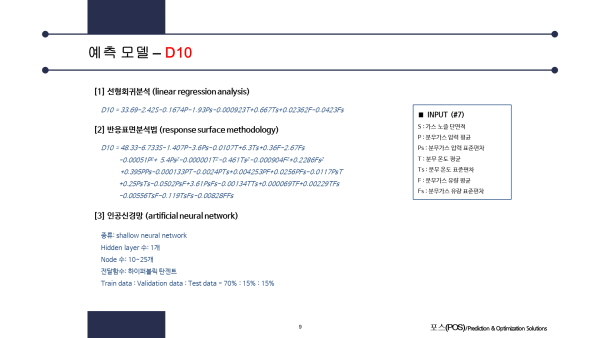
The prediction model optimized the spraying process conditions by applying the response surface method (RSM) and artificial neural network (ANN) models to more than 400 sets of big data.


The D10 particle size distribution prediction example is as shown in the figure below.


■ I would like to hear about the research background and how it differs from other similar studies.

The metal additive manufacturing process has the advantage over existing metal parts manufacturing processes of being able to easily implement three-dimensional products without design restrictions using metal powder materials and having excellent accessibility to the manufacturing process. The use of additive manufacturing technology is significantly increasing in the industrial field, and the metal powder materials used in the metal 3D printing process are a core technology of the new high value-added materials, parts, and device industries that are showing high growth rates with an average annual increase in market size of 21% due to a sharp increase in demand every year.

Metal enemyThe biggest factor hindering the growth of the laminated molding industry is the high material price of metal powder. The price of Ti powder, which is most widely used in the domestic laminated molding field, is very high at approximately $230-700/kg, and there are restrictions on the use of specialized powder depending on the equipment used.

In the case of domestic powder materials for metal additive manufacturing, we are currently dependent on overseas sources for all quantities. However, in order to become self-sufficient in high value-added powder for additive manufacturing and enter the global market worth 1.5 trillion won, technology for improving the efficiency of the powder manufacturing process (high powder recovery rate) is urgently needed.

In this study, in order to optimize the process for manufacturing economical metal powder for additive molding by maximizing the recovery rate of metal powder for additive molding, the effects of process factors of Gas Atomization, a representative process, on the characteristics of the manufactured metal powder were investigated, and for optimization, △ experimental modeling to predict the average particle size D50 of metal powder (more than 35), △ prediction of the overall particle size distribution of metal powder through flow analysis according to the shape of the spray nozzle, △ mathematical prediction modeling using computer simulation and combining experimental data to predict the particle size distribution to improve accuracy were conducted.

Recently, the results of a study on optimization of the manufacturing process of Ni-Co superalloy powder using machine learning (artificial intelligence) have been published (Machine learning-driven optimization in powder maufacturing of Ni-Co based superalloy, Materials and Design, 198 (2021)). This study is as follows: △ Optimization modeling of the TPM-5002 super heat-resistant alloy powder manufacturing process through the VIGA process; △ Spray temperature (T) and spray pressure (P) are set as input variables (X1, X2) and the recovery rate of powder less than 53 ㎛ is set as the target characteristic (Y); △ The Bayesian Optimization (BO) algorithm is used for the data obtained through 25 sets of tests to predict the optimal spray temperature and spray pressure with the maximum recovery rate; △ Under the optimal conditions, a recovery rate of up to 77.85% is obtained, resulting in a 72% reduction in manufacturing cost compared to the existing process.

In this study, the effects of process factors on the characteristics of metal powders (Ti-6Al-4V alloy, Al-Cu alloy) for the EIGA and VIGA processes were investigated, and response surface methodology (RSM) and artificial neural network (ANN) models were applied to optimize the powder characteristics such as particle size distribution (D10, D50, D90), flowability, apparent density, and sphericity.

In the case of the above comparative artificial intelligence model, the input variables were selected as spray temperature and spray gas pressure, whereas in this study, they were expanded to include spray temperature, spray gas pressure, and spray gas flow rate.

In the case of the above comparative study, one set of input variables and target values was obtained in one experiment, but in this study, changes in three types of input variables were measured in real time at a speed of 1,000 data/sec, and the average value and deviation were calculated to obtain a total of six sets of input variable values.

In particular, in this study, a system capable of separating and classifying the manufactured powder in real time was developed and a patent application was filed (Multi-step cyclone device for precision collection of fine powder and precision collection method of fine powder using the same (Application No.: 10-2020-0167960). Using this, a maximum of 20 sets of target values were obtained per powder manufacturing, and a system capable of collecting big data in the metal powder manufacturing process was established for the first time in the world.

Applying response surface method (RSM) and artificial neural network (ANN) models to more than 400 sets of big dataThe process conditions were optimized.

Under optimal conditions, a recovery rate of up to 95% was achieved, resulting in a 50% reduction in manufacturing costs compared to existing processes.

■ I would like to hear about the outlook for what kind of economic effects and outcomes are expected in the future using this technology.

Currently, the price of Ti-6Al-4V alloy powder for laminated molding is 250,000 to 300,000 won/kg, but if the results of this study are utilized, the recovery rate can be improved to over 95%, allowing manufacturing at a manufacturing cost of 150,000 won/kg.

Big data and artificial intelligence (AI) technologies, which are being rapidly introduced in all fields recently, can be applied to various additive manufacturing metal powder manufacturing processes and used as models to predict and verify optimal process control conditions, thereby maximizing powder properties and productivity.

It is expected to be utilized in the metal powder material industry for laminated molding, the metal powder material industry for metal injection molding, optimization technology for root industry processes, and the development and distribution of calculator programs that can be easily used in metal powder manufacturing sites.

■ Lastly, please say a word to the readers.

Compared to the statistical optimization models that have been applied to optimize process variables in research and production sites for metal powder manufacturing processes to date, the use of artificial intelligence models has resulted in prediction and optimization accuracy results that are much better than expected.

As process variables increase and are applied to various process conditions, the obtained experimental data is used for machine learning of AI Agent, and it is expected that AI Agent showing high accuracy through repeated learning will change into a more valuable optimization model.

It takes a lot of time and resources to conduct experiments for all cases of complex process variables.Compared to the amount of time it takes to consume a circle, a well-trained AI agent can create about 1 billion process conditions, and we confirmed that it takes less than an hour to derive the optimal process conditions for manufacturing metal powder with the desired characteristics.

Before conducting this study, we were concerned that it would take enormous time and cost to substitute all cases and predict the optimal process conditions, but thanks to the contribution of the optimization algorithm of artificial intelligence, which is being developed exponentially, we were able to obtain answers that exceeded expectations in a short period of time, and it is expected that it can be expanded and applied to the entire production process in the future.

thank you