▲
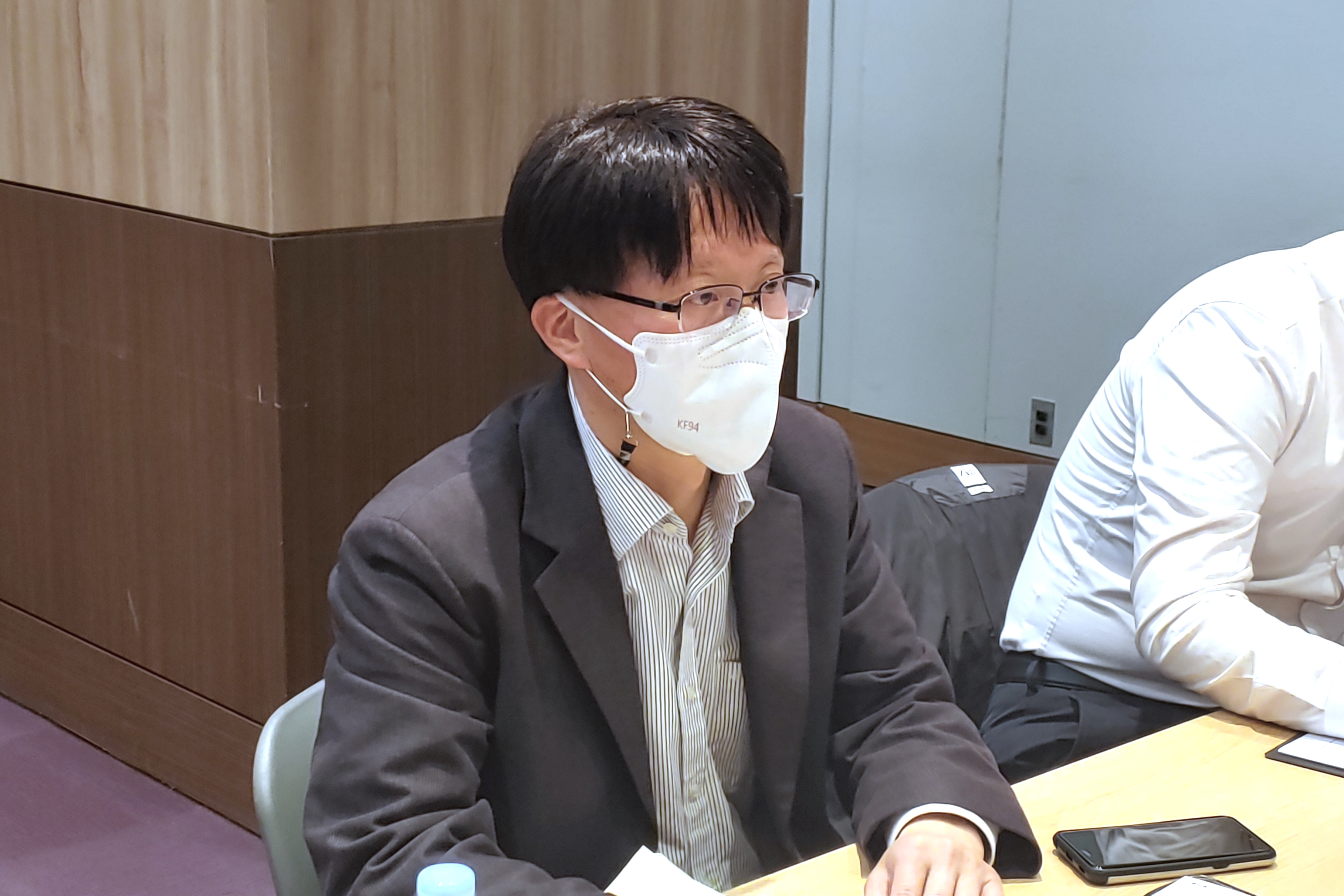
Dr. Lee Sang-bok (Director of the Functional Composite Materials Research Lab, Composite Materials Research Center, Korea Institute of Materials Science)
Millimeter wave response: absorption is more important than shielding
A combination of multiple functions such as heat dissipation, eco-friendliness, and light weight is essential.
Prospects for key technologies in future battlefields and communications industries
As 5G becomes more tangible beyond 4G (LTE), electromagnetic compatibility (EMC) corresponding to millimeter waves is emerging as an important future technology. In order to respond to the ultra-high frequency of tens of gigahertz in the 6G and aerospace era, and to solve the electromagnetic interference (EMI) problem caused by various integrated components of various sensors used in autonomous driving technology, millimeter wave response technology is absolutely necessary.
Accordingly, the Korea Institute of Materials Science has been researching and developing 'electromagnetic wave absorbing and shielding composite materials' corresponding to millimeter waves since 2019 under the leadership of Dr. Lee Sang-bok (chief researcher, Functional Composite Materials Laboratory, Composite Materials Research Division), and recently announced the successful development of the new material to the public in March. On the 14th, he attended the Advanced Materials Technology Briefing Session, introduced new materials, and held technology transfer consultations with interested companies.
The technological competition to get ahead in the development of EMI/EMC technologies that will be applied from the automobile industry, such as ECUs and autonomous driving radar sensors, to 6G, the next-generation communication beyond 5G, is heating up more than ever.
■Millimeter wave response, absorption is more important than shielding ▲Dr. Lee Sang-bok explains the ‘electromagnetic wave absorption and shielding composite material’ technology at the Korea Institute of Materials Science technology briefing session
As we enter the era of hyper-connectivity, including autonomous driving, 5G, and IoT, future industry trends are becoming increasingly important in terms of technology, including ultra-high frequency (millimeter wave), multi-band/broadband, and ultra-high density, along with environmental friendliness and human safety.
In the industrial trend of expanding the application of electromagnetic wave materials, the development of materials corresponding to millimeter waves was urgent. Dr. Lee Sang-bok pointed out the limitations of reflective shielding of conductive materials. The main reason was that existing electromagnetic wave shielding materials focused on shielding by using highly conductive materials, which caused electromagnetic interference problems.
He explained that “the electromagnetic shielding technology used in existing 3G and 4G uses conductive materials such as metal and artificial graphite, which causes reflection and secondary reflection of electromagnetic waves, and causes internal interference and malfunction problems,” and that electromagnetic wave absorption using magnetic materials is the key. In the 5G communication environment and industrial trends that require integration, existing shielding technology has limitations.
The new material from the research team at Lee Sang-bok, which uses magnetic materials, has electromagnetic wave absorption capabilities in the 26 GHz band, which can support 5G. Dr. Lee said, “It shows excellent absorption capabilities and low reflectivity at a thinner thickness than those using Japan’s TDK or existing commercial powders,” and “When we combined the conductive grid structure absorber and the magnetic metal fiber composite, the recent reflectivity was extremely reduced to 1-2%, and it showed an absorption capability that could absorb approximately 30-50 dB,” explaining the development results.
In addition, it was explained that in terms of the lightweight issue, it exhibits excellent absorption capacity and low reflectivity with a thinner thickness compared to existing materials. Dr. Lee stated, “Weight reduction technology has become an important issue in automobiles and communication terminals,” and “Compared to products from Laird in the U.S. and TDK in Japan, the new material developed by Materials Research Institute has reduced the thickness by half to 0.54 mm and has a comparative advantage in terms of function as it reflects less than 10% of electromagnetic waves.”
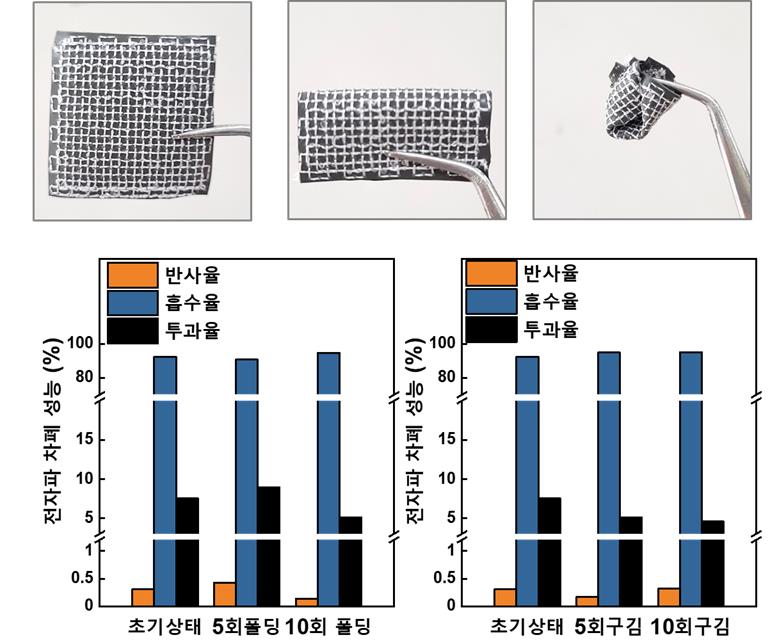
■ Beyond electromagnetic wave absorption, evolution into a multifunctional composite material ▲ Folding and crumpling experiment of 'electromagnetic wave absorption and shielding composite material' (Data - Korea Institute of Materials Science)
EMI materials must not only undergo a paradigm shift from electromagnetic shielding to absorption, but also must evolve from single-function to multi-function. The performance of composite materials is being demanded to be improved to include various functions, including electromagnetic wave absorption, heat dissipation, environmental friendliness/human body harmlessness, multi-band, and wide-band coverage.
The 'electromagnetic wave absorption and shielding composite material' of the Lee Sang-bok research team increased the electromagnetic wave absorption capacity by combining a copper grid with a composite film that mixes magnetic and heat-dissipating materials, and was designed so that the electromagnetic wave energy is converted into heat energy and then disappears. In addition, heat dissipation performance was improved by manufacturing the heat dissipation material in a 3D network structure.
Since the megatrend of wireless terminals is lightweight including foldable and flexible, the multifunctionality of materials must secure durability as well as lightweight. Accordingly, when a folding and crumpling test of composite materials was conducted more than 10 times, it was found that there was no significant difference in the performance degradation of absorption rate and reflectivity.
For future technological improvements, it appears that development of superior performance materials and multi-band response technology will be necessary. Dr. Lee stated, “In order to develop a thin electromagnetic wave absorbing material with excellent performance of low reflection and high absorption in the millimeter wave band, it is necessary to develop a material with excellent electromagnetic performance that has high dielectric constant and no magnetic loss.”
He also added, “Since various frequency bands will be utilized in the future electromagnetic environment (up to 28GHz), autonomous driving radar sensors (24GHz, 77GHz, 79GHz), UHD/HDTV wireless transmission (57-66GHz), and high-altitude satellite communications (up to 40GHz), multi-frequency control electromagnetic material technology that responds to electromagnetic waves of these various frequency bands will be required in the future.”
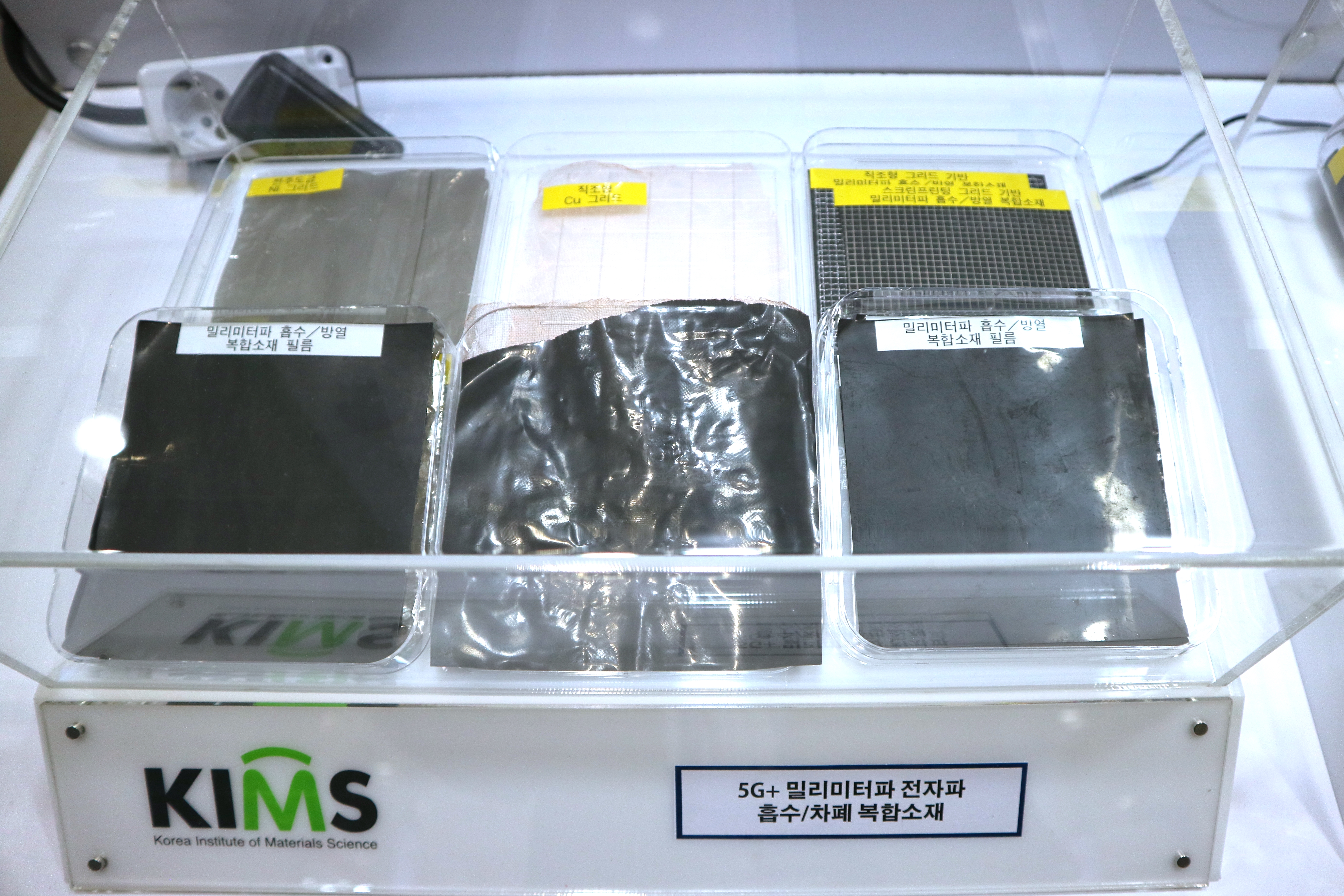
■ Electromagnetic wave absorption, expected to grow into next-generation market ▲'Electromagnetic wave absorption/shielding composite material' prototype
As the era of autonomous driving approaches, electromagnetic wave absorption and shielding are expected to become more important. Technology is needed to prevent interference and malfunction between multiple sensors installed inside autonomous vehicles, as well as to respond to radar interference between autonomous vehicles.
Due to the interference phenomenon of these vehicle radar sensors, ghost objects (fake objects) can be recognized as real objects. Regarding this, Dr. Lee Sang-bok said, “It is necessary to prevent the generation of ghost objects by absorbing electromagnetic waves.”
The 'electromagnetic wave absorption and shielding composite material' of the Materials Research Institute is expected to be commercialized for general use because it has various processing forms. Dr. Lee explained, "This material can be used in bulk products that require structural properties such as films, sheets, fabrics, and shield cans, and because the polymer resin can be used as is, it can be applied to various product forms."
Currently, it is known that companies in the fields of communication components, automotive electrical components, radar sensors, and smart TVs are interested in and contacting us for technology transfer of 'electromagnetic wave absorbing and shielding composite materials'.
Dr. Lee Sang-bok said, “The market for millimeter wave band electromagnetic wave shielding and absorption, which is applied to future autonomous driving radar components, future smart car electrical and communication components, 5G and 6G next-generation communications, and low-orbit satellite communication components, is expected to grow by more than 10% per year in terms of size, and market demand is also expected to increase accordingly.”
“Especially, electromagnetic waves of several tens of gigahertz in the millimeter wave band have the characteristics of strong straightness and large loss,” he said. “Because of this, the demand for absorbing materials is expected to grow more than for shielding materials.”