Physical AI HBM Smart Factory SDV AIoT Power Semicon 특수 가스 정정·반론보도 모음 e4ds plus

[모빌리티 그랑프리] Hyundai Motors and Kia Nano Technology Lead Future Innovation and Changes in Electrification and SDV

Google 우선 소스 기사입력2023.07.24 08:37


'Nano Tech Day' held… Material technology fundamental to realizing future mobility revealed
Nanotechnology announcements including self-healing, transparent solar cells, and oil capsule polymer coating

Hyundai Motor Company and Kia Motors presented coating technology based on nano materials that will lead future innovation and change, such as electrification and SDV, and next-generation solar cell technology.

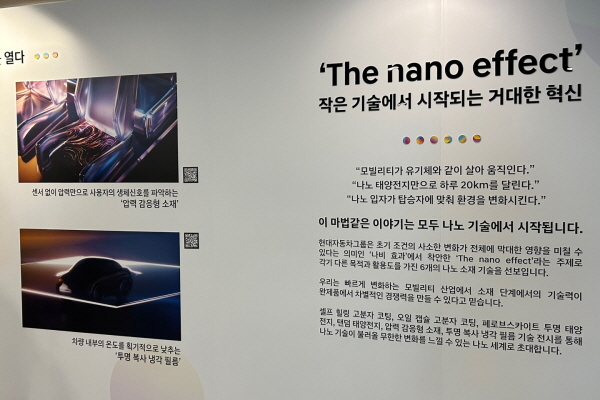
Hyundai Motor Company and Kia Motors held 'Nano Tech Day 2023' at Community House Masil in Seoul from the 20th to the 21st, and unveiled a number of new nano technologies that will form the basis for realizing future mobility.

Nanotechnology is the process of synthesizing substances and controlling their arrangement in units that are as small as one-hundred-thousandth the width of a human hair to create materials with new properties.

Hyundai Motor Company and Kia Motors exhibited the following: △‘Self-Healing Polymer Coating’ that heals damaged areas on its own, semi-permanently; △‘Oil Capsule Polymer Coating’ that dramatically reduces wear and tear on parts with nano capsules; △‘Transparent Solar Cells’ that can be applied to all windows that require transparency, such as those in automobiles and buildings; and △‘Transparent Radiation Cooling Film’ that dramatically reduces temperature rise inside vehicles.

■ Nano coating technology>

Autonomous driving and electrification are technologically advanced beyond comparison to the past, but even minor scratches or wear on core components can lead to fatal errors.

Small scratches on cameras and lidars can interfere with accurate judgment of the external environment, and electric vehicles that move with the ultra-high-speed rotation of large-capacity motors require wear resistance and durability of powertrain components.

Hyundai Motor Company and Kia Motors have introduced two polymer coating technologies that utilize nanomaterials to solve these problems.

It is a technology that heals wounds on its own, as if it were a living organism, and forms a lubricating film by bursting capsules in areas where friction occurs.

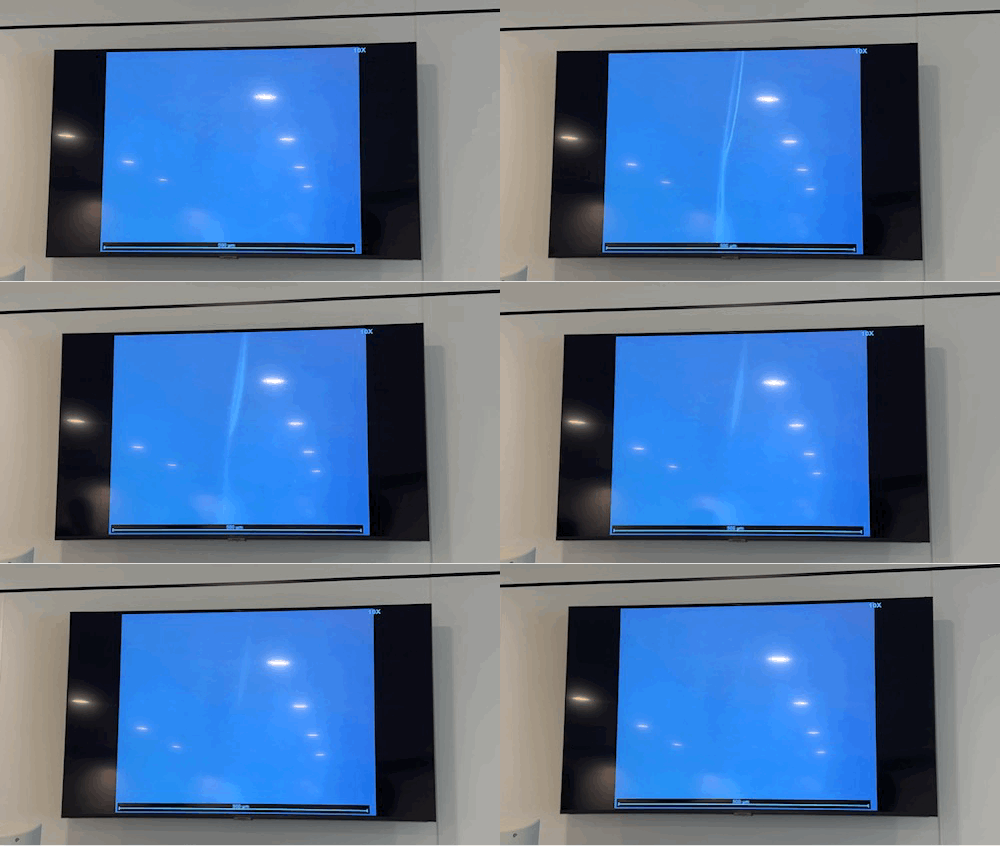
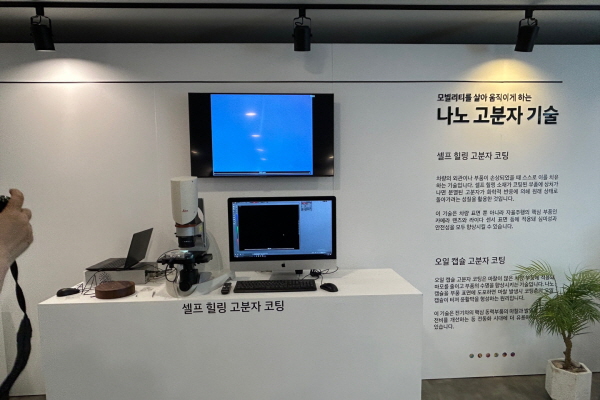
▲Video of self-healing polymer coating technology played at 10x speed

'Self-healing polymer coating' is a technology that heals damaged areas on its own when the vehicle's exterior or parts are damaged.

The self-healing technology developed by Hyundai Motor Company and Kia Motors has the advantage of enabling recovery in just two hours at room temperature without a separate heat source or recovery accelerator, and of enabling semi-permanent healing.
<br /> This technology utilizes the property of polymers that split when a part coated with a self-healing material is scratched, and which return to their original state of contact through a chemical reaction.

Although self-healing technology has been commercialized in the past, it was difficult to heal repeatedly once it was used because the recovery accelerator was embedded in the capsule or blood vessel inside the coating.

Hyundai Motor Company and Kia Motors expect to be able to provide differentiated customer value by utilizing self-healing technology in various areas through securing competitiveness that overcomes these limitations.

First of all, we are considering application to core autonomous driving components such as camera lenses and lidar sensor surfaces.

Because we believe it will be the most effective way to ensure customer safety. In the future, we plan to expand the scope of application to include vehicle paint surfaces and exterior grills.

In addition, we plan to continue research to maintain self-healing performance even in harsh external environments and to add functions such as water repellency and insulation.

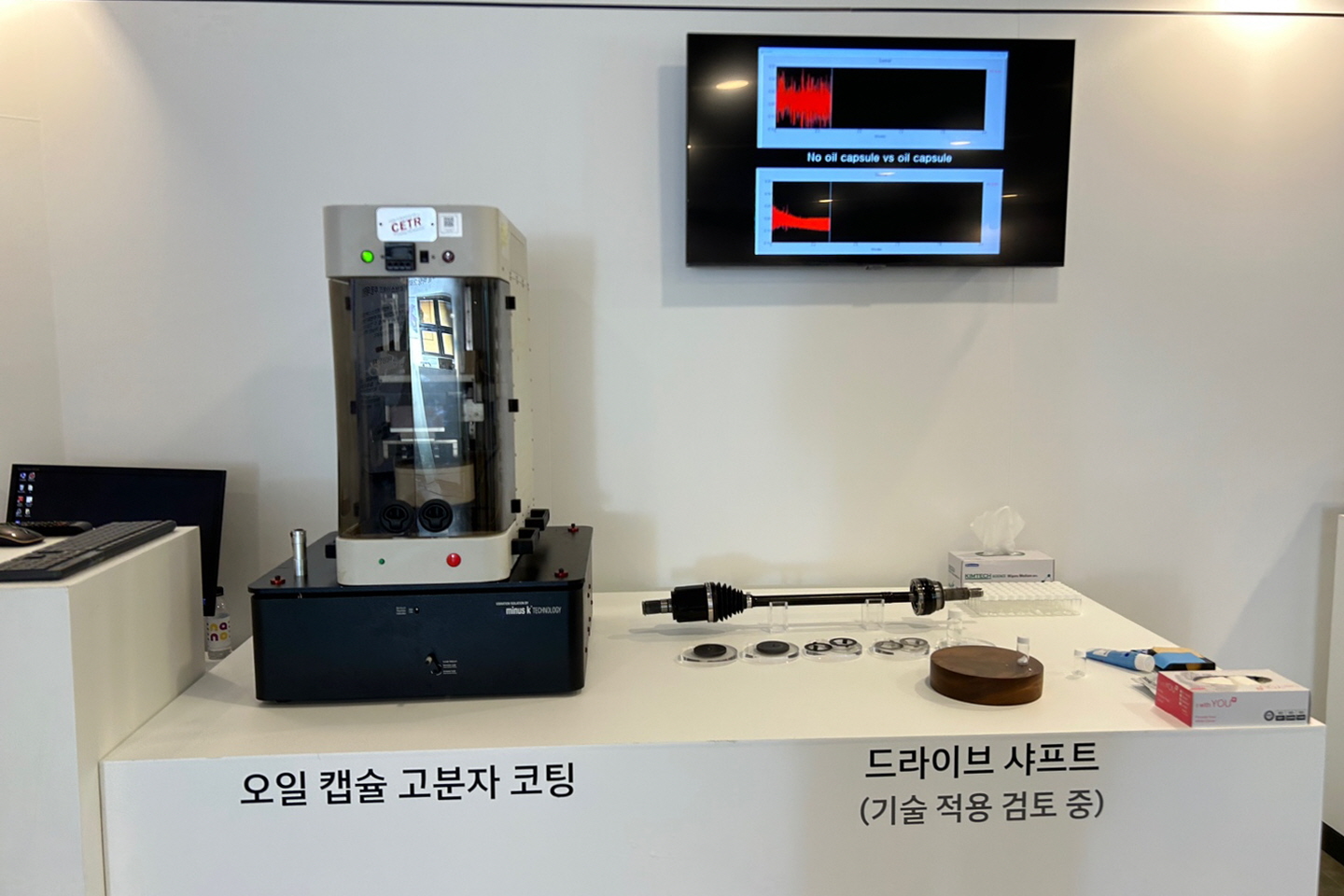
'Oil Capsule Polymer Coating' is a spin-off technology developed to expand possibilities during the research on nanocapsules, another method of self-healing.

When a polymer coating containing nano capsules is applied to the surface of a part, the oil capsules in the coating layer burst when friction occurs, and the lubricating oil inside flows out to form a lubricating film.

The oil capsule technology developed by Hyundai Motor Company and Kia Motors is characterized by overcoming the limitations of liquid and solid lubricants and possessing the advantages of both.

Since it contains a liquid lubricating component within the nanocapsule, it can achieve a high lubricating effect at a low cost and can be applied in a wide range like solid lubricants.

In addition, oil capsule coating has the advantage of performing a stable lubricating effect for a long time. Hyundai Motor Company and Kia Motors Corporation's own test results showed that the oil capsule coating applied to the parts performed its lubricating function without wearing out completely throughout the life of the parts.

The official who introduced the technology said that the results showed that there is no problem with the lifespan of electric vehicles, which is generally 8 to 10 years, or even longer.

This technology is expected to improve durability and efficiency by being applied to the core power transmission parts of vehicles that are subject to high heat generation and friction. In particular, it has the advantage of reducing the rotational loss of electric vehicle motors and reduction gears, thereby improving fuel efficiency and greatly increasing the lifespan of parts.

Hyundai Motor Company and Kia Motors are developing a product with the goal of mass production by applying this technology to the drive shaft that transmits the engine's driving force to the wheels.

In the future, we are also considering applying nano capsules containing fragrances to interior finishing materials so that you can feel a variety of scents every time you touch them.

■ Next-generation solar cell technology based on nano materials

In the electric vehicle market, extending driving range and reducing charging time are considered key competitive advantages.

Hyundai Motor Company and Kia Motors are researching high-efficiency energy generation technology based on solar cells to complete truly eco-friendly mobility. The nano-material-based solar cell unveiled that day can be used in a variety of applications, including in electric vehicles and buildings, and is considered a technology with great future growth potential.

Until now, most solar cells have been manufactured based on silicon materials, making them difficult to apply to areas that require transparency, such as building windows or vehicle glass.

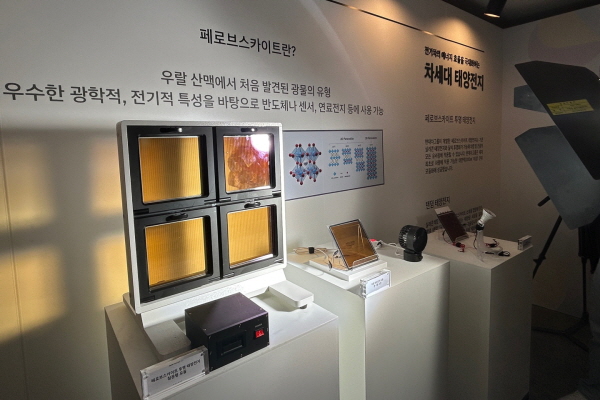
The 'transparent solar cell' unveiled by Hyundai Motor Company and Kia Motors today is a solar cell technology that uses perovskite material with excellent electrical and optical properties.

Perovskite is known to have a high photovoltaic efficiency in converting light into electricity, and when made into solar cells, the power generation efficiency is known to be 30% higher than that of silicon solar cells.

Accordingly, major global universities and energy companies are also jumping into the competition to develop solar cell technology using this material.

Hyundai Motor Company and Kia Motors are continuing their research to maximize perovskite’s other characteristic, transparency. As a result, they have achieved the feat of killing two birds with one stone: solar power generation and physical transparency by controlling the thickness of the light-absorbing layer.

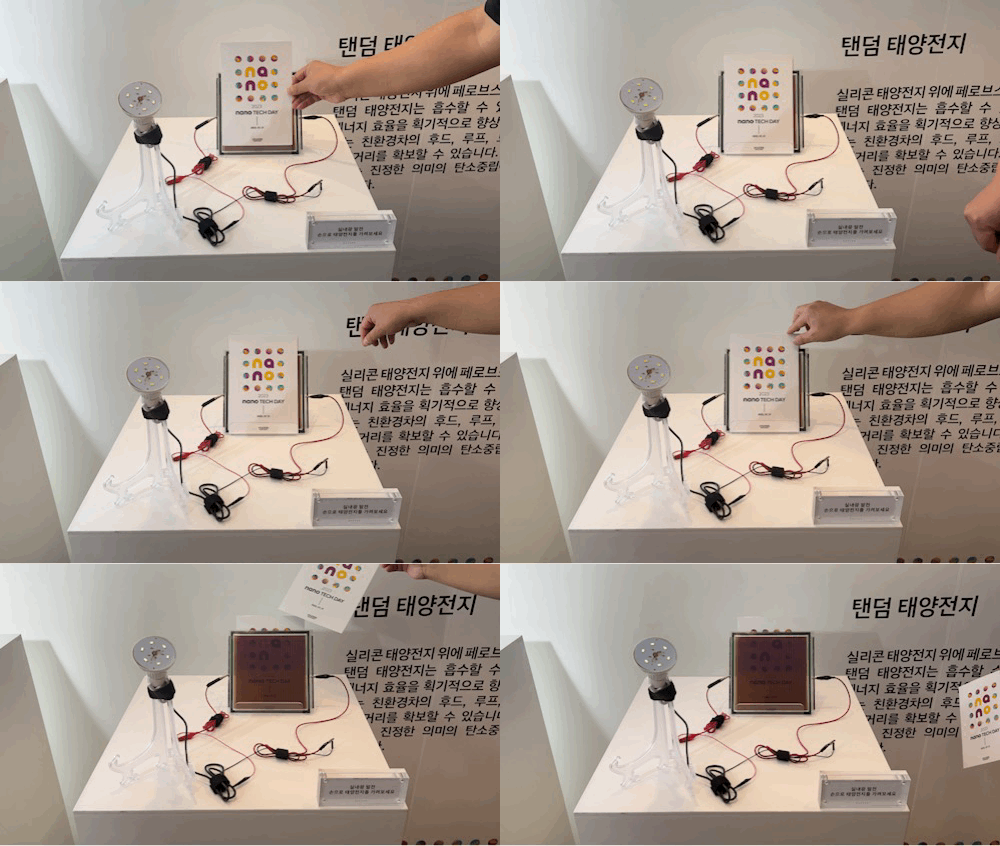
In particular, it is significant in that it developed a large-area (over 200㎠) transparent solar cell, breaking away from the existing small-area (1㎠) cell unit research. This is the world's first development of a transparent solar cell that exhibits 1.5 watt (W) performance even when scaled up to module size.

▲You can see the light bulb come on when the solar cell receives light.

While existing opaque silicon solar cells have been applied only to the roofs of electric vehicles, transparent solar cells are expected to be applied to all glass of the vehicle, maximizing the efficiency of electric vehicles with greater power generation.

If tandem solar cells are applied to electric commercial vehicles with a large area receiving sunlight, it is expected to have a greater effect in terms of power generation. Furthermore, if transparent solar cells that can be applied to the glass area are combined to utilize most of the vehicle body as a power generation system, it will be possible to get one step closer to true carbon-neutral mobility.

In addition, by replacing the windows of the building, it seems possible to reduce energy consumption while creating an architectural design that is not too out of place in terms of appearance. To this end, Hyundai Motor Company and Kia Motors are conducting various research together with Hyundai Engineering & Construction and others.

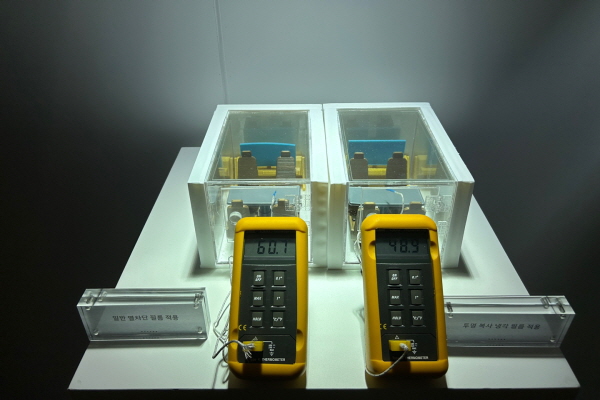
The 'transparent radiant cooling film' developed by Hyundai Motor Company and Kia Motors is an eco-friendly technology that is attached to the vehicle's window and lowers the temperature inside the vehicle without consuming additional energy even in hot weather.

▲You can see that the temperature is about 12 degrees lower when the transparent copy cooling film is applied.

In particular, Hyundai Motor Company and Kia Motors are the first in the world to successfully mass-produce a large-area product that can be applied to vehicle glass.

This material, made of a multilayer film structure, blocks heat such as ultraviolet rays, visible light, and near-infrared rays coming from the outside and radiates heat in the far-infrared range for effective radiant cooling.

While existing tinting films can only block external heat, transparent radiant cooling films have the added function of allowing heat to be released to the outside, creating a more comfortable environment inside the vehicle while also achieving a carbon reduction effect.

According to the results of Hyundai Motor Company and Kia Motors’ own tests on actual vehicles, vehicles with radiant cooling film attached showed an interior temperature lowering effect of up to 7℃ compared to vehicles with existing tinting film applied.

By significantly reducing air conditioning usage immediately after boarding a vehicle in the summer, vehicle driving cycle carbon emissions are expected to be reduced by approximately 0.3 to 0.8 percent.

The person who participated in the event said that in winter, They also said they will continue to research technologies to prevent the temperature from dropping too low.

As the glass area of future mobility, including electric vehicles and PBVs, increases, the utilization of this technology is expected to gradually increase.

In addition, it is expected to be applied in various fields such as buildings and solar cells where cooling is important in the summer, enabling efficient heat management and carbon reduction through this without additional energy use.