LOI on the development of next-generation solar cell modules using tandem solar cell cells
Hanwha Systems (CEO Sung-chul Eo) has begun full-scale development of next-generation space batteries through global cooperation.
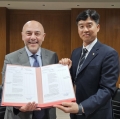
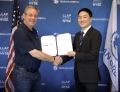
Hanwha Systems announced on the 22nd that its in-house venture Flexell Space signed a ‘letter of intent (LOI)’ with Airbus Defence and Space GmbH (hereinafter referred to as Airbus) to develop next-generation space solar cell modules using Tandem solar cells.
Through this agreement, Flexel Space and Airbus plan to design and develop space-grade solar modules that are more than half the weight of existing modules, while maintaining performance and efficiency.
Compared to the 20-30% efficiency of existing solar cells that convert solar heat into electrical energy, the solar cell to be jointly developed this time is expected to be a groundbreaking differentiated solar cell with low cost, high efficiency, fast production, and flexibility by applying Plexel Space's tandem solar cell.
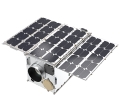
The tandem solar cell developed by Plexel Space combines CIGS and perovskite to provide light weight and high output at a lower cost than existing product lines, and is attracting attention as a driving force for the development of the satellite and spacecraft industries. It has a flexible bending property, so it can be rolled up and unfolded like a scroll, allowing customers to unfold the solar cell to the desired output and use it. It can also be applied to various satellite surfaces such as small areas and curved surfaces.
“We are very pleased to be working with Flexel Space to develop high-efficiency solar modules suitable for space environments,” said Michael Mittnacht, Solar Sales Manager at Airbus Defence and Space GmbH. “We will leverage the strengths of both companies to further innovate space solar technology.”
“We are very pleased to be working with Airbus, a leader in the satellite manufacturing market,” said Taehoon Ahn, Senior Researcher at Hanwha Systems and CEO of Flexel Space. “Through this collaboration, a satellite manufacturer will directly verify the actual performance of the first new material solar cell in space, and through this, we will establish an unrivaled position in the global space solar cell market.”
Meanwhile, with the advent of the New Space era led by the private sector, the satellite manufacturing market is growing, and not only satellites, but also the space exploration, high-altitude quasi-satellites (HAPS), also known as stratospheric drones, and space solar power markets are growing. In the diversely changing space market, Plexel Space’s solar cells are evaluated as a groundbreaking product that can replace expensive existing space solar cells.