반도체 AI 보안 인더스트리 4.0 SDV 스마트 IoT 컴퓨터 통신 특수 가스 소재 및 장비 유통 e4ds plus

Domestic production of cryogenic coolers for temperatures below -183℃

기사입력2024.10.21 15:42


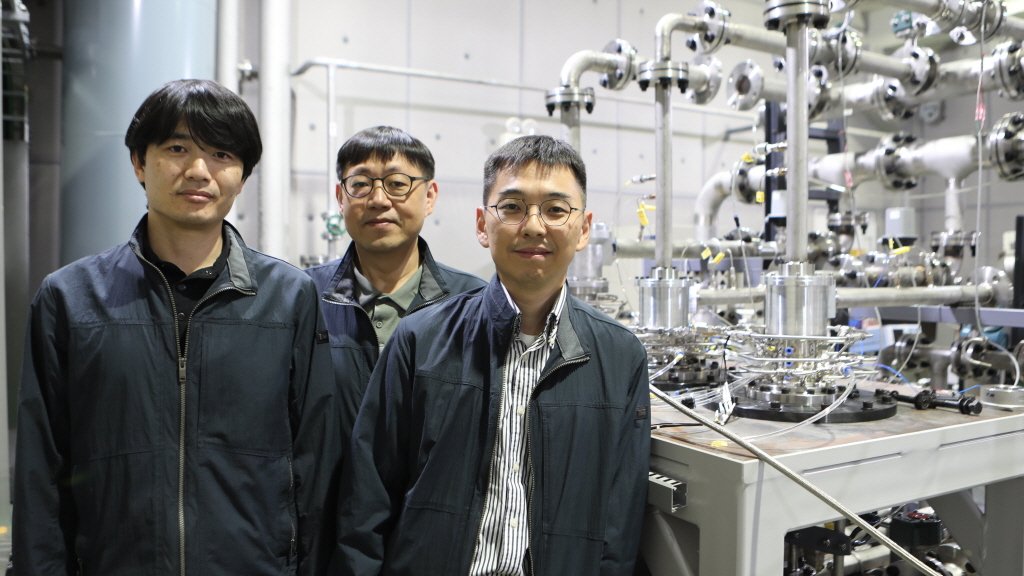
▲Research team led by Hyung-soo Lim, head researcher, Energy Storage Research Lab, Korea Institute of Machinery and Materials

Korea Mechanical Engineering & Construction Co. develops Korea's first ultra-low temperature turbo expander rated at -183℃ or lower
Improving the efficiency of alternative energy storage by storing cryogenic liquids such as hydrogen and natural gas

The first cryogenic turbo expander to operate at -183℃ or lower has been developed in Korea, and it is expected to significantly reduce dependence on overseas markets in the future cryogenic cooling system market and greatly improve the efficiency of alternative energy storage by efficiently storing alternative energy such as hydrogen and natural gas at cryogenic temperatures.

The research team led by Lim Hyeong-su, a senior researcher at the Energy Storage Laboratory of the Korea Institute of Machinery and Materials (President Ryu Seok-hyeon) under the Ministry of Science and ICT, recently announced that they have developed an oil-free cryogenic turbo-expander using a zero GWP refrigerant and completed a demonstration test of the expander for natural gas liquefaction.

A cryogenic turbo-expander is a device required for liquefying and storing alternative energy sources such as hydrogen, natural gas, and air by using the principle of lowering the temperature by expanding high-pressure gas with an impeller.

The Korea Institute of Machinery and Materials research team independently developed impellers, oil-free bearings, shafts, and casings to cool alternative energy to an extremely low temperature of -183℃ or below, and secured core technologies such as rotation stability, output control, and insulation design.

Using this, we succeeded in cooling neon, a zero GWP refrigerant, to below -183℃ under room temperature conditions.

Cryogenic turbo expanders rotate tens to hundreds of thousands of times per minute. Up until now, we have relied on overseas imports for the most part, but this development of technology by the Korea Institute of Machinery and Materials has created the possibility of domestic production.

For various alternative energy applications, an expander with a lower temperature than the existing -163℃ level was needed, and the research team achieved a temperature of -183℃.

In addition, while existing expanders required a separate oil supply device and had a complex structure because they were lubricated by supplying oil to the bearings, the expander developed by the Korea Institute of Machinery and Materials has a simple structure and small size because it uses a non-lubricated method, making it easy to apply even in small-scale industrial sites.

Using this technology, the research team developed an expander for hydrogen liquefaction, an expander for natural gas liquefaction, and an expander for air liquefaction, respectively. Of these, the expander for natural gas liquefaction can operate at temperatures up to -183℃ and has a capacity of 7 to 10 kW of refrigeration capacity, and is currently in the process of commercializing it with companies.

Lim Hyeong-su, a senior researcher at the Korea Institute of Machinery and Materials, said, “If alternative energy sources such as hydrogen are stored as liquids at extremely low temperatures, the energy density will increase significantly, which will allow us to dramatically reduce the size of storage facilities.” He added, “The development of core technologies for cryogenic turbo expanders will enable the domestic production of alternative energy storage systems to respond to climate change.”

This study was conducted with the support of the Basic Project of the Korea Institute of Machinery and Materials (Development of Core Machinery Technology for Large-Scale Liquid Air Energy Storage, Development of Turbo-Brayton Cryogenic Cooling System for Semiconductor Manufacturing Process) and the Ministry of Land, Infrastructure and Transport, Korea Transport Institute for Infrastructure and Transport Promotion (Development of Core Technology for Commercial-Grade Liquid Hydrogen Plant, Development of Technology for Energy Storage and Utilization System Based on Air Liquefaction).