

LightGuard: Edge AI Non-Contact Auxiliary Equipment Control System Based on RDK X5 and STM32
In work environments where it is difficult to directly touch control panels with contaminated hands or wet gloves, a non-contact control system where the RDK X5 recognizes light gestures from a flashlight or smartphone flash using Edge AI, and the STM32 safely controls auxiliary equipment.
주요 기능
콘테스트 프로젝트 진행 상황
각 Quest를 단계적으로 완성하는 프로젝트입니다.
Quest 1: 최종발표본
2026.08.28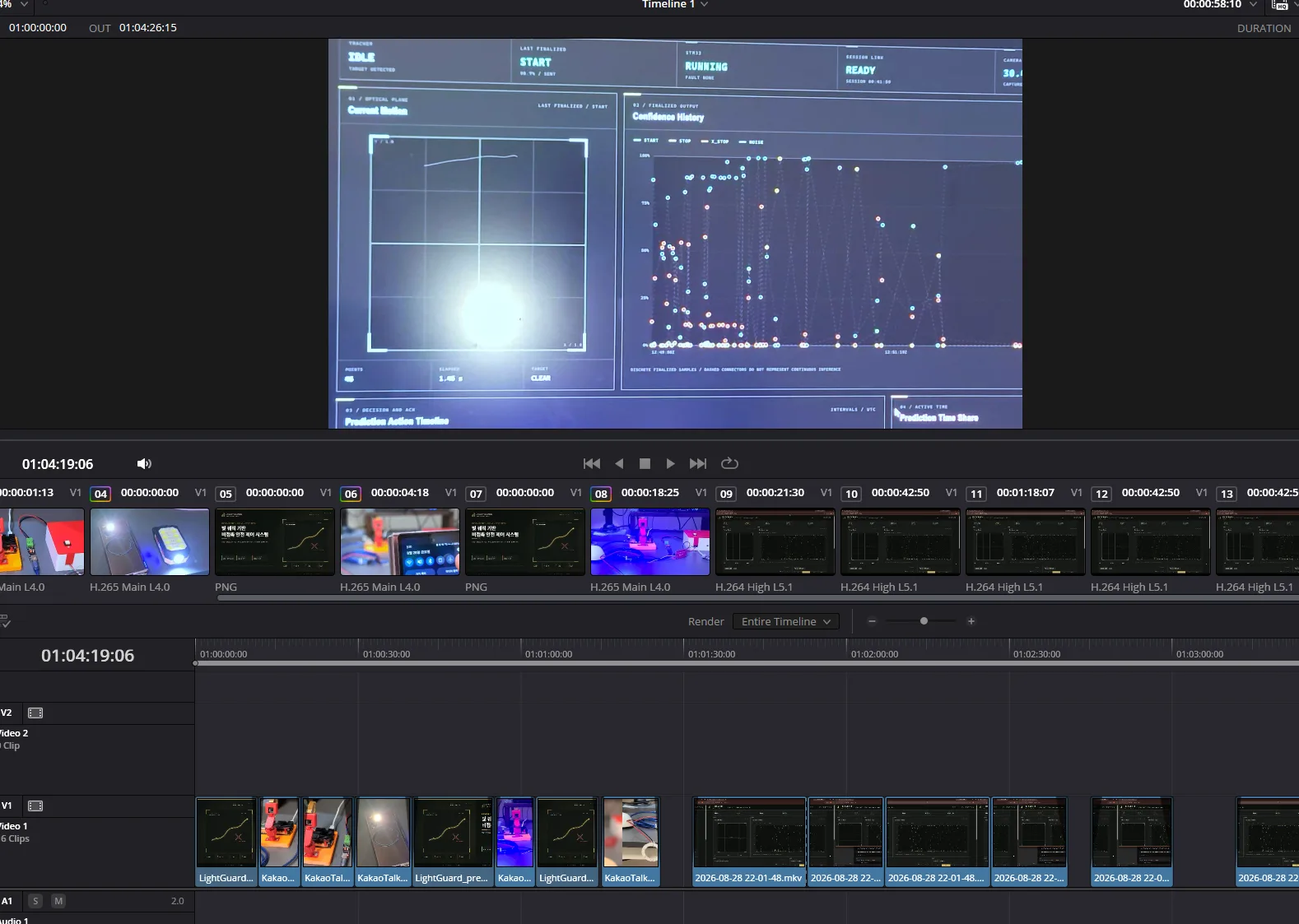
이미 만들어 둔 최종 보고서 기반으로 영상 제작을 완료하였습니다.
자막 추가 후 업로드 예정입니다.
최종 정리
최종 요약
■ Project Overview
LightGuard is a light trajectory-based safety control system developed to enable non-contact control of auxiliary equipment in situations where workers' hands or gloves are contaminated or both hands are in use, making it difficult to press physical buttons. Users can request equipment start, stop, and emergency stop operations using readily available light sources such as smartphone flashlights or handheld flashlights. There is no need to prepare a dedicated remote control or install a separate application, and the system can be used without connecting the smartphone and equipment via Bluetooth or wireless networks.
When a user moves light in front of the camera, the camera continuously identifies the position of the bright point, and the RDK X5 analyzes the direction of movement and the overall trajectory shape. Light moving from left to right is interpreted as start, light moving from right to left as stop, and X-shaped movement as an emergency stop request. Stationary light, reflected light, brief flickering, and incomplete movements are distinguished as non-commands and are not used for equipment control. The key aspect is that the system is designed not only to detect whether light is visible, but also to distinguish the intentional direction of movement and shape created by the user.
The RDK X5 is responsible for camera image processing, light trajectory generation, artificial intelligence discrimination, status screen display, and communication management. However, it does not directly actuate the relay based solely on artificial intelligence discrimination results. The discrimination result is transmitted to a separate STM32 controller via RS-485 communication, and the STM32 processes it as an operation request rather than a final command. The STM32 makes the relay output decision only after re-confirming the equipment's current state, communication connection status, distance sensor measurement state, and physical emergency stop input.
The completed prototype consists of a light source, IMX219 camera, RDK X5, NUCLEO-F446RE, distance sensor, RS-485 communication device, relay, and status indicator lights. On the status display screen, users can view the light trajectory input, artificial intelligence discrimination results, requests transmitted to the STM32, and controller responses. Through this, the entire process from user input through image processing, artificial intelligence discrimination, safety condition verification, and actual output control has been implemented as a single integrated system.
■ Key Achievements and Features
The first achievement is the implementation of a non-contact input method using universal light sources as an actual prototype. Conventional button or remote control methods may require workers to remove gloves or stop work, and operating with contaminated hands can spread contamination to equipment and the surrounding environment. LightGuard utilizes smartphone flashlights or handheld flashlights that users already possess as input tools, eliminating the need to manage separate input devices.
The second feature is an edge artificial intelligence structure where all image processing and artificial intelligence discrimination occur within the equipment. There is no need to transmit images to external servers or maintain internet connections, reducing the possibility of operation interruption due to network conditions. Instead of storing entire camera images for extended periods, the system extracts only movement information of bright points to construct trajectories, allowing the system to focus on the direction and shape information it actually needs. Through the RDK X5's status display, users can also verify what trajectory was input and how the system interpreted it.
The third feature is a structure that separates the roles of artificial intelligence and safety control. Artificial intelligence discriminates user intent, but an independent STM32 safety controller determines whether to actually output equipment. The STM32 comprehensively verifies whether communication is being maintained normally, whether obstacles have approached closely, whether physical emergency stop has been activated, and whether the equipment is currently in a startable state. When an abnormal state occurs, relay output is blocked, and even after communication is restored, the equipment does not automatically restart without new user start input. The emergency stop state is maintained until the user manually releases it on-site.
The fourth achievement is the integration of camera, artificial intelligence, communication, safety control, and output devices into a single functional pathway. The entire process has been verified—from actual light input being converted to a trajectory in the camera, passed through artificial intelligence discrimination, transmitted to the STM32, and resulting in equipment state changes. Camera initialization issues, RS-485 communication device defects, and actual user X trajectory discrimination problems that occurred during development were resolved by separating each function for inspection. When problems occurred, rather than unconditionally modifying the entire program, each component—camera, communication, model, and controller—was tested step by step to identify the cause, and only necessary improvements were made.
LightGuard is significant as an integrated control system combining user input, on-site processing, safety judgment, and output control, rather than a simple artificial intelligence demonstration. The camera and artificial intelligence board are responsible for interpreting user input, while the STM32 is responsible for the actual equipment's safety state, with roles clearly distinguished. Through this approach, a non-contact auxiliary input system has been completed that leverages both the convenience of artificial intelligence and the reliability of an independent safety controller.
■ Future Improvement Plans
In the future, plans include expanding actual usage data to ensure stable operation regardless of changes in users and work environments. Since trajectories can vary depending on user height and posture, light movement speed, shooting distance, type of light source, indoor lighting, and reflection conditions, input data will be collected in various environments and discrimination methods will be improved. Unintended inputs such as work lights, reflected light, and momentary light exposure will be repeatedly verified to reduce the possibility of incorrect commands in actual work environments.
Hardware improvements include converting the current prototype wiring to a dedicated circuit board and protective case structure. Camera and sensor positions will be fixed, wiring will be organized to prevent easy disconnection, and power protection circuits and isolated communication devices will be applied to enhance on-site operational reliability. Physical emergency stop and relay power cutoff means will be maintained independently from the artificial intelligence system, and repeated verification will be necessary to ensure output is safely shut down in situations such as power reapplication, communication disconnection, sensor errors, and program termination.
User convenience features will also be enhanced. Status display and indicator light configurations will be improved to allow easier identification of current status, input trajectories, control requests, and failure causes. Guidance functions can be added to help users understand the cause when incorrect trajectories are input. A function for managing the correspondence between input trajectories and control requests will also be reviewed to allow equipment-specific operation settings.
Finally, field pilot applications are planned for low-voltage auxiliary equipment such as laboratory ventilation systems, low-speed pumps, and work lighting. User feedback will be reflected to improve input methods and installation locations, and the system's application scope will be gradually expanded through long-term repeated operation verification and failure situation testing. When applying to actual industrial equipment, safety certification and risk assessment will be conducted separately, and LightGuard will be utilized as an auxiliary input means to enhance work convenience rather than as a device to replace existing physical safety systems.
프로젝트 갤러리
프로젝트 제작 과정과 최종 결과물을 담은 이미지 갤러리입니다.
프로젝트 소개
목표 및 제작 동기
In cleaning, soldering, painting, resin post-processing, dust work, laboratory work, and similar tasks, operators sometimes need to manipulate ventilation fans, pumps, lighting, motors, relay-based auxiliary equipment while wearing gloves or with contaminated hands. In such cases, directly touching physical buttons or remote controls can cause contamination spread, operational inconvenience, and workflow interruption.
This project proposes a control method for auxiliary equipment without direct contact by using light sources as an input means that are as easy to use as flashlights or smartphone flashlights. Additionally, rather than directly connecting AI recognition results to outputs, we aim to implement a structure closer to actual on-site control by handling safety conditions such as emergency stop, proximity sensors, and communication timeout together in the STM32 auxiliary controller.
[Expected Results]
The final deliverable is a non-contact auxiliary equipment control prototype consisting of RDK X5, camera, STM32 development board, relay module, status LED, proximity sensor, emergency stop button, and external output equipment.
Users input commands such as START, STOP, and X_STOP by moving a flashlight or smartphone flashlight, and the system controls output equipment through Edge AI gesture classification results and STM32 safety state machine. Output equipment will be selected based on feasibility and demonstration potential from local exhaust fans, pumps, motors, lighting, and relay loads at the final demonstration stage.
The submitted deliverable will include a 3-5 minute demo video, GitHub code, gesture data collection code, AI training and inference code, STM32 firmware, circuit diagram, system architecture, and measurement results for gesture classification accuracy and response time.
프로젝트 컨셉
RDK X5의 카메라 입력으로 손전등 또는 스마트폰 플래시의 밝은 점을 검출하고, 일정 시간 동안의 좌표 궤적을 수집합니다. 수집된 좌표 데이터는 Edge AI 제스처 분류 모델의 입력으로 사용되며, 모델은 START, STOP, X_STOP, NOISE 등의 명령 클래스를 추론합니다.
분류된 명령은 UART 또는 USB Serial 통신을 통해 STM32 보조 제어기로 전달됩니다. STM32는 릴레이 출력, 상태 LED 또는 링 LED 표시, 근접센서 입력, 비상정지 버튼 입력, 통신 타임아웃 처리 등 현장 I/O 제어를 담당합니다.
AI 추론 신뢰도가 낮거나 NOISE로 분류된 경우에는 명령을 무시하고, X_STOP 제스처나 근접 위험 상태가 감지되면 출력 장비를 정지합니다. 이를 통해 RDK X5의 Edge AI 판단부와 STM32의 실시간 제어부를 분리한 구조로 구현합니다.
[하드웨어]
RDK X5, USB 카메라 또는 MIPI 카메라, STM32 개발보드, 릴레이 모듈, 상태 LED 또는 링 LED, ToF 근접센서, 비상정지 버튼, 스마트폰 플래시 또는 손전등, 최종 시연용 출력 장비
개발 일정
| 차수 | 기간 | 계획 내용 |
|---|---|---|
| 1차 | 2026-07-24 ~ 2026-07-27 | 1차 펌웨어 제작 |
| 2차 | 2026-07-27 ~ 2026-07-30 | 485 통신 및 대시보드 제작 |
| 3차 | 2026-07-30 ~ 2026-07-31 | NUCLEO-F446RE 통신 검증, ToF4M 안전 인터록 |
| 4차 | 2026-07-30 ~ 2026-08-11 | 펌웨어 및 프로그래밍, 하드웨어 배선 및 모델링 |
| 5차 | 2026-08-11 ~ 2026-08-12 | 기구 제작 |
| 6차 | 2026-08-12 ~ 2026-08-24 | 학습 및 디버깅, 마무리 |
| 7차 | 2026-08-25 ~ 2026-08-31 | 모델·데이터·검증 결과 문서화 |
주요 기능
- 빛 궤적 기반 비접촉 명령 인식 — 스마트폰 플래시나 손전등의 이동 궤적을 카메라로 추적하여 시작, 정지, 긴급 정지 명령으로 분류
- RDK X5 엣지 AI 실시간 추론 — 수집한 빛 궤적을 RDK X5의 BPU에서 분석하여 외부 서버 없이 현장에서 명령을 실시간 판별
- STM32 기반 독립 안전 제어 — AI 판별 결과를 제어 요청으로만 수신하고, NUCLEO-F446RE가 통신 상태와 안전 조건을 독립적으로 확인한 후 릴레이를 제어
- 다중 안전 인터록 및 비상 정지 — 거리 센서, 물리 비상 정지, 통신 단절 및 X_STOP 상태를 감지하면 출력을 즉시 차단하고 안전 상태를 유지
댓글 0개
아직 댓글이 없습니다. 첫 댓글을 남겨보세요!