

Fire detection and rescue robot
An autonomous robot that uses multi-sensor perception and vision-based flame detection to explore complex environments and perform firefighting tasks.
주요 기능
콘테스트 프로젝트 진행 상황
각 Quest를 단계적으로 완성하는 프로젝트입니다.
Quest 1: Project Planning and Disaster Scenario Design
2026.08.13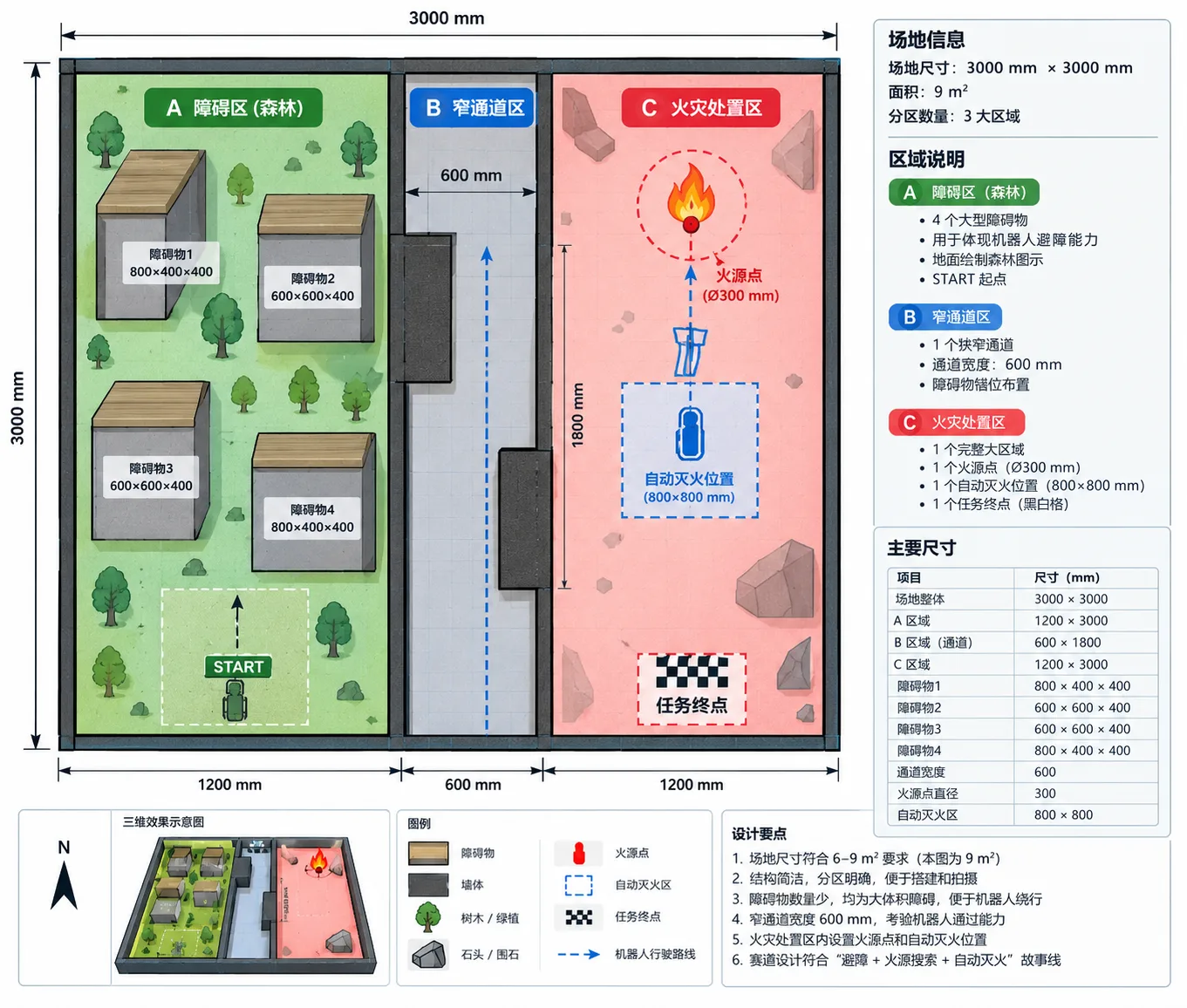
The project began by defining a practical problem: how a compact mobile robot can enter a hazardous environment, detect a potential fire source, and perform an initial firefighting operation without requiring a person to directly enter the dangerous area.
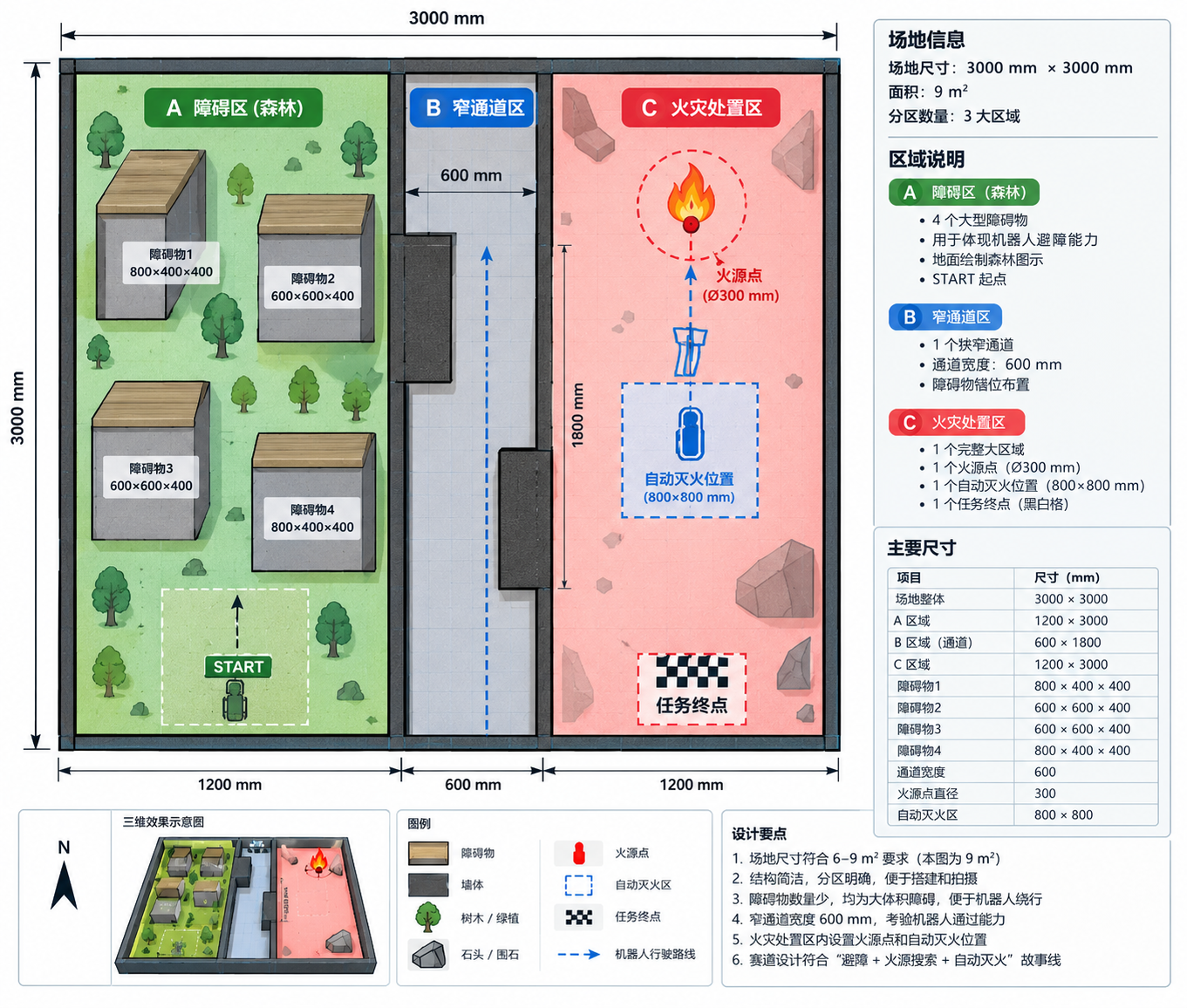
Based on this objective, we designed a self-defined disaster exploration environment for the robot. The environment was divided into three major sections: an obstacle zone, a narrow passage, and a fire-response zone.
The obstacle zone was designed to test the robot's ability to perceive and avoid physical obstacles. The narrow passage was introduced to test whether the robot could maintain stable movement under spatial constraints. The fire-response zone was designed as the final task area, where the robot detects a flame source and performs the firefighting operation.
The robot and the physical environment were designed together rather than treating the robot as an independent device. This allowed us to establish a complete task flow from environmental exploration to fire detection and firefighting, providing the basis for subsequent hardware integration and software development.
Quest 2: Hardware Integration and Basic Motion Control
2026.08.20After defining the exploration scenario, we started building the physical robot platform and integrating the main hardware components.
The robot uses an STM32F103C8T6 microcontroller as the main control unit. The motor driver and dual DC motors were integrated first to establish basic movement functions, including forward movement, backward movement, turning, and stopping.
We then integrated the ultrasonic sensor, infrared sensors, flame sensor, servo motor, water pump, OLED display, and wireless communication module. Each module was tested individually before being integrated into the main control system.
At this stage, the main focus was to establish a stable hardware and software foundation for subsequent autonomous functions. We also adjusted the motor control parameters and communication commands according to the actual movement behavior of the physical robot.
Quest 3: Obstacle Avoidance and Line Following Development
2026.08.27After completing the basic hardware integration and manual movement control, we developed the robot's autonomous movement functions.
An ultrasonic sensor was integrated to detect obstacles in front of the robot. When an obstacle is detected within a predefined distance, the control system adjusts the robot's movement to reduce the risk of collision.
At the same time, infrared sensors were integrated for line following. The sensors detect the predefined path on the ground and provide feedback to the motion control system, allowing the robot to maintain its position along the designed route.
During physical testing, we adjusted the motor control parameters, sensor response thresholds, movement timing, and turning behavior according to the actual performance of the robot. The obstacle avoidance and line-following functions were then combined to support continuous movement through the designed exploration environment.
Quest 4: Fire Detection and Automatic Extinguishing Development
2026.09.03After completing the basic autonomous movement functions, we focused on developing the robot's core firefighting capability.
A flame sensor was integrated into the robot to detect potential fire sources. To improve the detection process, the sensor was mounted on a servo mechanism so that it could scan different directions when searching for a flame.
Once a flame is detected, the robot can stop its movement and use the servo mechanism to adjust the sensing direction toward the detected fire source. The control system then activates the water pump to perform water spraying.
During development, we repeatedly tested the flame sensor, servo movement, and water pump under different physical conditions. The servo angle, detection response, and pump control were adjusted based on the actual behavior of the robot.
The completed subsystem established the basic process of fire detection, directional searching, and automatic water spraying, which became the core firefighting function of the final robot.
Quest 5: Vision Recognition and Voice Interaction Integration
2026.09.23After completing the basic movement and firefighting functions, we further expanded the robot's perception and interaction capabilities.
A camera was integrated as an additional visual sensing method for flame recognition. Compared with relying only on the flame sensor, the camera provides visual information that can be used to identify potential flame sources and improve the robot's overall perception capability.
We also developed a voice control interface on the computer side. Speech recognition is used to convert Chinese voice commands into control commands that are transmitted to the robot through wireless serial communication. The system supports commands such as moving forward, moving backward, turning, stopping, obstacle avoidance, and switching to firefighting-related operating modes.
During integration, we tested the communication between the voice-control interface and the embedded controller, and adjusted the command mapping and response behavior to ensure that voice commands could be correctly transmitted to the robot.
The addition of visual flame recognition and voice interaction expanded the system from a basic autonomous mobile platform into a more flexible robot that combines environmental perception, autonomous operation, and human-robot interaction.
Quest 6: System Integration and Final Scenario Testing
2026.10.01In the final development stage, we integrated the robot's movement, environmental sensing, fire detection, visual recognition, firefighting, and human-robot interaction functions into one complete system.
The integrated system was tested in the self-defined disaster exploration environment. The final task flow was designed as:
START → obstacle zone → narrow passage → fire-response zone → flame detection → fire searching → automatic water spraying → task completion.
During the final testing stage, we focused on the coordination and stability of the different subsystems. We checked the robot's movement through the obstacle area and narrow passage, the response of the flame detection system, the servo scanning behavior, the activation of the water pump, and the communication between the computer-side control interface and the robot.
Several rounds of integrated testing and adjustment were performed based on the actual physical behavior of the robot. The final prototype was able to demonstrate the complete process from environmental exploration and fire detection to firefighting in a real physical test environment.
The completed system demonstrates the practical integration of embedded control, multi-sensor perception, visual recognition, autonomous movement, human-robot interaction, and physical firefighting in a compact mobile robot.
최종 정리
최종 요약
■ 완성 소개
Final Result Introduction
We developed an autonomous firefighting robot for exploring and responding to potential fire hazards in complex physical environments.
The final prototype integrates an STM32F103C8T6 embedded control system with ultrasonic sensing, infrared sensing, flame detection, camera-based flame recognition, servo control, a water pump, OLED status display, and wireless communication.
The robot was tested in a self-defined disaster exploration environment consisting of an obstacle zone, a narrow passage, and a fire-response zone. The complete demonstration workflow is designed as:
START → obstacle zone → narrow passage → fire-response zone → flame detection → fire searching → automatic water spraying → task completion.
Through the integration of environmental sensing, movement control, fire detection, visual recognition, human-robot interaction, and physical firefighting, the project demonstrates how a compact mobile robot can perform initial fire-response tasks in an environment where direct human access may be difficult or unsafe.
■ 주요 성과 및 특징
Key Achievements and Features
1. Integrated Physical Prototype
A complete physical firefighting robot was developed by integrating embedded control, motor drive, environmental sensors, actuators, wireless communication, and firefighting hardware into a compact mobile platform.
2. Autonomous Environmental Response
The robot combines ultrasonic obstacle avoidance and infrared line following to support autonomous movement through the self-defined exploration environment.
3. Fire Detection and Firefighting
The robot integrates a flame sensor, servo-controlled directional searching, and a water pump to perform the basic process of detecting a potential fire source, searching for its direction, and spraying water.
4. Vision-Based Flame Recognition
A camera was added as an additional visual sensing method for recognizing potential flame sources, providing information beyond the dedicated flame sensor.
5. Human-Robot Interaction
A computer-side voice control interface was developed to transmit voice commands to the robot through wireless serial communication. This provides an additional method for monitoring and controlling the robot when human intervention is required.
6. Physical Scenario Validation
The complete system was tested in a self-defined physical environment containing obstacles, a narrow passage, and a fire-response area. The final demonstration focuses on verifying the coordination between environmental perception, movement, fire detection, and firefighting.
■ 향후 개선 계획
Future Improvement Plans
The current prototype demonstrates the basic integration of autonomous movement, environmental sensing, fire detection, visual recognition, and firefighting. Future development will focus on improving the robot's autonomy, robustness, and adaptability.
First, the perception system can be further improved by combining multiple sensing sources and developing more reliable visual fire recognition under different lighting and environmental conditions.
Second, the navigation system can be extended beyond predefined paths toward more flexible autonomous navigation. Additional distance sensors and localization methods could be introduced to improve the robot's ability to operate in unknown environments.
Third, the firefighting mechanism can be improved through more accurate fire-source localization and more precise control of the spraying direction and duration.
Finally, the system could be further developed for practical scenarios such as warehouses, industrial facilities, underground spaces, and other hazardous environments where preliminary fire detection and remote intervention may be valuable.
The long-term goal is to develop a more robust disaster-response robotic platform that can perceive complex environments, make appropriate decisions, and perform physical tasks with reduced human exposure to hazardous conditions.
프로젝트 갤러리
프로젝트 제작 과정과 최종 결과물을 담은 이미지 갤러리입니다.
프로젝트 소개
목표 및 제작 동기
The goal of this project is to develop an autonomous firefighting robot capable of exploring hazardous environments, detecting potential fire sources, and performing basic firefighting tasks without requiring people to enter the dangerous area directly.
The robot is designed for a self-defined disaster exploration environment containing obstacles, a narrow passage, and a fire-response zone. It integrates an STM32-based embedded control system with ultrasonic sensing, infrared sensing, flame detection, camera-based flame recognition, servo control, and a water pump. Through the integration of these components, the robot can perform autonomous movement, obstacle avoidance, line following, flame detection, flame searching, and automatic water spraying.
A key objective of the project is to demonstrate how a compact mobile robot can combine environmental perception, motion control, visual recognition, and physical firefighting into one practical system. The project also explores voice-based human-robot interaction as an additional control method.
Ultimately, the project aims to provide a practical prototype for preliminary fire detection and firefighting in hazardous environments, while establishing a foundation for future improvements in autonomous navigation, perception, decision-making, and disaster-response capabilities.
프로젝트 컨셉
Core Concept
The core idea of this project is to build a compact autonomous firefighting robot that can enter hazardous environments, explore predefined physical obstacles, detect fire sources, and perform initial firefighting operations. Instead of focusing only on remote-controlled movement, we integrate environmental perception, autonomous motion, flame detection, visual recognition, and physical firefighting into a single mobile platform.
The robot operates in a self-defined disaster exploration environment within the contest's 4 m × 3 m space. Our scenario consists of an obstacle zone, a narrow passage, and a fire-response zone. This environment is designed to simulate the basic challenges a robot may encounter when entering a hazardous area, where direct human access can be difficult or unsafe.
Technical Differentiation
The main difference of our project is the integration of multiple sensing and interaction methods into a practical and compact robotic system. The robot combines ultrasonic sensing and infrared sensing for environmental perception and movement control, flame sensors for fire detection, a camera for vision-based flame recognition, and a servo mechanism for flame searching and directional adjustment. Once a fire source is detected, the robot can stop, search for the flame direction, and activate a water pump for firefighting.
In addition to autonomous functions, the system also supports voice-based human-robot interaction and wireless control. This allows the operator to switch between autonomous operation and human intervention when necessary. The combination of autonomous perception, physical action, and human interaction makes the system more flexible than a conventional remote-controlled firefighting vehicle.
Development Approach
The project follows a practical "sense–decide–act" approach. Sensors and the camera first provide information about the surrounding environment and potential fire sources. The embedded control system then processes these inputs and selects the corresponding movement or firefighting action. Finally, motors, the servo mechanism, and the water pump physically execute the selected action.
Through iterative testing, we continuously adjusted the robot's movement, obstacle avoidance, flame detection, servo scanning, and firefighting mechanisms. Rather than building a purely conceptual system, our goal is to demonstrate a complete physical prototype that can perform a meaningful disaster exploration and firefighting task in a real environment.
주요 기능
- Autonomous Obstacle Avoidance — The robot uses ultrasonic sensing to detect obstacles in front of it and automatically adjusts its movement to avoid collisions. This enables the robot to move through a physically constrained disaster environment without requiring continuous manual steering.
- Line Following and Autonomous Navigation — Infrared sensors are used to detect the predefined path and support automatic line following. Combined with obstacle avoidance, the robot can continuously move through the exploration environment and pass different sections of the designed scenario.
- Flame Detection and Direction Searching — The robot combines flame sensing with a servo-controlled scanning mechanism to detect a potential fire source and search for its direction. When a flame is detected, the robot can stop and adjust the sensor direction to locate the fire source before starting the firefighting operation.
- Automatic Fire Extinguishing — After detecting a fire source, the robot activates the water pump and performs automatic water spraying. The servo mechanism helps adjust the spraying direction, allowing the robot to complete the basic fire detection and extinguishing process without direct human access to the hazardous area.The water pump fires precisely at the locked flame and keeps spraying until it is extinguished; the rover then patrols to confirm there is no re-ignition before continuing its mission.
- Vision-Based Flame Recognition and Voice Control — A camera is used to provide vision-based flame recognition as an additional fire detection method. The robot also supports voice-based commands, allowing the operator to start, stop, or switch between different operating modes when human intervention is required.
댓글 0개
아직 댓글이 없습니다. 첫 댓글을 남겨보세요!