Techday
Physical AI HBM Smart Factory SDV AIoT Power Semicon 특수 가스 정정·반론보도 모음 e4ds plus

IoT Promotes Convergence Between Technologies, Considerations When Applying It to Industrial Sites

Google 우선 소스 기사입력2020.02.25 16:51

'The number of connected things is expected to reach 25 billion by 2021'
Edge, Processor, DX, IoT Concept Technology Convergence
Introducing rapid prototyping is essential for IIoT suppliers


The terms 4th Industrial Revolution and ICT Convergence are commonly used by the government and companies to emphasize innovation. There are other words that follow along with them. They are 5G, AI, and IoT. This combination, which is like a set menu, is a technology that cannot be left out for modern humans.

5G can be easily defined as the fifth generation of mobile communications, and AI can be easily defined as artificial intelligence. On the other hand, IoT requires a more detailed analysis. IoT is an abbreviation for Internet of Things, meaning the Internet of Things. The Internet of Things is not a concept that is immediately apparent.
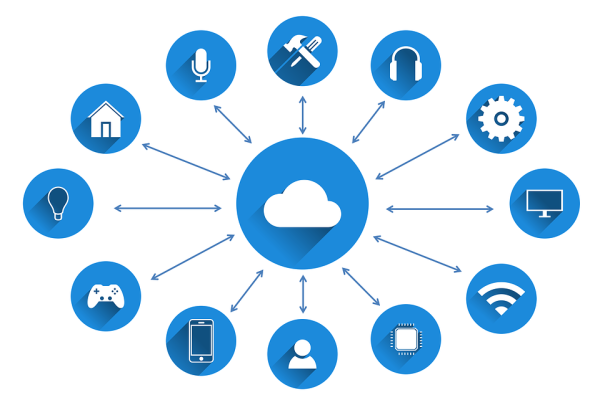
The Internet of Things connects various objects through wireless communication.
It is a concept of mutual communication.

To put it simply, the Internet of Things is a technology that connects various objects to the Internet by embedding sensors and communication functions in them. In other words, it is a concept that connects various objects and enables them to communicate with each other through wireless communication. Here, things refer to various embedded systems such as home appliances, mobile devices, and wearables.

With the recent advancement of AI technology, IoT is evolving from control and monitoring to an intelligent Internet of Things based on cognitive technology that learns, infers, and judges.

According to Lee Doo-won, CEO of Anist, intelligent IoT uses AI and machine learning to go beyond the execution of rigid programming models and showcase advanced functions through AI, enabling natural interactions between people and their surroundings.


The Evolution of IoT, Edge, Microprocessors, and DX
Intelligent IoT does not have much functional difference from existing IoT. This is because the communication technology that connects things and the platform technology that manages things and connects them with services are similar. The reason why the question of whether IoT is a technology or not arises is probably because no new technological evolution is visible.

However, IoT is also evolving technologically. No, it cannot help but evolve. As the use of IoT spreads, that is, the speed at which things are connected to the Internet increases, the number of things increases exponentially, and as a result, data increases explosively.

According to Gartner, the number of connected things installed worldwide is expected to reach 25 billion by 2021. IDC predicts that the annual data generation will continue to grow at a rate of 30% annually from 16 zettabytes (ZB) in 2016 to 163 zettabytes (ZB) in 2025. One zettabyte is 1 billion terabytes. In particular, it is predicted that the data generated by things will account for 80% of the total.
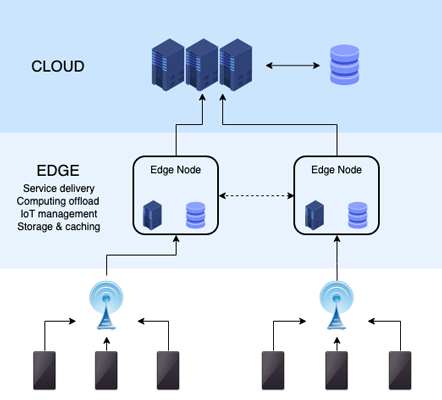
▲Edge computing architecture (Image = Wikipedia)

The explosion of things and data is providing many opportunities, but also increasing digital complexity. This is exposing the burden of cloud-centric central processing and the limitations of real-time response. As an alternative, the importance of the edge is increasing.

There is also progress in embedded microprocessors in objects. Chipmakers like Intel and Arm are focusing on developing smaller, more efficient microprocessors to power the exponentially increasing number of objects.

Microprocessors are being optimized and advanced for various demand sources. In addition to MCUs, which are the mainstream embedded processors, intelligent SoC technology that combines GPUs optimized for calculations and NPUs optimized for learning is making significant progress.

In addition, the explosion of data has brought about interest in data. The advancement of data analysis technology has greatly expanded the scope of what data can do. Digital transformation (DX), which replicates the real world in a digital space to create various economic and social effects, has become an essential virtue for companies.

The shift from the cloud to the edge and the advancement of microprocessors indicate that we are entering an era where things in the field that were previously limited to simple sensing and actuation will become more intelligent, make more informed decisions, and respond autonomously. Additionally, the rise of DX, coupled with the edge paradigm, highlights the need for prediction and control technologies based on synchronization between the real and virtual worlds.

Following this trend, IoT should now be viewed as a fusion between technologies rather than a fusion between industries.


To utilize IoT in industry
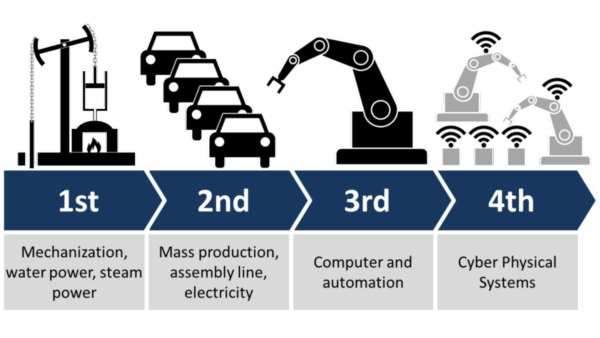
IoT can be viewed as personal, public, and industrial depending on where it is applied. Personal IoT is used to build smart homes, public IoT is used to build smart cities, and industrial IoT is used to build smart factories. In particular, the Industrial Internet of Things (IIoT) is also called Industry 4.0.
Industry 4.0 is Germany’s 4th industrial revolution policy.
It's the same concept as IIoT.

IIoT pursues predictive maintenance, demand forecasting, inventory optimization, increased productivity, employee training, and utilization of collaborative robots based on sub-components such as ▲cloud ▲sensors and connected devices ▲AR ▲AI ▲big data ▲digital twin ▲cybersecurity ▲additive manufacturing and digital scanning.

So what efforts are needed to properly implement IIoT? Jacob Lunn Lassen, senior marketing manager for IoT and functional safety at Microchip, said that the biggest challenge of IIoT is finding the optimal application and next-generation innovation.

According to him, IIoT is perceived as an abstract concept that is difficult for many companies to innovate. The industry describes it as, 'You can create connected sensors that measure all kinds of data within a facility.'

This narrative around IIoT hinders the development of innovative and groundbreaking solutions that can take customers’ productivity, quality and competitiveness to unprecedented levels. So how can we better understand and evolve our customers’ IoT needs?

Larsen advises that you should continually ask yourself, “Where is the most problematic part of your production line?” For example, if belt slippage, which causes unstable movement of the equipment, is the problem, an IIoT vendor might offer a specific sensor that identifies when slippage occurs.

This allows the customer to always run the belt at the desired speed and to respond immediately in case of problems. Planned maintenance and real-time management are always less expensive than unplanned production line interruptions.


Examples of Accelerating IIoT Deployments
Rapid innovation requires rapid prototyping. Microchip is helping address key issues that limit prototyping and innovation in IIoT environments with its AVR-IoT and PIC-IoT WG development boards.
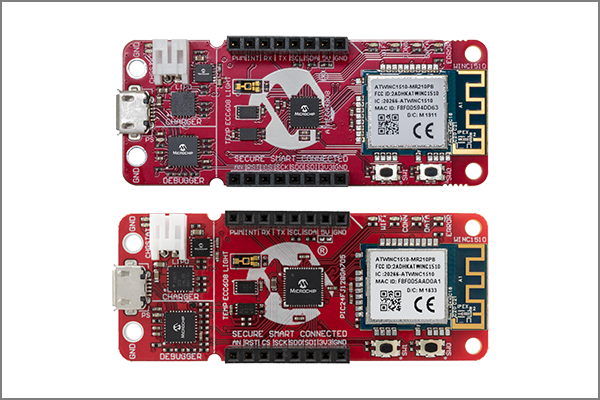
AVR-IoT (top) and PIC-IoT (bottom) development boards (Photo = Microchip)

With Wi-Fi connectivity, security, and cloud connectivity, the AVR-IoT and PIC-IoT boards serve as a starting point for developing a wide range of applications. These range from wireless sensor nodes to intelligent lighting systems and the cloud for remote command or control.

Easily connect embedded applications to the Google Cloud with this plug-and-play board that combines AVR® and PIC® MCUs, a CryptoAuthentication™ secure element, and a fully authenticated Wi-Fi network controller module.

Click™ connectors are ideal for sensor prototyping by using existing Click modules or adding the sensor types you need to solve existing engineering problems.

Microchip’s boards address key connectivity and security challenges. Developers can work with industry partners to rapidly design and evaluate IIoT concepts on a small scale. This enables rapid learning and iteration, and allows ideas and concepts to be easily and quickly implemented into solutions.

For design houses to successfully lead IIoT innovation, it is important to build partnerships with the right developers. Cloud and cloud processing require skilled software and web developers, and as data becomes more massive, data analysts and AI experts are also needed.

In today's competitive marketplace, IIoT suppliers and industrial companies that do not embrace rapid prototyping to develop advanced automation and monitoring solutions are bound to struggle.

Few companies have the skills, time, and funding needed to develop secure Wi-Fi solutions that accelerate prototyping and IIoT innovation. Adopting components such as Microchip's AVR-IoT and PIC-IoT development boards and leveraging the know-how of experienced developers will help you gain an edge in the industrial market.


In summary
Data is called the oil of the 4th industrial revolution. As the value of data becomes increasingly important, the number of connected things is increasing rapidly every day, and as a result, the total amount of data is increasing, increasing digital complexity.

To address this complexity, edge computing is being activated rather than cloud computing, microprocessor optimization is being implemented, and digital transformation is accelerating. IoT encompasses all of this.

Securing and analyzing data through IoT is becoming the basis for corporate competitiveness, and attempts to apply this to industrial sites are continuing. If you want to implement IIoT and realize it as corporate competitiveness, you must first dig into the most problematic part of the process.

With this, we need to quickly develop IIoT prototypes using IoT development boards, and collaboration between existing personnel and data experts is a prerequisite.
이수민 기자
기사 전체보기

1 Comments:

  1. 김*원

    안전한 드론 이착륙장 격납고 제안 https://www.youtube.com/watch?v=ufpidPF8ImQ https://www.youtube.com/watch?v=tyg81_V4rto https://www.youtube.com/watch?v=6hJiJApBE1A https://www.youtube.com/watch?v=QT1ZrsAqvNc