5G performance is inadequate for providing B2B convergence services
6G is 50 times faster than 5G and reduces wired delay
AI introduction and security-based design for all sections Mobile communications is an essential technology for national convenience and social and industrial development, and is a basic technology that has a significant impact on national competitiveness.

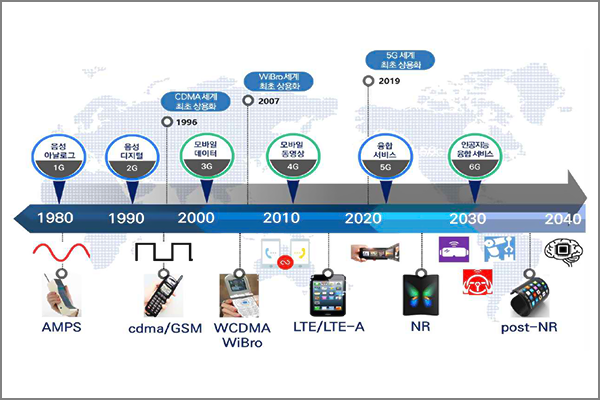
▲ The mobile communication generation changes every 10 years [Image = Ministry of Science and ICT]
Korea first introduced 1G in 1984, 2-3 years later than advanced countries, followed by 2nd generation mobile communications (2G; GSM/CDMA) in 1996, 3rd generation mobile communications (3G; WCDMA/HSDPA/WiBro) in 2002, and 4th generation mobile communications (4G; LTE) in 2011.
And on April 3, 2019, Korea successfully commercialized the world's first 5th generation mobile communication (5G), rising from a latecomer to a leader in mobile communication technology. Korea currently holds 27% of the 3GPP standard patents.
1G (phone), 2G (text), 3G (low-capacity video), and LTE (real-time video) could only provide B2C services limited to mobile phones due to their performance. On the other hand, 5G has the potential to be applied not only to mobile phones but also to various cutting-edge terminals, providing B2B convergence services to various industries.
I believed in the theory until I experienced it. The problem is that it only has possibilities. 5G was introduced to the public as having ultra-high speed, ultra-low latency, and hyper-connectivity characteristics, but in reality, this was not the case.
On the 5th of this month, the Ministry of Science and ICT conducted the first 5G quality evaluation since commercialization. The maximum transmission speed of 5G was only 4 times faster than that of LTE, and the transmission delay time was not much different.
Related article: First quality evaluation results announced after 5G commercialization: "We still can't stand alone without LTE" There was a big difference between the government and the three mobile carriers' announcements at the beginning of commercialization that 5G would be 20 times faster than LTE and have only 1/10 the transmission delay.
5G is not yet a mature technology. 5G standalone mode (SA), which operates only with 5G, has not yet been commercialized. The currently used 5G non-standalone mode (NSA) operates together with LTE.
In addition, the frequency bands used by 5G are largely divided into two: the 3.5GHz band and the 28GHz band. The commercialized band is the 3.5 GHz band, and the theoretical maximum 5G transmission speed (20 Gbps) is possible only in the 28 GHz band.
Related article: 5G commercialization era soon to be one year old? It's still the 4.5G era However, since the 28GHz band signal is highly straight and has difficulty avoiding obstacles, more base stations are needed than 3.5GHz band base stations to fully utilize it. The introduction of 5G SA, which requires technological supplementation, is gradually progressing, but the introduction of 5G in the 28GHz band, which requires infrastructure expansion, is sluggish due to COVID-19.
Consumer dissatisfaction is growing due to the high cost and unsatisfactory service quality. The three mobile carriers are unable to come up with specific 5G B2B convergence services. Compared to the rest of the world, our country's 5G environment is not bad, but it has not reached the absolute standard.
Why 6G is Needed, Because 5G Isn't Enough As the global mobile communications market size is estimated to reach approximately 1,161 trillion won in 2026, the Ministry of Science and ICT announced on the 6th the '6G Mobile Communications R&D Promotion Strategy' to secure a leading position in the industry and market related to 6th generation mobile communications (6G), which is expected to be commercialized between 2028 and 2030.

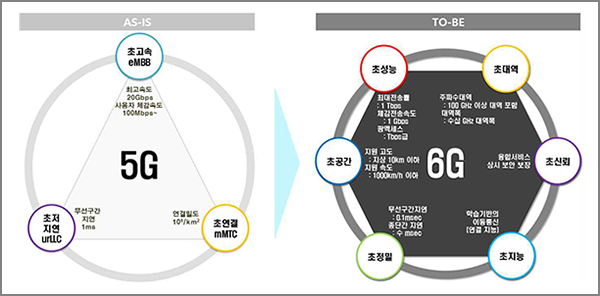
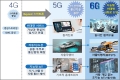
▲ Different characteristics of 5G and 6G [Image = Ministry of Science and ICT]
In its promotion strategy, the Ministry of Science and ICT pointed out the inherent limitations of 5G.
First, the end-to-end delay was not considered. 5G only reduced the delay time for the wireless section to 1ms. The delay time between network ends, including the wired section, was tens ofms and could not be reduced. Therefore, even if the delay time for the wireless section is reduced, the effect is bound to be minimal.
And from the beginning, the performance was insufficient to realize convergence services. Even the theoretical maximum transmission speed of 5G, 20 Gbps, has limitations in popularizing ultra-high-speed convergence services used by many people, such as autonomous driving and AR/VR.
In addition, AI integration is still in its early stages. AI is still being used only for network resource management in 5G core networks. It is not being used in the wireless sector.
Finally, the coverage is ground-centric. 5G coverage only supports terminals up to 120 meters above the ground. Therefore, it cannot support future aerial vehicles such as drones and flying cars.
The Ministry of Science and ICT explained that in order to complement the limitations of 5G, 6G must have a transmission speed of 1 Tbps, be able to utilize the 100 to 300 GHz band, reduce wireless section delay time to 0.1 ms and wired section delay time to 5 ms, and expand coverage to 10 km above ground.
In addition, he stated that AI technology must be applied to all sections of the network, and unlike 5G, which only standardized minimum security functions, 6G must incorporate security technology from the product and service design stage.
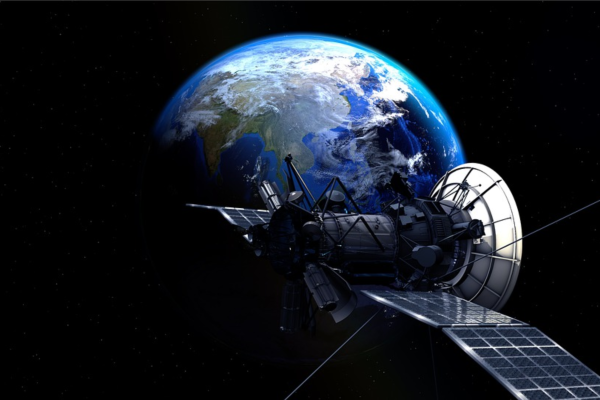
▲ Satellite communications are expected to be needed for 6G
To implement this, △Tbps-class wireless communications, △Tbps-class optical communications infrastructure, △THz RF components, △THz frequency utilization, △ultra-precision networks, △3D spatial mobile communications, △low-orbit satellite communications, △intelligent wireless networks, △intelligent mobile cores, and △security quality assurance technologies are required.
Related article: Investing 200 billion won in R&D funds over 5 years to secure 6G mobile communication technology Next-generation mobile communications usually begin preparations 10 years before commercialization. Korea began preparing for 5G commercialization in 2012, one year after the commercialization of LTE, by forming a 5G standardization industry-academia-research council. But we focused only on the beginning and didn't pay enough attention to smooth operation.
This is not a problem that only applies to our country, but in the process of preparing for 6G commercialization, we must pay thorough attention to future operations to prevent the problems that occurred after 5G commercialization from reoccurring.