Materials Research Institute, Future E-Mobility Electrification Parts Industry Exchange Meeting Held
Sharing awareness of the reorganization of the mobility and parts industry supply chain ecosystem The Korea Institute of Materials Science (KIMDS), a government-funded research institute under the Ministry of Science and ICT, reported that breaking away from machine-centered thinking is necessary to find new opportunities in the various future mobility industries.
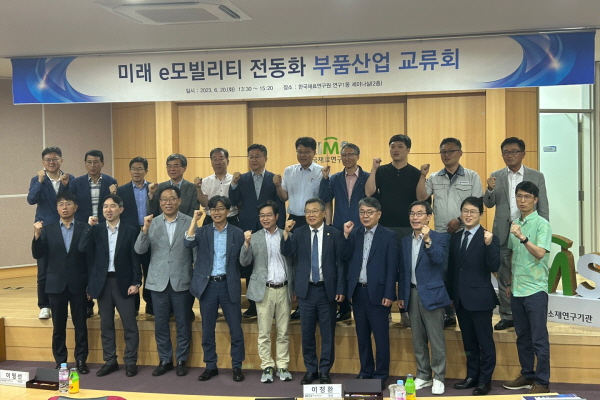
On the 20th, the Korea Institute of Materials Science held the 'Future E-Mobility Electrification Parts Industry Exchange Meeting' in the seminar room of Research Building 1 of the Korea Institute of Materials Science, providing a forum for discussion on changes in perception of the future automobile industry and practical response measures.
Lee Jeong-hwan, the president of the Materials Research Institute, said, “We prepared this exchange meeting to find new opportunities for regional companies to develop in the future e-mobility industry,” and “I hope this discussion will help share awareness of the current state of the collapse/reorganization of the global mobility and parts industry supply chain ecosystem and seek a direction for development.”
The Materials Research Institute said that it prepared this exchange meeting in order to create an opportunity to change the old perspective on automobiles.
Changwon City has developed around the automobile parts industry, which is centered on the machinery industry, but is currently facing a crisis in which the number of internal combustion engine automobile parts has decreased by approximately 37% from approximately 30,000 to less than 20,000 due to the wave of electrification in the automobile industry.
We need to break away from machine-centric thinking to find new opportunities in the various future mobility industries. The analysis of the material is that it can be done.
Lee Jeong-hwan, the head of the Materials Research Institute, said, “There are local small and medium-sized parts and materials companies that have already selected and are pushing forward with areas in which they can do business in the mobility electrification component group, but there are also many companies that are experiencing difficulties.” He added, “I hope that companies will make good use of the Materials Research Institute and universities to strengthen their capabilities.”
The head of the Lee Hang-gu Automotive Convergence Technology Institute spoke about the 'Electric-powered autonomous vehicle industry trend and the direction of linking lightweight materials' and pointed out the lack of personnel participating in research as an issue that needs to be resolved.
Director Lee Hang-gu said, “The budget invested in training future car personnel exceeds 1 trillion won, but I don’t think people will feel the impact in the field.”
He continued, saying that in the current situation where education is being provided starting from universities, assuming that undergraduate students study for master's and doctoral degrees, they will not be deployed in the field until 2030, and it is uncertain whether the current automobile industry structure will continue as is.
The director added that although the government is pursuing a policy to transform 20% of the approximately 4,700 parts manufacturers with 10 or more employees into future car parts manufacturers by 2030, it must also be recognized that the speed of the industry's transformation is quite rapid.
Kim Se-hoon, former vice president of Hyundai Motor Company, gave a presentation on the topic of ‘Future e-mobility electrification direction’ and emphasized that we must recognize that Europe is a more frightening law than the IRA and that we must take a closer look at European regulations.
While our country has only set a goal of reducing emissions by 40% by 2030, Europe is already in the process of legislating this.
A representative example is the legislation requiring automobiles and ships to achieve zero carbon emissions by 2035.
Korean companies exporting to Europe are producing He emphasized once again that thorough investigations into how much CO2 is generated from products must be conducted and that this must be done without fail.
Meanwhile, in the ensuing discussion, there was an in-depth discussion on rare earth elements, and experts expressed their opinion that the importance of rare earth elements is increasing to the point that there is a saying that “after the Iron Age comes the rare earth age.”
In response to a question from the audience regarding rare earth elements, Lee Jeong-gu, director of the Korea Institute of Materials Science, said that from a materials perspective, actively using rare earth elements rather than unconditionally trying to avoid using them would be one way to prepare for the future society.
In addition, Lee Jeong-hwan, the head of the Korea Institute of Materials Science, said, “The Korea Institute of Materials Science is continuously conducting research on rare earth elements,” adding, “Since most of the rare earth elements that are strategically used in industry are imported from China, we are also researching ways to avoid using rare earth elements so that the industry is not harmed in the event of a trade issue.”