Physical AI HBM Smart Factory SDV AIoT Power Semicon 특수 가스 정정·반론보도 모음 e4ds plus

“AI-based manufacturing innovation is slower than expected”

기사입력2023.06.15 16:07


MIT, Hyundai Motors, Korea Institute of Machinery and Materials, etc. share manufacturing experience and insights
We must consider how to manage, standardize, and share domain knowledge.

Innovations in manufacturing technology using AI are progressing more slowly than expected, and experts shared their experiences that it is difficult to apply AI to manufacturing-related data due to its confidentiality.

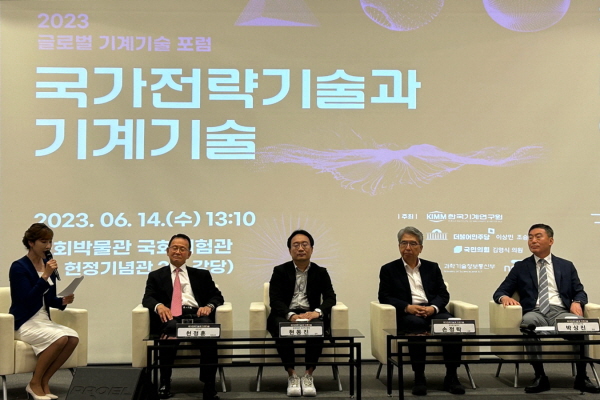
The Korea Institute of Machinery and Materials (KIMM), Rep. Lee Sang-min, Rep. Cho Seung-rae, and Rep. Kim Young-sik held the '2023 Global Machinery Technology Forum' on the topic of national strategic technology and machine technology at the National Assembly Museum on the 14th.

In a panel discussion held at the forum, Professor Jeong-Hoon Cheon of MIT, Executive Director Dong-Jin Hyun of Hyundai Motor Company, Advisor Jeong-Rak Son of Doosan Energy, and President Sang-Jin Park of Korea Institute of Machinery and Materials participated and shared their experiences and insights in response to questions from participants.

As ChatGPT is attracting a lot of attention and AI diffusion is becoming a very important topic, Hyundai Motor Company Managing Director Hyun Dong-jin answered the question about what preparations the manufacturing industry should make.

“Innovation in manufacturing technology using AI is moving more slowly than expected because we need to innovate while solving current manufacturing problems,” said Executive Director Hyun. “Engineers will continue to work hard to solve problems, and I hope to have the opportunity to re-evaluate in five years.”

He started the story by saying, “It seems true that ChatGPT is branding AI,” but added, “When you actually link ChatGPT, it seems difficult to perform the function of conveying information because it is a generative AI.”

There are concerns that ChatGPT's capabilities and solutions could create both false and expected results, which is true for most AIs.

He said that the most important thing in AI is domain knowledge, and that we need to think about how to manage, standardize, and share it.

Professor Cheon Jeong-hun also said, “Even though the technology has been developed, it has been difficult to apply AI in the manufacturing industry because the company has a lot of sensitive data and does not share it,” adding, “It is difficult to obtain data in the manufacturing industry, so MIT is also focusing on areas where data can be collected, such as transportation and utilities.”

MIT Professor Cheon Jeong-hun also talked about the current state of Korea's manufacturing industry in his keynote speech.

As of 2021, Korea's manufacturing industry was worth 457 billion dollars, accounting for 28% of Korea's GDP in 2022, and employing 3.7 million people.

While it is strong in consumer goods and heavy industry such as electronics, automobiles, and steel, it is weak in advanced equipment and materials used in semiconductor equipment, aerospace, pharmaceutical, and biomedical industries, and its slow growth rate is considered a problem.

Professor Cheon Jeong-hun answered questions about how Korea should respond in the manufacturing ecosystem where digital transformation, including the application of AI, is rapidly taking place.

Professor Cheon Seok-ja said that manufacturing and software experts should conduct research together, and that Korea should have excellent technological capabilities.He said that it could become a better manufacturing country than other countries.

He cited the current problem of Industry 4.0 as trying to adapt software that is not suitable for manufacturing.

Professor Chun Seok-ja said, “Manufacturing and software experts need to work together to build a system, but the current situation is like not knowing whether the horse is pulling the carriage or the carriage is pushing the horse,” criticizing the lack of direction.

He added that the reason for the rapid advancement of Industry 5.0 also contains the meaning of organizing this confusing situation.

There was a positive response to the future of Korea's manufacturing industry, which is recognized worldwide.

He said he firmly believes that if Korea accurately understands the changing trends and their significance and develops technology, it will no longer be a follower but a leader.

When asked about the role and importance of public research institutes in terms of mechanical technology, which is a very important technological innovation element in national strategic technology, Park Sang-jin, the president of KIMM, answered, “Research institutes and public research institutes often try to maintain their own colors, but it is important to abandon such thinking and play a role as a focal point for cooperation.”

Director Park added that it is necessary to secure platform-type openness and that efforts should be made to discuss and persuade the government about things that need to be built in the more distant future, rather than focusing too much on things that can be completed within a year.

He also argued that in order to fill an empty space with stones, there must be pebbles as well as large rocks, and that we should envision moving forward by proposing and leading diverse and flexible businesses, including R&D and policies that are currently centered around large-scale businesses.

Hyun Dong-jin, Hyundai Motor CompanyHe agreed that the scale of dance research is very large, but questioned how industry, academia, and research should respond. He said that from a company's perspective, the most important thing is to hire good talent.

Meanwhile, Park Sang-jin, president of KIMM, introduced KIMM by saying, “KIMM is leading the mission-oriented research on 20 detailed key technologies in 8 fields, including semiconductors, displays, advanced robots, and manufacturing, among the 12 national strategic technologies and 50 key technologies.” He added, “This forum will be a place to seek strategies for mechanical technology research and development, which is the foundation for the global competition to secure strategic technologies, which is accelerating with the enactment of special laws.”