Serial order
(1) Sensor on May 17th
(2) Connectivity on May 20th
(3) Actuator on May 24th
(4) Microcontroller on May 26
(5) May 28 Security [Editor's Note] When smoke is detected in a house, the fire detector sounds, firefighting equipment near the detector is activated, and an emergency call is sent to the homeowner and the fire department. In fields other than firefighting, the implementation of such systems that operate without people has become easy and widespread in our daily lives, and it seems that further development will continue in our daily lives in the future. A system that connects and operates through the Internet of Things without human intervention is called the Internet of Things. The Internet of Things is being applied to many aspects of our lives, whether we know it or not, such as health care, power, gas, parking lots, and home appliances. Accordingly, this magazine has prepared a five-part series to examine cutting-edge technologies that make the Internet of Things possible.
Smart Home, Car, Factory, Hyper-connectivity between devices increases productivity by dozens of times
Wireless technologies such as Wi-Fi and Bluetooth, 3-way development in efficiency, speed, and power
■ Difference between electronic products and IoT, ‘ Connectivity ’ Electronic devices can perform excellent tasks on their own, but when each device communicates with another, the capabilities of each device can be increased by several or even dozens of times.

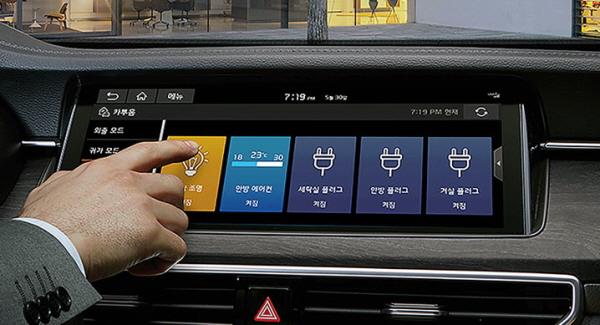
▲Smart cars have evolved into ‘moving living spaces’ through connectivity. (Photo: Hyundai Motor Company)
div data-hjsonver="1.0" data-jsonlen="5545" id="hwpEditorBoardContent">
The field in which connectivity has recently emerged as the most important issue is the automobile industry, and through connectivity, automobiles are evolving into 'moving living spaces'.
Through intelligent voice recognition services, it provides voice control of in-vehicle devices and real-time information to drivers, and various services to drivers through connection with car cloud. In addition, the connected car-specific operating system turns cars into high-performance computers that run on wheels.
Also, the field where connectivity is most widely used and frequently encountered in our daily lives is the smart home.
Connectivity is exploding in the smart home market. Representative fields include the white goods market including smart TVs, smart lighting, security cameras, and smart speakers.
Smart TVs have become an indispensable part of our daily lives, combining Internet access with a variety of features such as web surfing, gaming, and social networking.
Smart lighting can be adjusted to suit each individual's lifestyle by adjusting the brightness of the light, and can also perform various functions by linking with a smartphone.
A representative example of connectivity can also be found in the industrial sector: the smart factory.
In a smart factory, the entire product production process is connected via wireless communication, and the process is carried out automatically. The plant can be operated with minimal operating personnel, improving productivity, quality, and customer satisfaction.
These services are possible because of connectivity, that is, the connection between each device.
■ Representative connectivity technologies: Wi-Fi and Bluetooth Technologies that enable connectivity include technologies we know such as Wi-Fi, Ethernet, and Bluetooth, and in addition, there are technologies such as Zigbee, Z-Wave, and NFC, which are classified by transmission speed, coverage, power consumption, and cost.
○ Wi-Fi Wi-Fi, a representative technology, has no officially defined meaning, and is generally referred to as wireless LAN in Korea. A trademark that can be used by companies that are members of the Wi-Fi Alliance, it is a standard for short-distance wireless communication and requires a wireless Internet router/AP.
There are many technologies such as 802.11b/a/g/n/ac/ad/ax according to the standard, and they are evolving into core connectivity technologies for IoT with advantages such as high-speed data transmission, low latency, and IP support.
In 2018, more than 3 billion Wi-Fi chipsets were shipped on the market, 80% of which were 802.11ac.
802.11ac does not use the 2.4 GHz band and only uses the 5 GHz frequency band, implementing a wireless gigabit network with an overwhelming speed of 433 Mbps at a minimum 1Tx-1Rx (1x1) and 3.7 Gbps at a maximum 8Tx-8Rx (8x8), which is 68.5 times faster than the previous Wi-Fi 4.
As the next generation of Wi-Fi, 802.11ax is bringing gigabit speeds anytime, anywhere. This standard was developed to improve the weak wireless network output, which is a shortcoming of 802.11ac, and to guarantee the best QoS (quality of service) speed even when many devices are connected simultaneously over a wide area.
The next-generation 60GHz 802.11ay is realizing high-speed transmission of over 20Gbps.
Ultra-low-power Wi-Fi 802.11ba delivers dozens of times less power consumption.
Wi-Fi technology is advancing in three directions: transmission efficiency, transmission speed, and power consumption.
○ Bluetooth Bluetooth is being used as a low-end IoT wireless solution in low-cost, low-power, and audio applications.
It is mainly used in ultra-short-distance wireless ranges of about 10m in portable devices such as mobile phones, earphones, and laptops.
There are various versions from Bluetooth 1.0 to Bluetooth 5.0, and while it has the advantage of being easy and convenient to use, its distance limitation is a disadvantage.
■ Industry consensus on improving inter-device compatibility Improving inter-device compatibility for the realization and expansion of IoT is also emerging as an important connectivity issue.
In order to ensure compatibility of the Internet of Things through standard specifications regardless of brand in the Internet of Things, the OCF 1.0 standard of the OCF (OPEN Connectivity Foundation), an Internet of Things standards organization, has been ratified as an ISO/IEC JTC 1 international industry standard.
Since each manufacturer has different operating systems and communication standards for connecting to the Internet of Things, compatibility between IoT devices has been a problem, but through the OCF standard, IoT devices can be I was able to play a role.
OCF is participated by multinational companies from all over the world, including Samsung Electronics, LG Electronics, Intel, Microsoft, Qualcomm, and Electrolux.
■ Semiconductor industry strengthens manufacturing of chips with improved connectivity functions The semiconductor industry is making various attempts to manufacture chips that integrate functions such as Wi-Fi and Bluetooth, as well as chips suitable for low energy or high performance.
Infineon offers the option to choose between
Bluetooth low energy products and
dual mode Bluetooth solutions , with the SDK and IDE and configuration tools of ModusToolbox.-iot-work/">Provides a powerful yet easy-to-use
toolset to quickly and easily develop Bluetooth-enabled IoT solutions.
We also offer
AIROC™ Wi-Fi + Bluetooth combo products to enable ultra-small form factor IoT designs, which integrate
IEEE 802.11a/b/g/n/ac WLAN and
Bluetooth into a single chip.