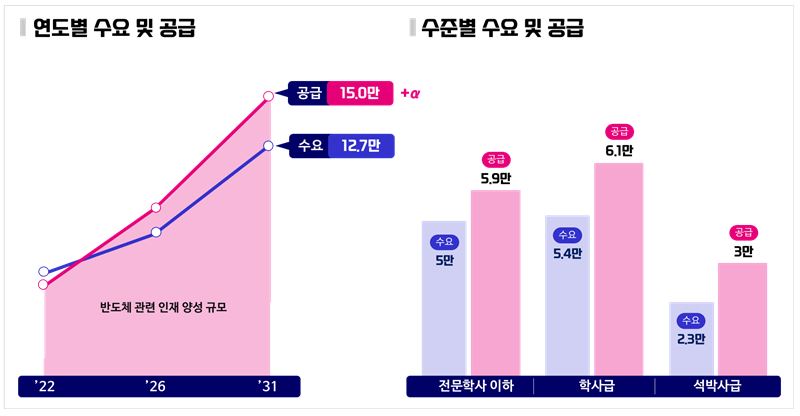
▲Semiconductor Manpower Demand Forecast and Supply Plan (Data - Ministry of Education)
Nurturing semiconductor professionals from vocational high schools to master's and doctoral level
Yoon government reflects industry-academia-research voices in policy through regulatory reform and expansion of personnel
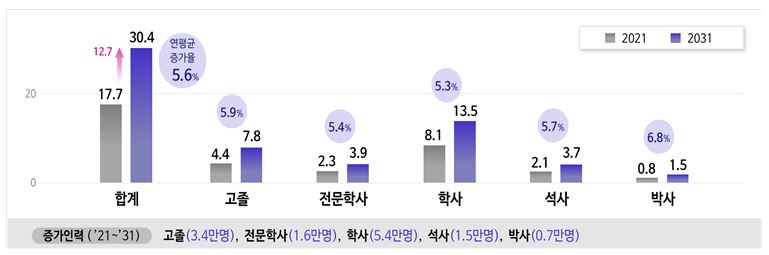
The semiconductor industry is expected to expand in size and reach 304,000 people in 10 years. A government-wide policy drive is underway to meet the demand for semiconductor workers, which is expected to require an additional 127,000 people.
At the State Council meeting held on the 19th, presided over by President Yoon Seok-yeol, the 'Semiconductor-related Talent Development Plan' jointly prepared by relevant ministries was discussed. It is a place prepared to establish policies related to the development of specialized talent and solutions to the manpower shortage in companies.
The government formed a task force team for fostering advanced industry talents with the participation of relevant ministries and specialized agencies in June and began to identify policy tasks for fostering semiconductor talents. It is known that this plan was created after gathering opinions from the field, including from the industry and education sectors.
Currently, the number of employees in the semiconductor industry is approximately 5,000 per year, and the supply structure is centered on practical personnel such as vocational high school graduates and associate degree holders. The TF team analyzed that if the current personnel supply system is maintained, the semiconductor industry's labor shortage will become more severe. This is because the semiconductor industry is in dire need of bachelor's degree workers, and therefore requires diverse talents in each field, from vocational high school graduates to master's and doctoral level workers.
■ Training 150,000 semiconductor personnel, starting with regulatory reform and staff expansion 
▲2031 semiconductor industry workforce outlook (data: Korea Semiconductor Industry Association)
The Yoon administration announced that it aims to train 150,000 semiconductor-related personnel over the next 10 years. It presented a vision to reduce policy lag by establishing semiconductor personnel training paths other than degree programs and to foster an ecosystem for training high-quality, high-level personnel by improving the education and research environment.
The TF team explained that it would expand talent production through regulatory reform and expansion of semiconductor-related gardens.
According to the announced talent development plan, in the case of cutting-edge fields such as semiconductors, when establishing or expanding departments, regardless of region, if only the faculty recruitment rate is met among the four major requirements, the number of students can be increased. In addition, a ‘contractual quota system’ will be newly established, which will allow temporary increases in the number of students in existing departments without establishing separate departments.
The TF team also presented specific plans for fostering advanced semiconductor talent. The plan is to designate universities specializing in semiconductors and provide large-scale financial and regulatory support. Semiconductor specialized universities are expected to be guaranteed financial autonomy through comprehensive financial support, including: △elimination of barriers by category, and △exclusion from application of upper limits on personnel expenses, equipment, and scholarships.
In terms of regulatory reform, measures will be put in place to actively utilize semiconductor industry experts as teaching resources. Qualification requirements for part-time and visiting professors in advanced fields will be relaxed, and a semiconductor education support team comprised of field experts will be formed at vocational high schools and universities.
■ Multi-track semiconductor specialist training 
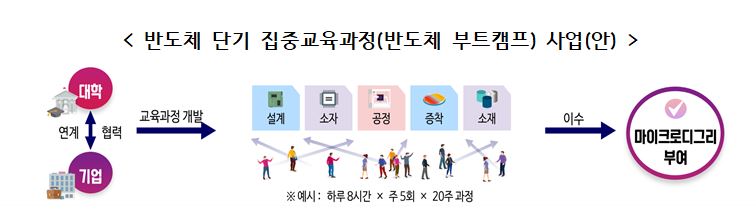
▲Semiconductor Bootcamp Business Plan (Data - Ministry of Education)
The semiconductor industry requires semiconductor manpower in various sectors and levels. The semiconductor industry is not only represented by Samsung Electronics and SK Hynix in Korea, but also has a complex and linked industrial landscape consisting of materials, parts, and equipment companies, as well as packaging, testing, and design.
Accordingly, the TF team announced that while focusing on nurturing advanced semiconductor personnel, it will expand programs for nurturing talent throughout the entire cycle and at each level. While drastically expanding investments in large-scale research and development projects to foster key professional talent, creating a research environment, and providing scholarships, it also included a plan to foster semiconductor convergence talent.
The Ministry of Education announced that it plans to promote the establishment of a new semiconductor short-term intensive education course (semiconductor boot camp) and, through collaboration with the Ministry of Trade, Industry and Energy and the Ministry of Science and ICT, to vitalize the operation of semiconductor specialized major departments through the Digital Innovation Sharing University and the Ministry of Science and ICT collaborative innovation talent cultivation project.
In addition, in order to foster practical talent, we will expand customized programs for corporate needs and concurrent training courses at vocational high schools and junior colleges. We will expand the semiconductor-specialized campus and departments at Korea Polytechnic, which fosters practical talent for the field, to increase production and manufacturing personnel.
We also plan to expand support for professional education to strengthen the capabilities of employees. We mentioned the activation of education and training through the Ministry of Science and ICT’s short-term semiconductor design course and the Ministry of SMEs and Startups’ semiconductor field engineer training program, as well as the expansion of joint training centers that share high-cost training facilities and equipment.
■ Establishment of a control tower for nurturing semiconductor talent 
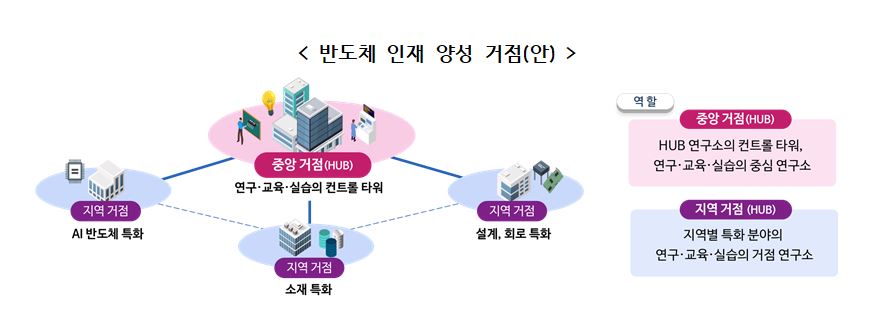
▲Semiconductor talent training base plan (Data - Ministry of Education)
The 'Seoul National University Semiconductor Joint Research Center' is expected to serve as a central hub (control tower) and perform the core functions of semiconductor education and basic research. By establishing regional semiconductor joint research institutes, a collaboration system between bases will be established, and regional research institutes will be in charge of specialization in areas such as AI semiconductors, materials, design, and circuits.
This collaborative system is expected to be realized by supporting the construction of expensive semiconductor equipment facilities and joint use of national semiconductor and nano infrastructure.
In addition, in order to respond to the issue of talent development nationwide, a 'Talent Development Strategy Meeting' will be established to build a foundation for collaboration, and a win-win cooperation system between regional universities and semiconductor SMEs, such as the regular holding of the 'Fabless-Foundry Symbiotic Council' of the Ministry of SMEs and Startups, will also be promoted.
Deputy Prime Minister and Minister of Education Park Soon-ae said, “I expect this plan to be the starting point for fostering cutting-edge talent,” adding, “Fostering cutting-edge industry talent is a task at the national survival strategy level, and we will ensure that local universities can leverage their strengths to foster cutting-edge industry talent.”
Meanwhile, the TF team is planning a semiconductor talent development policy with the participation of the entire government, including the Ministry of Strategy and Finance, the Ministry of Science and ICT, the Ministry of Trade, Industry and Energy, the Ministry of Employment and Labor, the Ministry of Land, Infrastructure and Transport, and the Ministry of SMEs and Startups, under the chairmanship of the Vice Minister of Education.