■ MOSFAre there any considerations when using ET in parallel?
MOSFETs are connected in parallel to handle the high load current required in systems such as high-power motor drives, servers, and telecommunications.
In theory or simulation, calculations or simulations are made assuming that the total load current is divided by the number of MOSFETs in parallel and that the same current flows through each MOSFET. However, in actual applications, current imbalance may occur due to deviations in the characteristic values of the produced MOSFETs and differences in PCB wiring patterns due to space constraints.
Therefore, the deviation in the characteristic values of the MOSFET used in product design cannot be compensated for each product, but it is necessary to sufficiently review the Min-Max values of the characteristic values.
MOSFET datasheets contain several characteristic values related to the product, among which the gate threshold voltage, VGS(th), is an important parameter to consider when using MOSFETs in parallel.
■ MOSFET parameter differences in paralleltm_campaign=202211_ap_kr_pss_pss.ppsi_mos" target="_blank">What is the effect on current imbalance between MOSFETs?
MOSFETs have the characteristic of allowing current to flow when turned on and not flowing when turned off.
The imbalance of current flowing between parallel-connected MOSFETs due to differences in MOSFET parameters can be the main cause of the difference in VGS(th) values mentioned above.
This can be easily understood by thinking that a low VGS(th) means that the MOSFET turns on first or turns off later, and conversely, a high VGS(th) means that the MOSFET turns on later or turns off first.
Therefore, during switching operation, the current is concentrated toward the MOSFET with lower VGS(th) which turns on first and turns off later.
■ Please explain the factors and considerations for analyzing system power consumption. As a factor for analyzing power consumption, it is necessary to know the current flowing when the MOSFET is turned on, and the voltage and current changes during the corresponding time when the MOSFET is turned on and off.
This part can be calculated using the characteristic values in the MOSFET datasheet, or a circuit can be configured and verified using the MOSFET simulation model provided on our website.
Especially when calculating power consumption using simulation, more accurate results can be obtained by considering factors such as the inductance and temperature of the PCB wiring.
In real application conditions, the waveform is captured using an oscilloscope, and thisAnalyzing using can also be one method.
■ What is the impact of power dissipation imbalance and gate threshold voltage {VGS(th)} difference? When an imbalance in the current flowing between MOSFETs connected in parallel occurs due to a difference in the VGS(th) value among the MOSFET parameters, a large amount of current flows to the MOSFET with a low VGS(th) value, which increases the conduction loss and switching loss, resulting in a large overall loss.
Also, a large loss means a large temperature increase.
Therefore, the reliability of MOSFETs, which are subject to high stress due to high losses and temperatures, will decrease, and in some cases, this may lead to MOSFET failure, increasing the probability of failure of application products.
■ How does transconductance (gfs) affect current sharing? Transconductance, one of the MOSFET parameters, refers to the change in drain current according to the change in gate-source voltage.
Therefore, it can be seen that when the change in the voltage between the gate and source is large, the change in the drain current is large, and the higher this value, the more the imbalance in current sharing tends to increase.
■al&utm_campaign=202211_ap_kr_pss_pss.ppsi_mos" target="_blank">Please explain the features of Infineon's latest generation power
MOSFET .
Infineon's medium-voltage MOSFETs have a VGS(th) range that is distributed and managed less than the range typically offered, offering several advantages for using MOSFETs in parallel.
In particular, the latest generation OptiMOS™ 6th generation has achieved improved on-resistance RDS(on) and FOM (Figure of merits – RDS(on) x Qg / Qgd) compared to the existing 5th generation product.
This allows developers to increase the efficiency of their systems through lower conduction and switching losses, and also gives them a bit more freedom in terms of heat generation.
Additionally, it can contribute to lowering the system cost by reducing the number of MOSFETs in parallel.
Furthermore, it offers the advantage of being able to reduce the solution size by using small-capacity inductors and capacitors because the switching frequency can be increased quickly.
Therefore, OptiMOS™ 6th generation products are the perfect solution to optimize efficiency across a wide range of output power systems while maintaining a balance between light and heavy load conditions in SMPS applications.
today OptiMOS™ 6th generation is available in 40V and 100V versions, and 60V, 80V, 120V, 150V, and 200V versions are in development.
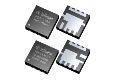
It provides a wide range of packages, such as SuperSO8 5x6mm, PQFN 3.3x3.3mm, and sTOLL 7x8mm, providing a high degree of freedom in system development.