Microchip - Apr 26 (e4ds)
Physical AI HBM Smart Factory SDV AIoT Power Semicon 특수 가스 정정·반론보도 모음 e4ds plus

Nuvoton Launches Electric Vehicle Battery Monitoring Chipset

기사입력2023.09.06 10:19


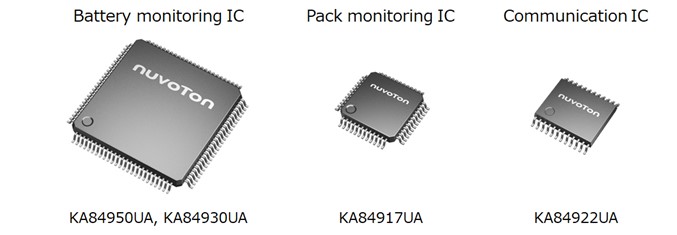
▲New product composition of Nuvoton battery monitoring chipset (Image: Nuvoton)
Enhanced battery safety with dual and precision measurement support

As the electric vehicle market grows rapidly to achieve carbon neutrality, the auto industry is under pressure to meet demands for extended electric vehicle driving ranges by improving the safety of lithium-ion battery packs and increasing pack capacity and integration.

On the 29th, Nuvoton announced the launch of its 4th generation battery monitoring chipset that measures the voltage and temperature of battery cells and the current of battery packs for automotive battery control.

To extend battery life, technologies that collect various battery parameters, such as battery temperature and charge/discharge current, are also required.

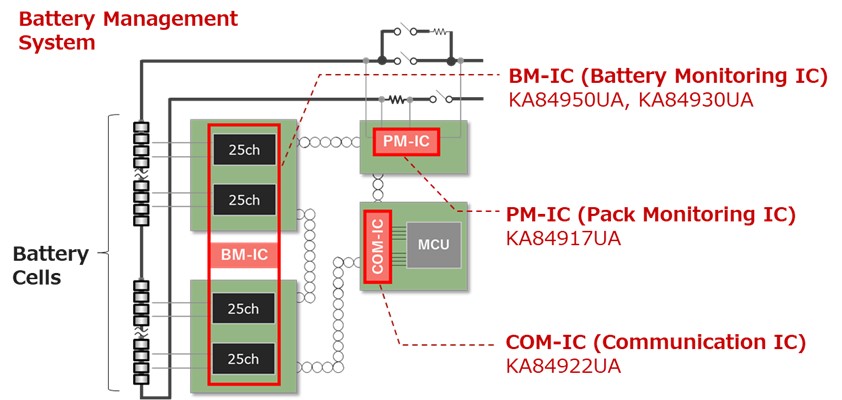
Nuvoton's new solution enables a single IC to manage up to 25 series battery cells, simplifying automotive battery systems that typically consist of 100 to 200 series battery cells. The battery monitoring IC currently developed by Nuvoton measures up to 25 series battery cells, which is 25% more than existing products.

It also supports battery management system (BMS) redundant measurement system and bidirectional ring communication safety that complies with Automotive Safety Integrity Level D (ASIL-D).

The redundancy measurement system and daisy-chain communication make it easier to develop and design a BMS that complies with ASIL-D of ISO26262. The trend toward connected cars that are connected to communication requires stability in preventing communication interruption in the event of a failure, and the redundancy system and daisy-chain communication play such a role.

To enhance safety, Nuvoton introduces a dual measurement system in the battery monitoring IC and pack monitoring IC circuits to measure battery parameters. Daisy chain communication between chipset ICs adopts bidirectional ring communication to ensure continuous communication even when an abnormality is detected.

There is no problem when the electric vehicle is in operation, but when the vehicle is parked with the power off, the battery can be relatively vulnerable. In this way, a safety function is needed to detect abnormalities in the battery while parked and activate the BMS to respond to the abnormality.

The Nuvoton chipset enables the operation of an abnormality detection system through continuous battery monitoring even when the MCU is in power-saving mode while the electric vehicle is parked. The 4th generation chipsets enter a low power consumption mode that allows periodic standalone monitoring of battery status when the MCU is in sleep mode.

If an abnormality in battery cell temperature or voltage is detected, the chipset uses daisy chain communication to activate the MCU, causing the BMS to start up.


▲BMS system and product mounting area diagram (Image: Nuvoton)

These monitoring solutions improve safety through high-precision estimation. A more accurate estimation of the battery state of charge and health is ensured by synchronized current and voltage measurements within 10us.

Synchronized current and voltage measurements within 10us improve the accuracy of battery cell internal impedance calculations, enabling high-precision estimation of charge and health status. The new chipset automatically synchronizes battery cell voltage and battery pack current within 10us, allowing more accurate calculation of battery power and internal impedance, enabling the BMS to precisely estimate the battery status.

Nuvoton said, “In order to realize a ‘sustainable society’ where mass-produced batteries are reused rather than discarded, it is desirable to use batteries for a long period of time,” and “The launch of the 4th generation battery monitoring chipset serves as an interface between the IC and MCU to collect and monitor various parameters and support safety.”