마이크로칩7월
Physical AI HBM Smart Factory SDV AIoT Power Semicon 특수 가스 정정·반론보도 모음 e4ds plus

Intel's 10th-generation Core processors will coexist on both 10nm and 14nm processes.

Google 우선 소스 기사입력2019.10.10 19:05

Intel Announces Core Processors Built on 10nm Process
Coexistence of 10nm and 14nm cores in the same generation
New Xeon and CoreX Processors and Project Athena Unveiled


Intel has introduced its next-generation processor lineup targeting the PC market for the first time in Korea.
Intel debuts new processor in Korea (Photo = Intel)

On the 10th, Intel held a press conference at the JW Marriott Dongdaemun Square Hotel in Jongno 6-ga, Seoul, and introduced the 10th generation Core processor for laptops, the new Core X processor for desktops, and the Xeon X-2000 processor family for workstations.

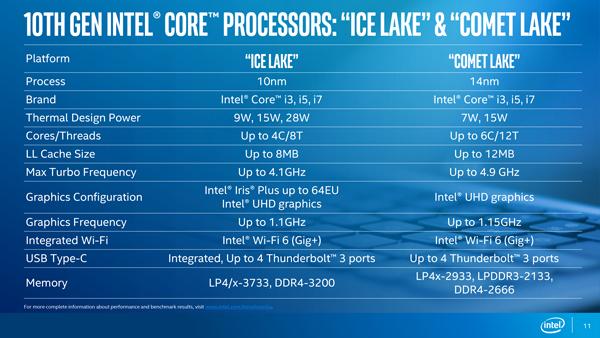
The 10th Gen Intel Core processors for laptops, codenamed 'Ice Lake' and 'Comet Lake', were produced using the 10nm and 14nm processes, respectively.
Ice Lake and Comet Lake (Image = Intel)n>

The Ice Lake Core processor, built on a 10nm process, features a new built-in GPU, Intel Iris Plus graphics, which enhances graphics performance for 1080p gaming, 4K HDR video streaming, high-resolution photo processing, and 4K video editing. It supports up to 4 cores and 8 threads and a single-core turbo frequency of up to 4.1GHz.

AI technology has also been applied. 'Intel Deep Learning Boost' technology is a dedicated instruction set that accelerates neural networks on the CPU. It supports high-bandwidth inference applications with up to 1 teraflop of GPU engine computing. 'Intel Gaussian & Neural Accelerator (GNA)' is a dedicated engine for background workloads such as speech processing and noise suppression, and operates at ultra-low power to maintain maximum battery life.

While being the same generation as Ice Lake, Comet Lake Core processors, built on a 14nm process, focus more on productivity, including enhanced CPU performance. Comet Lake supports up to 6 cores and 12 threads, with a single-core turbo frequency of up to 4.9GHz. Additionally, both core processors support Wi-Fi 6 and Thunderbolt 3, enhancing connectivity.
Jack Huang, Intel APJ Regional Sales Manager
(Photo = Reporter Lee Su-min)

“The PC market remains a key target for Intel, despite our expansion into various markets in recent years, including memory, IoT and FPGAs,” said Jack Huang, Intel Asia Pacific Japan regional sales manager.

He also said, “Intel sees the Intel CPU that was released five years ago as a rival,” and “We will release products with powerful performance to drive replacement demand from PC users and satisfy the needs of consumers with products specialized for gaming and creating.”

On this day, Intel also unveiled for the first time eight types of 'Intel Xeon W-2200' processors for workstations for professional creators and four types of 'Intel Core X' processors for desktops with increased overclocking flexibility. The 12 processors are scheduled to be released in November.
Intel Korea CEO Kwon Myung-sook (Photo = Reporter Lee Su-min)

“Intel’s ultimate goal is to provide consumers with new experiences,” said Kwon Myung-sook, CEO of Intel Korea. “To achieve this, we will work with our partners to coordinate not only CPUs but also various components and software to provide the best platform that users want.”

Meanwhile, Intel first unveiled Project Athena at Computex 2019 in Taipei, Taiwan, in May. Project Athena is a joint strategy between Intel, its partners, and vendors to improve the laptop user experience.

To ensure laptops have fast restarts, high performance and instant responsiveness, long battery life, fast connectivity, compatibility with various form factors, and AI enhancements, Intel has been operating open labs in Taipei, Taiwan, Shanghai, China, and Folsom, California, USA since June.
이수민 기자
기사 전체보기