반도체 AI 보안 인더스트리 4.0 SDV 스마트 IoT 컴퓨터 통신 특수 가스 소재 및 장비 유통 e4ds plus

Dell: “Generative AI Helps Create Corporate Performance”

기사입력2024.04.30 16:02


Facing difficulties in actual implementation phase, preferring on-premise/hybrid model

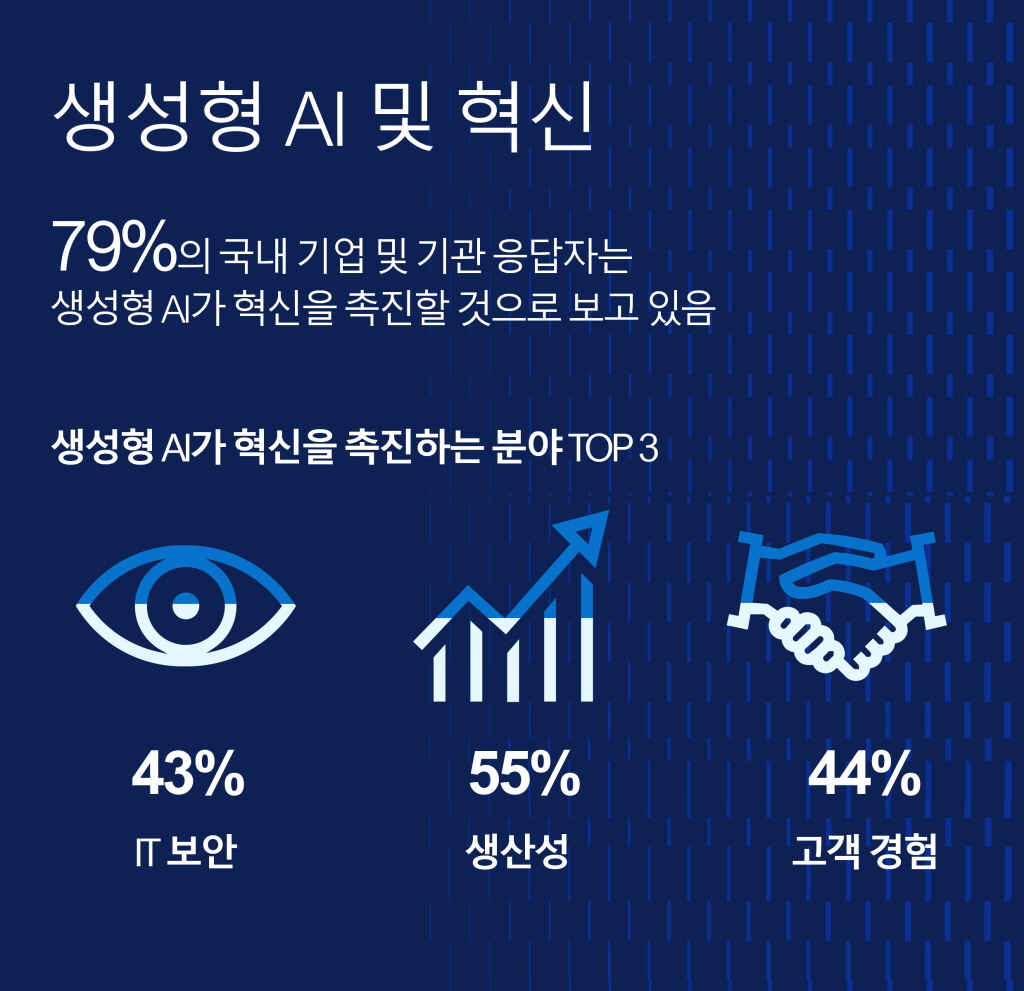
Dell Technologies has released the results of a survey showing that a significant number of companies and organizations, 79% in Korea and 81% worldwide, believe that generative AI will accelerate innovation.

Dell recently announced the results of a study on 'Innovation Catalysts' commissioned by independent research firm Vanson Bourne.

About 6,600 IT leaders and business decision makers from 40 countries around the world and 300 from Korea participated in this study.

Our research shows that a significant number of businesses and organizations are optimistic about AI and generative AI, while recognizing the pace of change and taking steps to accelerate innovation.

72% of domestic companies and 82% of global companies responded that they are currently well positioned for competitive advantage in their industry and have a solid strategy.

Meanwhile, 63% of domestic companies and 48% of the global average responded that they are uncertain about what the industry will look like in the next 3 to 5 years, and 77% of domestic companies and 6 out of 10 global averages (57%) responded that they are having difficulty keeping up with change.

They say that the difficulties they face in pursuing innovation include lack of suitable talent (39% domestically, 35% globally),Lack of mountain resources (35% domestically, 29% globally) and data privacy and cybersecurity issues (28% domestically, 31% globally) were cited.

The report analyzed that many organizations are paying attention to generative AI, and in particular, they responded that they expect this technology to be innovative and provide significant value in terms of improving productivity (55% of domestic companies, 52% global average), improving customer experience (44% of domestic companies, 51% global average), and improving IT security posture (43% of domestic companies, 52% global average).

Most IT decision makers (81% of domestic companies, 82% global average) prefer on-premises or hybrid models to solve expected problems when implementing generative AI.

70% of domestic companies, and 68% on average globally, were concerned that generative AI would raise new security and privacy issues, while 73% of domestic companies and the same global average agreed that data and IP are so important that they cannot be stored in generative AI tools that can be accessed by third parties.

This suggests that generative AI is moving from an idea to a practical implementation stage and is facing real-world challenges. The most concerning areas are the issues of risk and responsibility. Both the domestic and global averages, 76%, agreed that the organization, not the machine, the user, or the public, is responsible for AI malfunctions and unwanted behaviors.

In addition, most respondents (78% of domestic companies, 83% global average) said that introducing AI regulations now is important to maximize the potential of AI for future generations. More than 75% predicted that if the power of AI is concentrated in a few hands, it will lead to difficulties in competition and market imbalance.

Cybersecurity has been a constant headache for organizations. 83% of respondents worldwide, and even more in South Korea at 88%, said they had been affected by a security attack in the past 12 months.

The majority (89% in Korea and globally) are pursuing a zero-trust deployment strategy, and 78% globally and 69% in Korea responded that they have an incident response plan in place to recover from cyberattacks or data leaks.

The top three priorities are malware, phishing and data breaches, with phishing involving employees' role in the broader threat.

For example, 73% of domestic companies and 67% on average worldwide reported that some employees ignore IT security guidelines and practices because it reduces efficiency and productivity, while 69% of domestic companies and 65% on average worldwide responded that insider threats are a major concern. This indicates the need to focus on training employees as they are the first line of defense.

As technologies like generative AI advance and data volumes increase, the importance of data infrastructure has increased. Investing in scalable, modern infrastructure has been identified as the first area that companies must improve to accelerate innovation.

The ability to share data across the business is also a key part of innovation, with only one in three respondents (30% of domestic companies, 33% global average) saying they are able to turn their current data into real-time insights to support innovation.

On the other hand, 78% of domestic companies and 82% on average worldwide responded that data is a factor in competitive differentiation and that data use and protection must be included in generative AI strategies, indicating that organizations are responding to this challenge. Half of respondents said they are prepared to have most of their data coming from the edge within the next five years.

The report also found that two-thirds (71% of domestic companies, 67% global average) recognized a shortage of talent necessary for innovation in terms of technological capabilities. Learning agility and desire to learn, AI fluency, creativity, and creative thinking were selected as the most necessary technologies and capabilities over the next five years.

Regarding sustainability, 42% responded that ‘promoting environmentally sustainable innovation’ is an important area for improvement. 68% of Korean companies and 79% on average worldwide are experimentally introducing service-type solutions to manage their IT environments more efficiently, and 70% of Korean companies and 73% on average worldwide are actively moving AI inference to the edge (e.g. smart buildings) to improve energy efficiency, showing that energy efficiency is emerging as an important agenda.

When it comes to strategic use of IT departments, a significant number of business decision makers, 89% of domestic companies and 81% of global average, have reasons for excluding IT decision makers from strategic conversations, but both departments cited strengthening relationships as the second most important factor for improvement.

“As optimism grows about disruptive forces like generative AI, there is a clear trend toward proactive action to transform technology as a technology, especially in today’s rapidly changing world,” said Kim Kyung-jin, president and CEO of Dell Technologies Korea. “A strong ecosystem of trusted partners can help build a secure, sustainable, and scalable technology foundation.”