KITECH Webinar_~7.22
Physical AI HBM Smart Factory SDV AIoT Power Semicon 특수 가스 정정·반론보도 모음 e4ds plus

5G device penetration rate is the fastest among all mobile generations

Google 우선 소스 기사입력2021.07.26 09:40

The number of 5G subscriptions by the end of this year is expected to be around 580 million
The fastest spread is in China, the slowest is in Europe
North America and the Middle East have the highest percentage of 5G subscribers


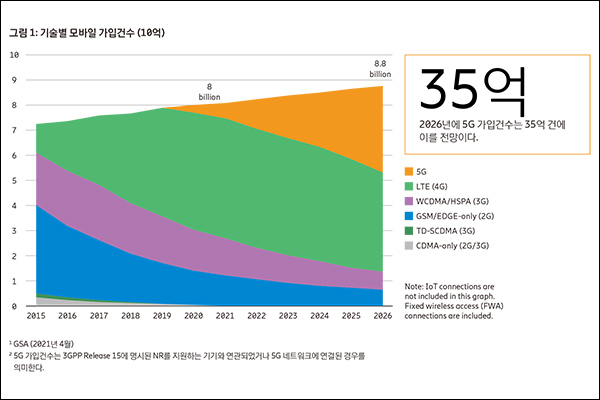
5G adoption is the fastest of any mobile generation. With a daily 5G subscription trend of about one million, the number of 5G subscriptions is expected to exceed 580 million by the end of 2021.
▲ Number of mobile phone subscriptions by generation [Graph = Ericsson]

Ericsson announced this on the 20th through the 20th Ericsson Mobility Report . The report predicted that there would be approximately 3.5 billion subscriptions and 60% coverage by the end of 2026.

The pace of adoption varies significantly across regions, with Europe in particular having a slow start and lagging behind China, the US, South Korea, Japan and the Gulf Cooperation Council (GCC) in terms of 5G deployment.

5G is expected to surpass 1 billion subscriptions two years ahead of LTE. This has been driven in particular by China’s rapid adoption of 5G and early release of low-cost 5G devices. More than 300 5G smartphone models have already been announced or commercially released.

Northeast Asia is expected to have the largest share of 5G subscriptions, with 1.4 billion expected by 2026. North America and GCC markets are expected to see the highest 5G penetration, with 5G subscriptions expected to account for 84% and 73% of total mobile subscriptions, respectively.

“We are already at the next stage of 5G,” said Fredrik Jejdling, Executive Vice President and Head of Business Area Networks at Ericsson. “It is time to further concretize use cases and realize the potential of 5G.” He advised that “businesses and society must prepare for the post-pandemic world, where 5G-based digitalization will play a key role.”

Meanwhile, the report said the semiconductor shortage would have limited impact on the telecom industry, with 500 million 5G devices set to be delivered this year, or 35-45% of all devices.