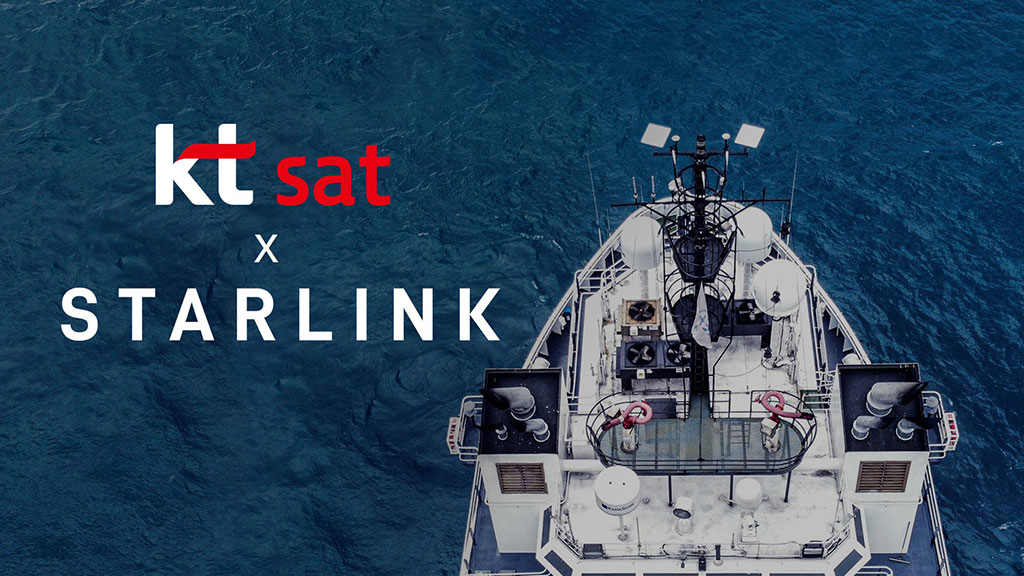
Combining geostationary and low-Earth orbits… Prospects for securing maritime communications customers
Starlink Korea to be introduced domestically as soon as government approval is received
KT SAT is introducing Starlink's low-orbit satellite service to the domestic market.
KT SAT announced on the 29th that it will launch a new Starlink satellite internet service with the American aerospace company SpaceX.
Starlink, provided by Elon Musk's SpaceX, is a low-Earth orbit (LEO) satellite communication system that aims to provide high-speed, low-latency internet to users around the world.
Following the signing of a distribution and supply agreement between Hanwha Systems and OneWeb on the 23rd, KT SAT is launching its second domestic low-orbit satellite communications business. KT SAT plans to provide Starlink, focusing on mobility to create synergy between geostationary and low-orbit satellites. This will be particularly focused on maritime communications.
Ships typically sail for at least six months once they set sail, requiring a communications network that supports both work and leisure. KT SAT stated, "We will provide the optimal communications environment for ship customers by offering both continuous, stable communications in geostationary orbit and low-latency, high-speed communications in low-Earth orbit."
KT SAT has been providing communications necessary for ship operations using its own geostationary satellites. The advantages of geostationary communication are that it supports a minimum guaranteed speed without service interruption and has wide coverage, making it continuous and stable, and thus it was provided for ship operations.
However, with the recent rise in interest in seafarer welfare, demand has grown for high-speed communications that can support employees' leisure activities, such as OTT, online classes, and gaming, and satisfy their digital needs. KT SAT has upgraded its maritime communications service by simultaneously offering geostationary-based MVSAT (Maritime Very Small Aperture Terminal) and Starlink.
KT SAT's Starlink service integrates its own resources with Starlink. KT SAT boasts, "We are the only operator in Korea with our own satellites, ground control and customer centers, and maritime solutions."
KT SAT CEO Song Kyung-min said, “Low-orbit satellite services have high utility value in that they provide ultra-high-speed communications in areas where terrestrial communications networks are difficult to access, such as aviation and maritime areas.” He added, “As a multi-orbit service provider, KT SAT will provide better service value to customers with a high-quality communications network that combines geostationary satellite service know-how with non-geostationary satellites.”
Meanwhile, Starlink services are scheduled to be introduced in Korea as soon as Starlink Korea, SpaceX's Korean subsidiary, receives necessary government approval. KT SAT announced its plan to "accelerate the influx of new customers after Starlink's launch and provide satellite communications to over 2,000 ships worldwide within three years."