SKT's proposed quantum cryptography technology gets ITU-T approval
ITU-T SG17's first QKD technology-related standard
SKT applied to Seoul-Daejeon section in April last year SK Telecom announced on March 31 that its technical report on 'Security considerations for quantum key distribution network' proposed by the company at the ITU-T conference held online from the 17th to the 26th of last month was finally approved as an international standard (TR.sec-qkd).
This standard is the first quantum key distribution (QKD) related standard completed by SG17, a specialized research organization related to communications security within ITU-T. This establishes global standards for the security requirements that must be met when transmitting quantum keys between remote communication bases, as well as the level of security required for communication bases that manage quantum key distribution.

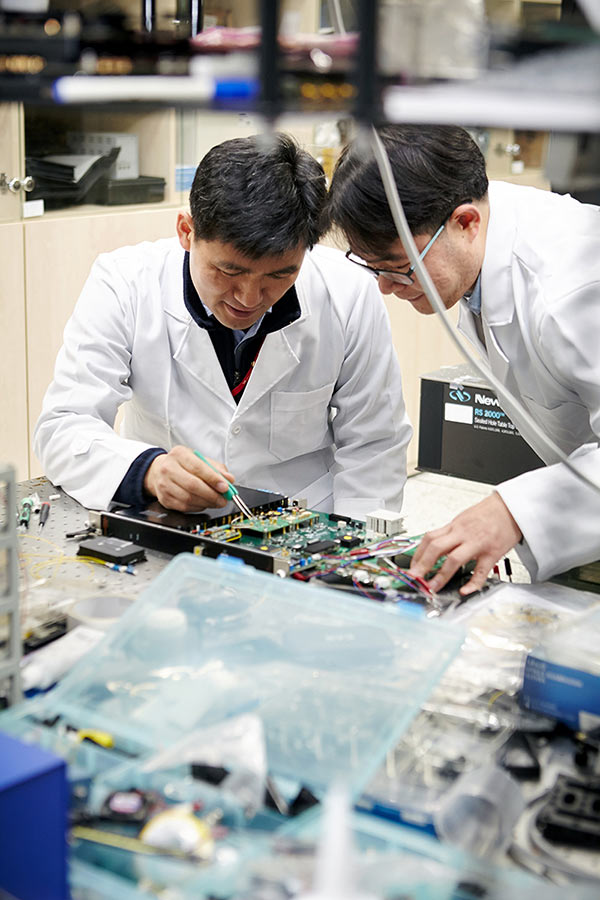
▲ Researchers studying quantum cryptography at IDQ Korea branch
[Photo = SK Telecom]
In April last year, SK Telecom applied its subsidiary IDQ's QKD technology to the Seoul-Daejeon section, a key transmission section for nationwide data traffic, to strengthen the security of transmission and reception of 5G and LTE data.
Quantum key distribution technology is a technology that uses the characteristics of quantum to create an encryption key that cannot be hacked by a third party and distributes it to the sender and receiver at the same time. If a third party attempts to infiltrate the communication network and steal the encryption key, the information contained in the quantum itself changes, so it is possible to immediately detect whether there has been a hacking attempt.
SK Telecom also proposed an amendment (Corrigendum) to the 'Overview on networks supporting quantum key distribution' adopted by ITU-T in October of last year, which received final approval.
Quantum cryptography is a technology that increases the security of communication networks by applying the characteristics of quantum mechanics to them. If someone attempts to intercept the information, traces are left behind and its shape is distorted, making replication impossible. The core technologies include QKD and quantum random number generator (QRNG) technology.
QRNG is a technology that uses the characteristics of quantum to create a ‘true random number’ without a pattern. Even if a third party attempts to hack and steal the random number, it cannot be interpreted because there is no pattern.
The random number system currently applied to security systems appears random, but in reality, it has a certain pattern, which can be immediately interpreted by supercomputers. Quantum random number generation technology can be applied to various IoT products, including communication networks, public certificates, and OTPs.