2026 Physical AI Conference
반도체 AI 보안 인더스트리 4.0 SDV 스마트 IoT 컴퓨터 통신 특수 가스 소재 및 장비 유통 e4ds plus

“Korea to become the best country in AI by 2024”

기사입력2024.01.02 11:58

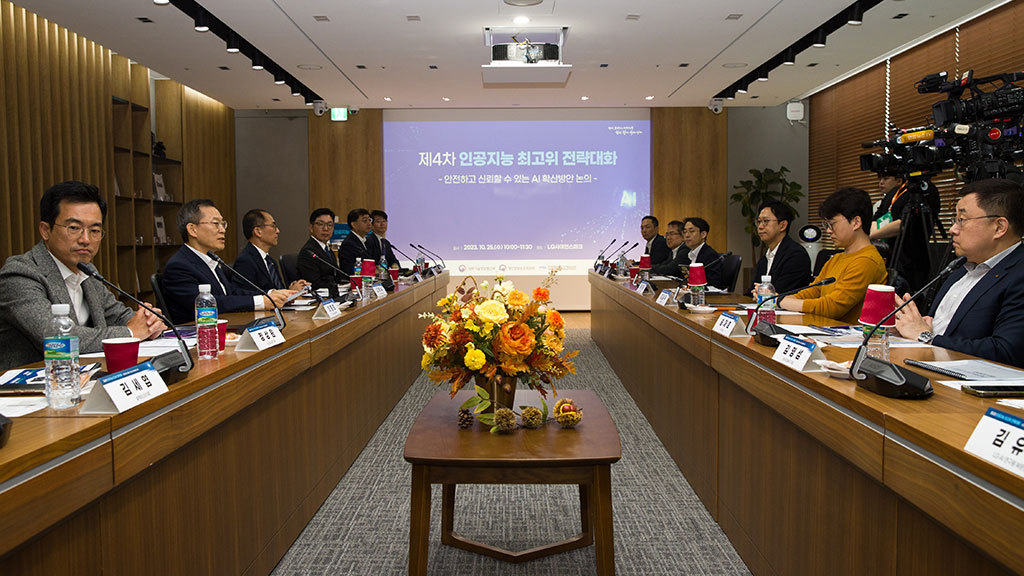
▲The 4th AI High-Level Strategic Dialogue held in October 2023 (Ministry of Science and Technology data)

Promoting a national blueprint to enhance AI industry competitiveness
Co-hosting the 'AI Safety Summit' in May… Leading AI Norms

Following the ChatGPT craze of OpenAI, the spread of AI technology at the national level is expected in 2024. The Korean government is making all-out efforts to secure global technological hegemony by securing ultra-large AI competitiveness in the digital era.

The Ministry of Science and ICT announced the 'AI Daily Life and Advancement Plan' in January 2023, the 'Super-large AI Competitiveness Reinforcement Plan' in April, and the 'National AI Daily Life Implementation Plan' in September. As a result of establishing a joint inter-ministerial strategy and promoting AI daily life, AI technology has spread to all citizens and industries.

In particular, despite the low competitive growth rate, high interest rates, and high prices, Korea's AI sales increased by an annual average of 41.9% from KRW 2.58 trillion in 2021 to KRW 5.20 trillion in 2023. According to the Information Statistics Survey (Korea Intelligence Information Society Agency), the proportion of Korean companies using AI technology and services to lead digital transformation is close to 30%.

The National IT Industry Promotion Agency has selected the following industries as those with high ripple effects when applying AI: virtual convergence, content media, smart manufacturing, distribution logistics, education, security, autonomous vehicles, service robots, smart cities, smart homes, and medical and healthcare. Investment at the national level is urged, focusing on these industries.

The government has been preparing measures to proactively integrate large-scale AI services in the private and public sectors in response to industrial demand. It has mainly built and opened high-quality text data on a large scale as a basis for learning and inferring large-scale AI models. It plans to apply projects to services in five major private sector fields, including law and medicine, and to use platforms (APIs) to support the development of large-scale AI-based national innovation services and conduct education-related tasks based on a budget of 38.3 billion won in 2024.

The AI war is unfolding not only in terms of AI services, but also in core infrastructure such as AI semiconductors and data centers. As the scale of large language models and multi-modal models such as OpenAI's ChatGPT, which announced GPT-4 Turbo, MS Bing, Google Bard, Tesla Grok, Naver HyperClova X, and SKT Adot are becoming increasingly large, AI semiconductor-based servers are emerging as core infrastructure. The government provided computing resources, including the opening of the Gwangju AI Data Center last October.

■ Urgent need to establish measures to ensure AI ethics

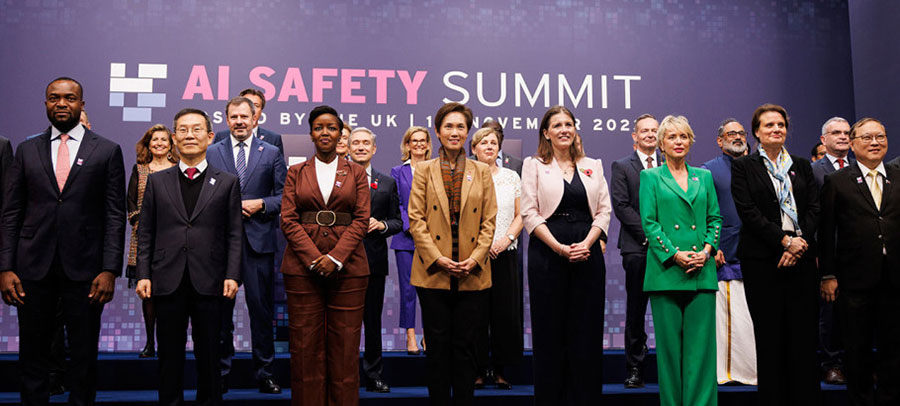
▲2023 November UK AI Safety Summit (Ministry of Science and Technology data)

This year, attention is focused on establishing AI standards to resolve AI disputes. As concerns about AI side effects such as the so-called hallucination phenomenon of generating false information and telling lies, and racial discrimination and sexism are raised, the entire world is actively working on establishing measures to secure AI reliability.

In particular, with the US pursuing self-regulation and the EU pursuing strong regulation, a balanced approach that fits our country's circumstances is emphasized. At the AI norms discussion meeting held on the 28th, Park Yoon-gyu, Second Vice Minister of Science and ICT, explained, "Not only the US and the EU, but also the G7's 'Hiroshima AI Process' and the UN's 'High-level AI Advisory Body Operation' are fiercely competing for leadership in AI norms at the international community level." Kang Ji-won, an attorney at Kim & Chang, said, "Compared to the existing executive committee, the EU's recent AI bill has expanded the scope of AI prohibitions and established general-purpose AI regulations."

In Korea, discussions are underway on establishing a legal system through ongoing meetings based on the national AI ethics standards established in 2020. Last June, the 'Ultra-Large AI Promotion Council' comprised of domestic super-large AI companies and SMEs and startups was launched, and the private-sector-led 'AI Legislation Reform Team' and 'AI Ethics Policy Forum' are actively promoting the discovery of tasks for revising laws and systems and the establishment of related policies. Last October, the '4th Artificial Intelligence High-Level Strategic Dialogue' was held, where super-large AI companies such as Naver, LG, and SKT agreed to gradually introduce 'visible watermarks' for AI-generated results, and a high-risk AI guidebook is scheduled to be prepared in the first quarter of 2024.

In addition, the Ministry of Science and ICT participated in the 'AI Safety Summit' with major domestic companies such as Samsung Electronics and Naver, attended by AI ministers from 28 countries around the world and Google, Microsoft, OpenAI, and Amazon last November. Based on the Digital Bill of Rights, Korea has decided to co-host the next AI Safety Summit with the UK (tentatively scheduled for May, Korea). As a host country, Korea will be able to proactively propose AI safety agendas.

The Ministry of Science and ICT said, “With the recognition that the AI industry is a key growth foundation that will drive national growth and advancement, we will do our best to establish and promote related policies such as securing original technologies, fostering companies, and cultivating talent in order to make a leap forward as the world’s best AI country by 2024.” The Ministry also said, “We will do our best to promptly enact the AI Act, which contains the legal basis for systematically supporting the AI industry and responding to side effects, and to lead the norms regarding AI at the AI Safety Summit.”