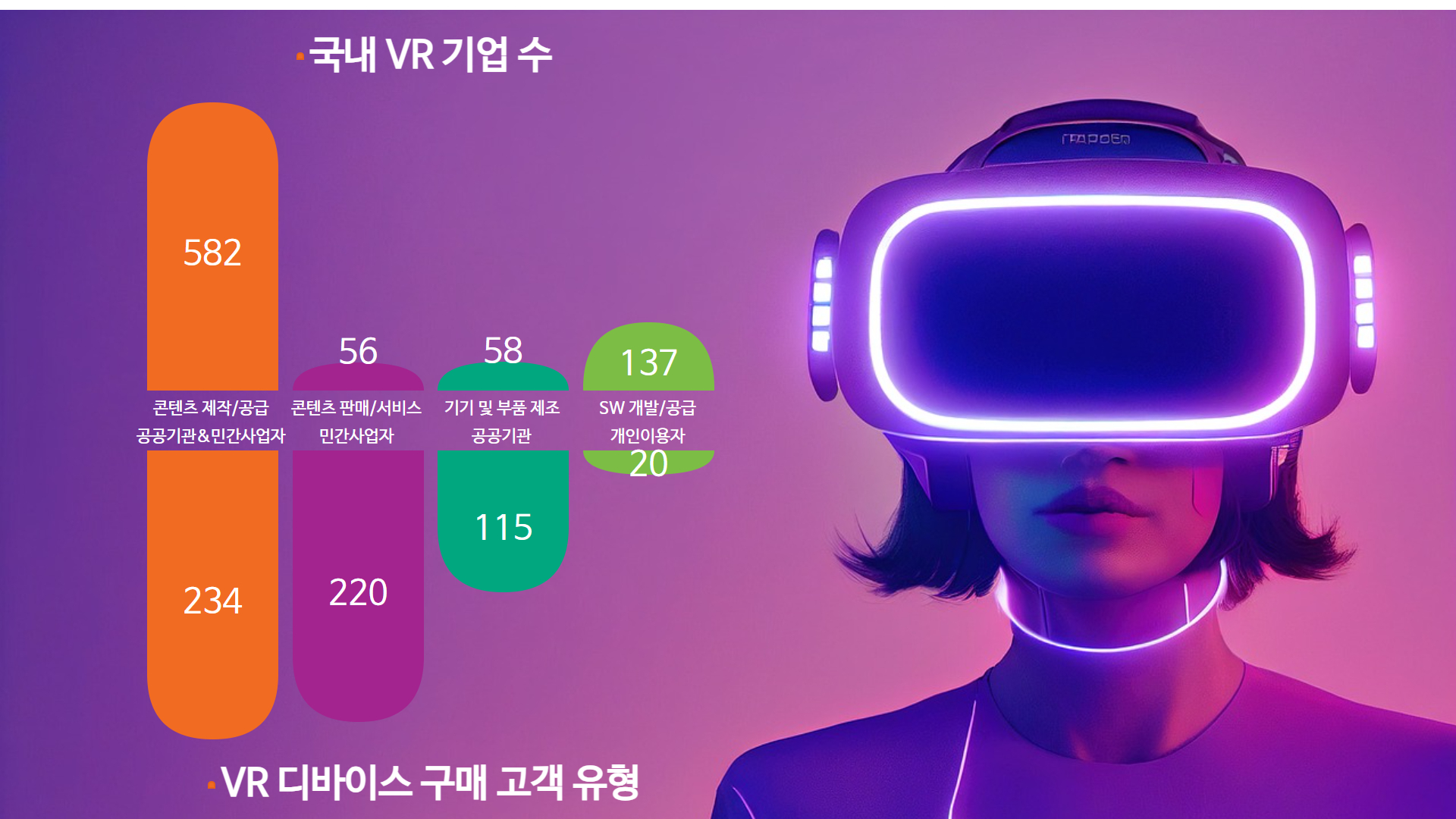
▲Current status of domestic VR industry (Graphics: e4ds news/Data: Software Policy Research Institute)
“Korea, content/media over 80%, HW/components developers under 8%”
Domestic VR market size, SW·content ↑1 trillion won...HW 50 billion won
Apple Vision Pro, which Apple unveiled touting spatial computing, is scheduled to be released in the first half of next year. As a result, expectations in the metaverse industry are also growing. Attention is focused on whether the metaverse ecosystem can be reorganized around big tech to escape the slow market expansion.
The argument is that the domestic metaverse industry has a low proportion of domestic device, material, and component developers due to its focus on content and software (SW), and that the market entry and ecosystem of technology companies in these fields should become more active.
■ Korea, overwhelming preference for metaverse content, media, and SW .jpg)
▲Number of domestic VR companies (Source: Software Policy Research Institute)
In the domestic VR/AR market, the number of dedicated device and component manufacturers is only in the single digits, showing that most industries are concentrated in content and SW-related fields.
According to the '2022 Virtual and Augmented Reality Industry Survey' published by the Software Policy Research Institute, out of 711 VR/AR companies, only 58 companies, or 8.2%, are manufacturing dedicated devices and parts, while 582 companies, or 81.9% of the total, are in the content production and supply industry.
Including 56 companies in the content sales and service industry (7.9%), we were able to confirm that 90% of the domestic metaverse industry landscape is comprised of content companies.
The content industry's sales ratio is 984 billion won as of 2021, and in terms of sales per company, one company has an average sales of about 1.7 billion won. The VR/AR device manufacturing industry is in an even worse situation. Total sales amounted to 43.1 billion won, which is only 740 million won per company.
At the XR industry policy meeting, Sim Eui-sik, team leader of the Korea Immersive Metaverse Content Association (KOVACA), explained, “About 80% of metaverse companies are in the content industry, and it is estimated that only 3-5% of companies are developing devices for the XR industry.” He added, “In Korea, the market has been formed around parts and materials, as finished products have not yet been released to the market.”
■ Device manufacturers are the weak link... Content is also lacking in substance 
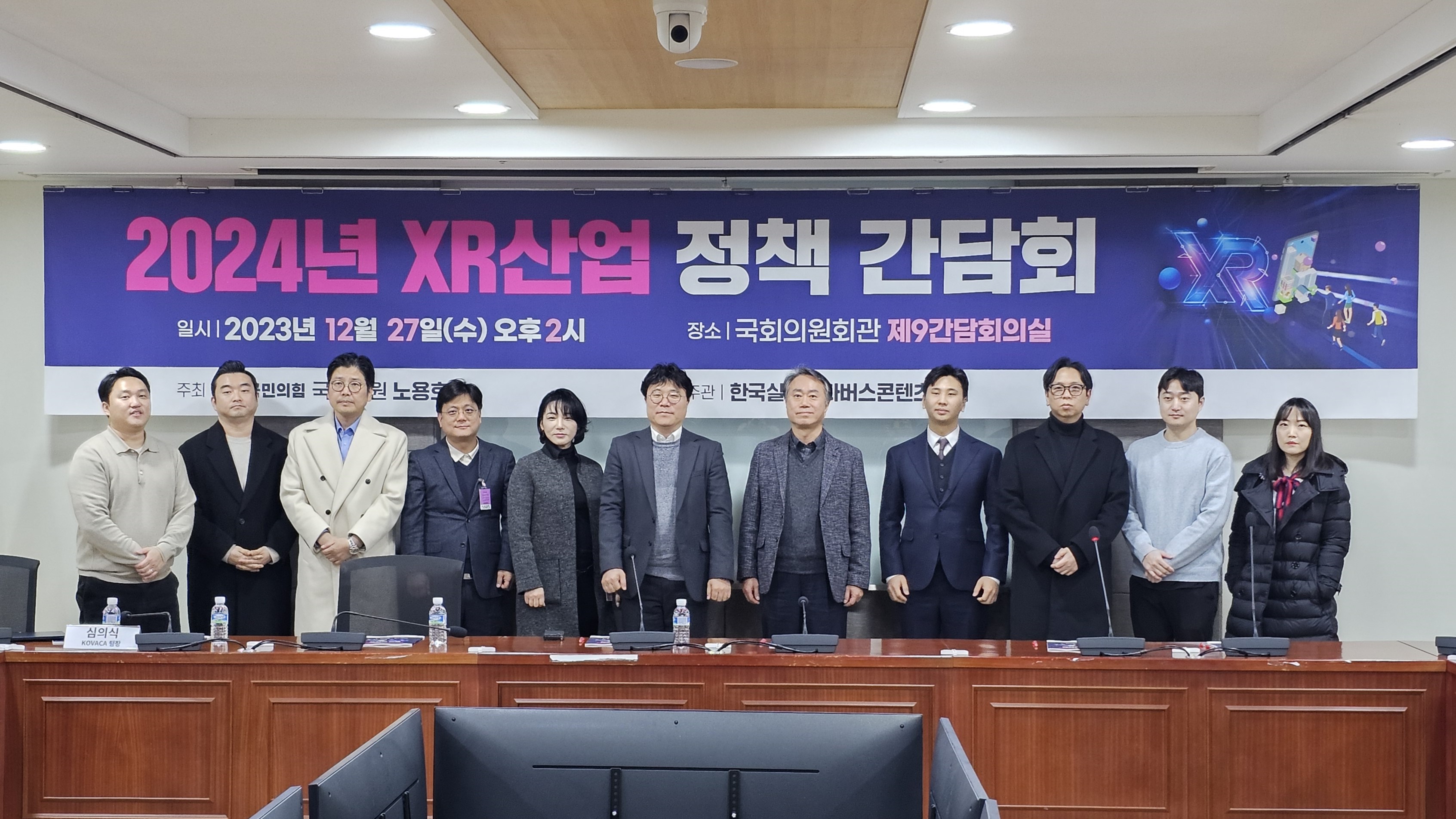
▲2024 XR Industry Policy Meeting
Given this situation, small and medium-sized companies and startups with weak capital to develop hardware (HW) are focusing on developing new technologies to appeal to the next-generation cutting-edge market, but they are still at the level of presenting prototypes.
At the 2024 XR Industry Policy Discussion held at the National Assembly Members’ Hall in Yeouido on the 27th, Team Leader Sim Ui-sik pointed out the absence of domestically produced VR/AR devices and argued that investment in devices and content linkage utilizing them should be supported simultaneously through policies to establish a foundation for market formation.
Currently, domestic VR/AR device development is being carried out mainly by small and medium-sized companies and startups, and there are no products that have been released to the market and can be purchased directly by consumers. In fact, it is observed that the main sources of revenue are R&D prototypes and development and delivery of local government/agency projects.

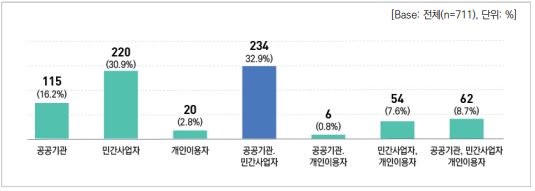
▲Types of VR/AR device purchase customers (Source: Software Policy Research Institute)
There were also concerns raised about the decline in self-sufficiency, with some pointing out that “content companies are also focusing on R&D,” and others pointing out that “the biggest problem is that there are no devices, consumers, or markets.”
Despite the vulnerability of the domestic XR industry, among domestic companies, startup company Letinar, which develops AR optical lenses, has reportedly achieved certain results, such as winning the CES Innovation Award and supplying AR optical modules to global companies, and is seeking to enter the parts and materials market through the development of next-generation core technologies.
Team Leader Shim advised, “The domestic metaverse industry tends to focus on R&D technology development, so it is necessary to prepare a roadmap for the development of technology standards to prepare for the global market,” and pointed out, “This needs to be established as a macro roadmap, such as a three-year plan, led by the government.”