▲(From left) Professor Ji-yoon Kim, first author, researcher Jun-gyu Choi
Real-time change of shape and characteristics, utilization of various machine core parts
A material that can change shape and properties in real time has been developed. It is expected to be used as a key component in various machines such as robots that adapt to dynamic changes or require shape transformation.
UNIST (President Yong-Hoon Lee) announced on the 5th that Professor Ji-Yoon Kim's research team in the Department of Materials Science and Engineering has developed the world's first metamaterial that can control the shape and properties of a material in real time, overcoming the limitations of existing materials.
Unlike existing metamaterials that cannot change their designed shape and properties or can only be changed to a limited extent, they can be used in real time and in the right place.
Metamaterials are artificial materials designed to have special physical properties, unlike ordinary materials found in nature. Ordinary materials such as jelly expand horizontally when pressed vertically, but metamaterials can shrink horizontally even when pressed vertically. These properties can be applied innovatively in various fields such as architecture, aviation, and robotics.
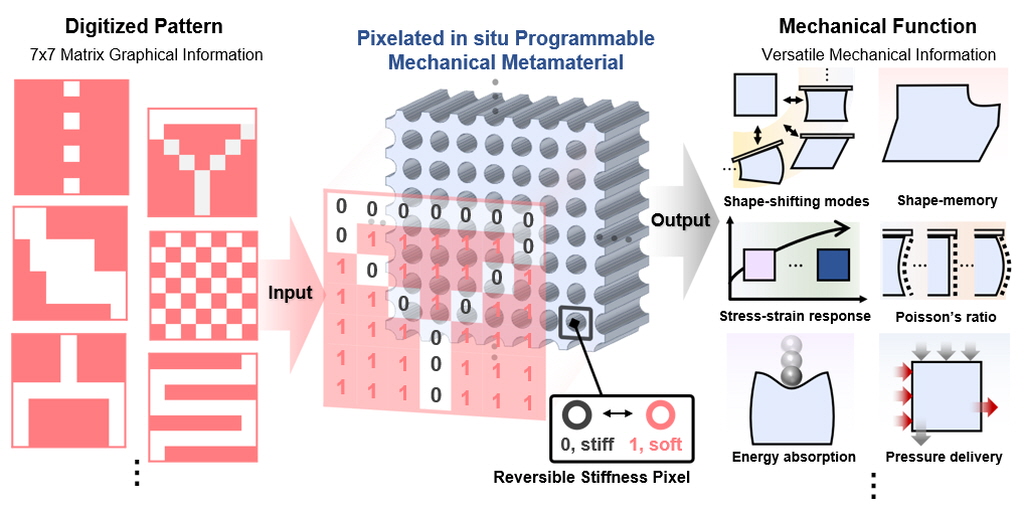
The research team succeeded in developing a metamaterial that can control the shape and properties of a material in real time. The research team fused a “low melting point” alloy that changes the metapixel, which is the basic unit structure of the metamaterial, into a liquid or solid, which are representative states of the material. By controlling the state of the fused alloy in this way at the level of tiny pixels, we were able to implement various properties of the metamaterial.
The research team designed the fused alloy to express digital pattern information (0=liquid, 1=solid) and to input digital pattern commands in real time. Through the input digital pattern, various properties such as the shape, strength, and deformation ratio of the metamaterial can be controlled in real time.
The first author, Choi Jun-gyu, a researcher in the combined master’s and doctoral program, explained, “The developed metamaterial can implement desired properties within a few minutes without additional hardware,” and “It will present new possibilities for implementing advanced adaptive materials, such as adaptive robot development in the future.”
The research team demonstrated an 'adaptive impact energy absorbing material' as an example of utilizing the developed metamaterial. This metamaterial changed its properties appropriately according to the impact that occurred in an unexpected situation. It minimized the force transmitted to the object being protected, reducing the possibility of damage or injury.
The research team also used metamaterials as a 'force transmission material' that can transmit force to a desired location and time. Force was applied to one side according to the command entered into the metamaterial. We verified that by inputting the path along which a given force is transmitted as a digital command, the adjacent LED switch on the opposite side can be selectively operated.
Professor Kim Ji-yoon of the Department of Materials Science and Engineering said, “This metamaterial, which can convert digital information into physical information in real time, is seamlessly compatible not only with various existing digital technologies and devices, but also with artificial intelligence technologies such as deep learning.” He added, “This will be the first step toward innovative new materials that can learn on their own and adapt to their surroundings.”
This study was officially published on January 25th in Advanced Materials, a world-renowned international academic journal, and was selected as the Back Cover paper. The research was conducted with the support of the National Research Foundation of Korea (NRF) under the Ministry of Science and ICT and the Korea Institute of Materials Science (KIMS).

▲Concept diagram of metamaterials that can be coded in real time