Physical AI HBM Smart Factory SDV AIoT Power Semicon 특수 가스 정정·반론보도 모음 e4ds plus

Our private satellite captured clear images of every corner of the Earth.

Google 우선 소스 기사입력2024.04.18 15:21


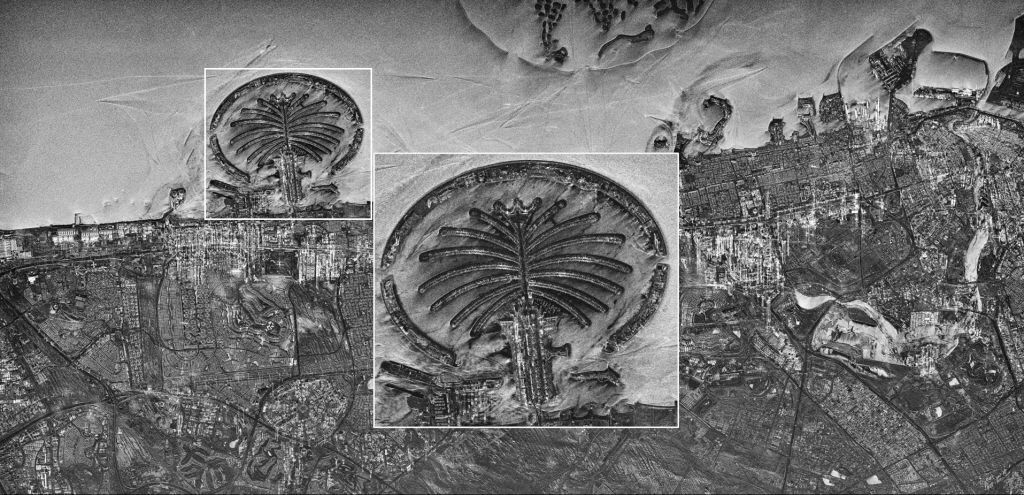
▲Palm Jumeirah, the world's largest artificial island shaped like a palm tree, in Dubai, photographed by Hanwha Systems' small SAR satellite

Hanwha Systems Releases First Small SAR Satellite Image

The image of the Earth as seen from space by our private satellite, including the artificial island in Dubai, was revealed, proving its capabilities.

Hanwha Systems (CEO Sung-chul Eo) released on the 18th videos (photos) of various parts of the Earth taken by the 'small SAR satellite', Korea's first private observation satellite launched into space on December 4th of last year.

The images sent from space 650km above the Earth by a small SAR satellite manufactured by Hanwha Systems include world-famous tourist attractions such as the splendid skyline of Manhattan, New York, and the world's largest artificial island shaped like a palm tree, Palm Jumeirah in Dubai.

It boasts image quality comparable to that of advanced SAR satellite images currently in operation, and in particular, the New York image clearly captures Central Park, located in the heart of Manhattan, and Yankee Stadium, the home stadium of the New York Yankees of the American Major League Baseball.

In addition, it is significant in that it has captured major bridges, rivers, and airports for detailed identification and observation.

The small SAR satellite is currently conducting test operations to collect ground terrain information, orbiting the Earth 15 times a day for four months after launch and performing two-way communications with ground base stations about six times.

SAR satellites are also called 'imaging radar satellites' because they irradiate electromagnetic waves toward the ground and then create a topographic map of the Earth's surface by synthesizing the reflected waves that bounce off the surface in time sequence.

The microwaves used in SAR can pass through thick clouds, making it possible to take Earth observation images and collect information regardless of day or night and in bad weather. It is widely used in various fields such as climate, environment, disaster, and catastrophe monitoring, construction, infrastructure development, new energy exploration, and security. It can detect subtle changes in the subject of observation, allowing prediction of urban ground subsidence (sinkholes), landslides, and changes in logistics volume.

Through this release, Hanwha Systems has proven the technological prowess of the first SAR satellite produced by a private company in Korea, and expects that through additional verification and correction work on the captured data in the future, it will be possible to sufficiently identify detailed objects such as △low-rise buildings and cars in urban areas, △plants and animals in forest areas, and △maritime vessel information.

According to Allied Market Research, a U.S. market research firm, the global satellite market size is expected to grow at an average annual rate of 8.1% until 2032, reaching USD 615.7 billion (KRW 837 trillion) in 2032, and the satellite service market in particular is expected to grow to USD 144.5 billion (KRW 197 trillion) in 2026.

Hanwha Systems plans to create various added values in the satellite service market by utilizing small SAR satellite technology, including: ▲environmental monitoring through high-resolution satellite image analysis for B2G (business-to-government) and B2B (business-to-business), ▲data analysis for GIS (Geographic Information System) map production, and ▲automatic fusion and analysis of satellite image information.

Sung-chul Eo, CEO of Hanwha Systems, said, “Through successful SAR satellite photography, we have once again proven our technological capabilities and status as a representative company of ‘K-Space’ and a leading company that will lead the future global space age.” He added, “Hanwha Systems will expand all areas of its space business from satellite development, manufacturing, launch, control, and service, and advance its civilian observation satellite services that can help the development of various industries at home and abroad in the future.”

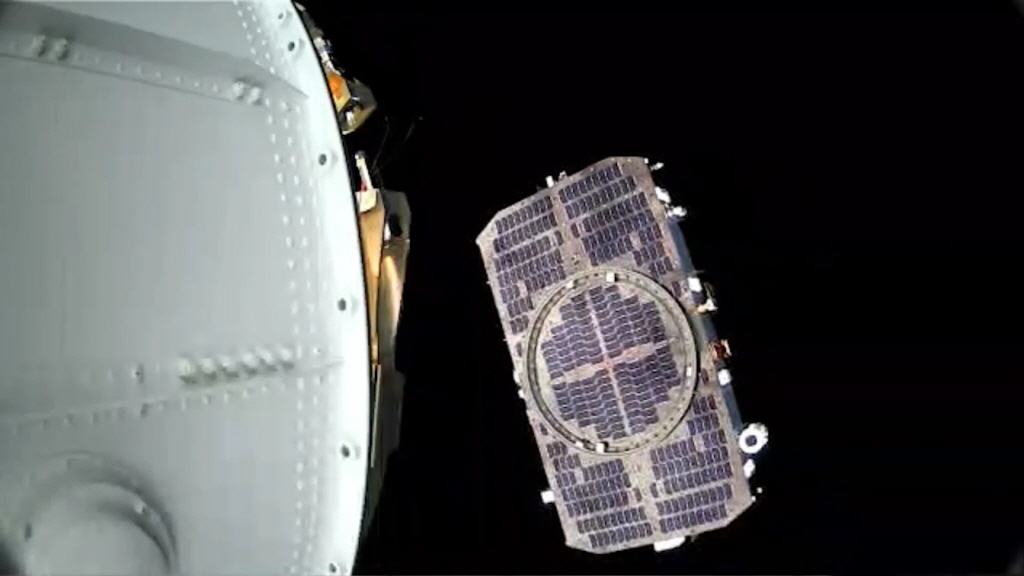
Meanwhile, Hanwha Systems' small SAR, which was successful this time, The satellite has a resolution of 1m and, unlike general satellites, is designed in a very unique way with the payload, main body, and solar panels integrated to allow for as many satellites as possible to be loaded onto a space launch vehicle.

Hanwha Systems' small SAR satellite was launched into space at 14:00 on December 4, 2023, and after settling into the target space orbit, it transmitted its first satellite signal stably at 15:45:40. Then, at 17:38:01, it succeeded in two-way communication with the ground control center, creating the first record of a private satellite launch made entirely with domestic technology.

▲Hanwha Systems' 'small SAR satellite' that arrived in space