반도체 AI 보안 인더스트리 4.0 SDV 스마트 IoT 컴퓨터 통신 특수 가스 소재 및 장비 유통 e4ds plus

Optimal Mixture of All-Solid-State Battery Cathode and Electrolyte Found

기사입력2024.07.29 13:23


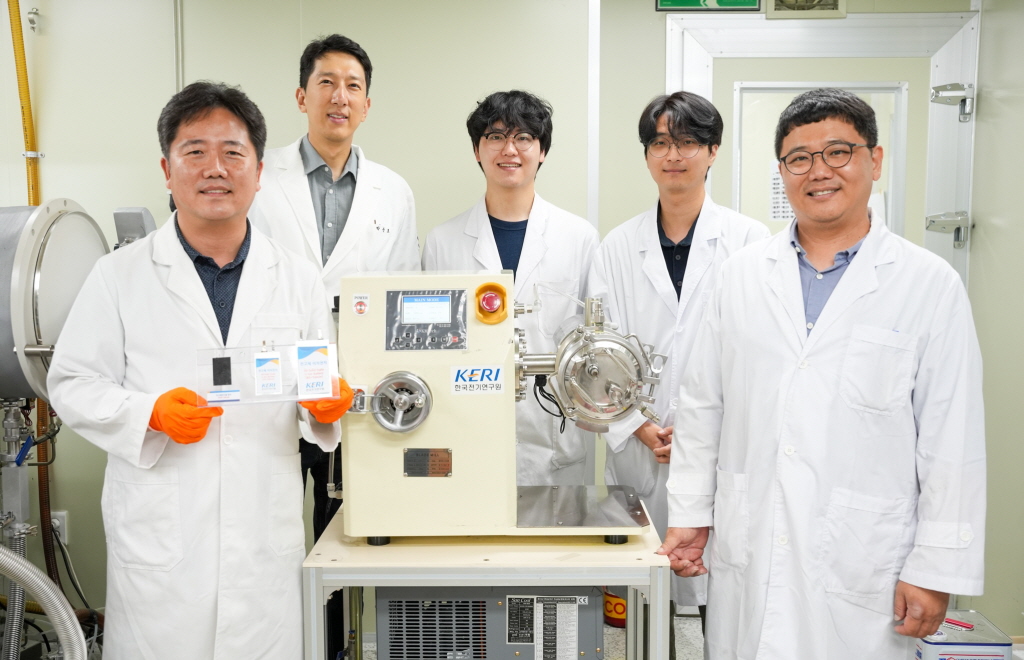
▲ KERI researchers, including Dr. Ha Yoon-cheol (left), pose in front of the 'blade mill' equipment for optimal mixing of positive electrode active materials and solid electrolytes for all-solid-state batteries.
Electrochemical Research Institute develops composite material by coating solid electrolyte on cathode active material

A material that realizes optimal mixing by coating a solid electrolyte on a cathode active material for commercialization of all-solid-state batteries has been developed, and it is expected to contribute significantly to improving the performance of all-solid-state batteries in the future.

The Korea Electrotechnology Research Institute (KERI) announced on the 29th that it has developed a technology to optimally mix positive electrode active materials and solid electrolytes for all-solid-state batteries (sulfide systems) together with the research team of Dr. Ha Yoon-chul from the Next Generation Battery Research Center, the research team of Professor Kim Byeong-gon from the Department of Applied Chemistry at Kyung Hee University, the research team of Professor Moon Jang-hyeok from the Department of Energy Systems Engineering at Chung-Ang University, and the research team of Professor Lee Seung-gi from the Department of Materials Science and Engineering at Pusan National University.

All-solid-state batteries are attracting attention as next-generation batteries due to their extremely low risk of fire or explosion, but due to the keyword “solid,” they require much more technological prowess and are more difficult to manufacture than existing “liquid electrolyte”-based batteries.

In particular, effective mixing and dispersion of the internal cathode active material, solid electrolyte, conductive material, and binder is known to be one of the difficult problems in the manufacture of electrode plates.

This is because the conditions are very strict, such as the need to create a channel with a structure that allows electrons and lithium to be transmitted well, and the interface resistance at the contact surface must also be low.

Up to now, in order to combine the cathode active material and the solid electrolyte, △mechanical in a wet or dry environmentThere were methods such as △a method of simply mixing and manufacturing it with a thickness of tens to hundreds of micrometers (one millionth of a meter) and △a 'core-shell' structure method that wraps the surface of the positive electrode active material with a solid electrolyte, but the movement of electrons or ions was not smooth, and it was not easy to form a low interface resistance.

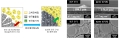
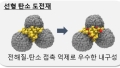
Accordingly, KERI and the university research team utilized a method of partially coating the cathode active material with a solid electrolyte. The solid electrolyte is sensitive to oxygen and moisture, and deterioration occurs if it is used incorrectly.

On the other hand, the research team developed a special equipment called a 'blade mill' that can use so-called 'inert (inactive) gases' that do not cause chemical reactions, and was able to study various types of solid electrolyte coating structures and experiment and verify the optimal mixing ratio with the cathode active material.

Afterwards, through various simulations, we secured a lot of data that could improve the 'active material utilization rate (actual operating capacity compared to theoretical capacity)' and 'rate characteristics (high-speed charging/discharging compared to low-current charging/discharging)' of all-solid-state batteries. And we applied the results to a prototype (pouch cell) and confirmed the performance improvement of all-solid-state batteries.

The related research results were published in a paper in 'Energy Storage Materials', a renowned international academic journal in the energy field. The 'JCR Impact Factor', which evaluates the influence of academic journals, is 18.9, placing it in the top 5% in its field.

Dr. Ha Yoon-cheol said, “In order to expand the use of all-solid-state batteries, it is important to improve the performance and price of the solid electrolyte itself, but the structural design and manufacturing process technology to effectively create electrode plates that facilitate the flow of ions and electrons are also important.” He added, “We will be able to greatly contribute to improving the performance of all-solid-state batteries by increasing the functionality of the electrode plates through a composite material of positive active materials partially coated with a solid electrolyte at an optimal ratio.”

KERI, which has secured a technology-related patent, expects that the achievement will receive much attention from those involved in the manufacturing of all-solid-state battery electrode plates and cells, and plans to discover related demand companies and promote commercialization.

Meanwhile, KERI is a government-funded research institute under the National Research Council of Science and Technology of the Ministry of Science and ICT.