.JPG)
▲
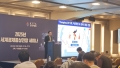
PwC Consulting Partner Yoo Won-seok is seen speaking at the Samil PwC seminar.
IRA Partial Reduction, Solar and Blue Hydrogen Expected to Maintain
China Tariffs Benefit Korea, Solar and Electric Power Components
On the 20th, local time, the inauguration ceremony of the 47th President of the United States, Donald Trump, was held. President Trump, who returned to the White House four years after leaving office in 2021, once again declared 'America First' in his inaugural speech.
Trump emphasized four policies in his inauguration speech. △Mentioned border protection and immigration policy △Expansion of fossil fuel production and exports and revival of manufacturing in the U.S. △Trade tariffs △Gender issues, etc.
In particular, it has been confirmed that all walks of life are busy preparing countermeasures for the anticipated major changes in energy policy in the United States, particularly in relation to industry.
At the seminar titled 'Trump 2.0, Outlook for the Korean Energy Market and Response Strategies of Companies in Response to Global Environmental Changes' hosted by Samil PwC on the 21st, the keynote of the US energy transition policy was examined and outlooks were shared accordingly.
The sectors that benefit from the shift in U.S. energy policy are expected to expand and maintain in the short term, including traditional energy industries such as natural gas and shale gas, blue hydrogen, solar energy, crude oil, CCS, nuclear power, and transmission and distribution network infrastructure, as well as eco-friendly energy that is generating real profits and benefits.
On the other hand, it is predicted that there will be negative effects on green hydrogen and offshore wind power, and it seems that renewable energy will be the first to be selected. The Inflation Reduction Act (IRA) will undergo some adjustments, but it is expected that it will not be completely abolished because some regions that benefit from the IRA are Republican supporters.
Despite the reduction in new renewable energy development, experts predict that the benefits will continue in areas such as economically viable solar power projects and blue hydrogen that has advantages linked to CCS. While there is a risk of decreased demand for solar modules due to the reduction in new development, there is also the possibility that domestic modules may benefit from the strengthening of tariffs on Chinese exports.
Domestic solar module export companies include HD Hyundai Energy Solutions, Hanwha Q CELLS, and Shinsung E&G. Hanwha Q CELLS recently succeeded in selling two solar power generation projects in Colorado and Virginia, USA, to a global private power company.
In addition, as the trend of expanding new power plants in the U.S. is accompanied by the construction of transmission and distribution networks, it is predicted that exports of domestic power component exporters such as transformers and wires will increase additionally. Hyosung Heavy Industries, a leading domestic power component company, is looking at its all-time high with a stock price of 506,000 won as of the 22nd, and HD Hyundai Electric closed at 401,500 won, a stock price increase of more than 300% compared to a year ago.
Regarding the impact on domestic companies, PwC Consulting Partner Yoo Won-seok predicted, “The U.S. solar energy business is recognized as being economically viable, but as the related market has recently been judged to be overheated, if support is reduced, businesses with less economic viability are likely to be eliminated first.”