PIM, performs processing tasks inside memory
Escape from the chronic bottleneck of the von Neumann architecture
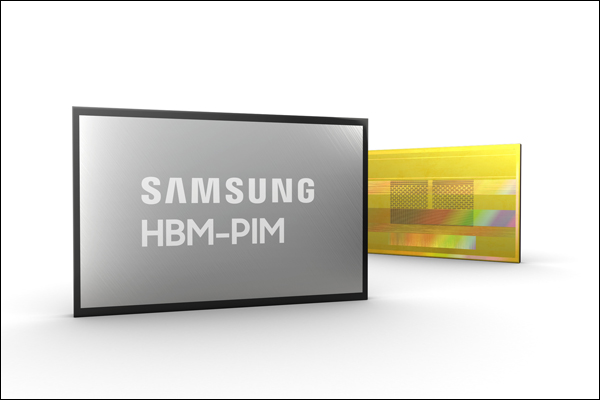
Verification work with customer AI accelerator within the first half of the year Samsung Electronics announced on the 17th that it has developed 'HBM-PIM', the industry's first combination of memory semiconductors and AI processors.

▲ Samsung Electronics, HBM-PIM Development [Graphic = Samsung Electronics]
PIM (Processing-in-Memory) is a technology that adds processor functions required for computational tasks inside the memory. Samsung Electronics developed HBM-PIM by adding an AI engine to the second-generation high bandwidth memory semiconductor 'HBM2 Aquabolt' that has been in mass production since January 2018.
Equipping an AI system with HBM-PIM increases performance by about twice or more compared to a system using existing HBM2, and reduces system energy by more than 70%. In addition, existing HBM interfaces are supported as is, so existing HBM users can strengthen their AI accelerator systems through HBM-PIM without changing hardware or software.
Recently, as the application areas of AI technology have expanded, the demand for high-performance memory has continued to increase, but it has been difficult to overcome the limitations of the von Neumann structure with existing memory.
The von Neumann architecture is the processing method used in most computers today. The CPU sequentially fetches instructions from memory, executes them, and stores the results back in the memory. If the amount of data exchanged between the CPU and memory increases during this process, a bottleneck occurs, delaying the processing of tasks.
To overcome this, Samsung Electronics installed an AI engine in each bank, the smallest logical unit within the memory, and maximized parallel processing to improve performance. HBM-PIM can perform computational processing within the memory, reducing data movement between the CPU and memory, which can improve the energy efficiency of the AI accelerator system.
Samsung Electronics succeeded in commercializing HBM-PIM by grafting the technology onto the DRAM process and published a paper at ISSCC, a global semiconductor conference.
Within the first half of the year, Samsung Electronics plans to complete testing and verification by installing HBM-PIM in customers’ AI accelerators. In addition, it plans to cooperate with customers in the future to standardize the PIM platform and build an ecosystem.