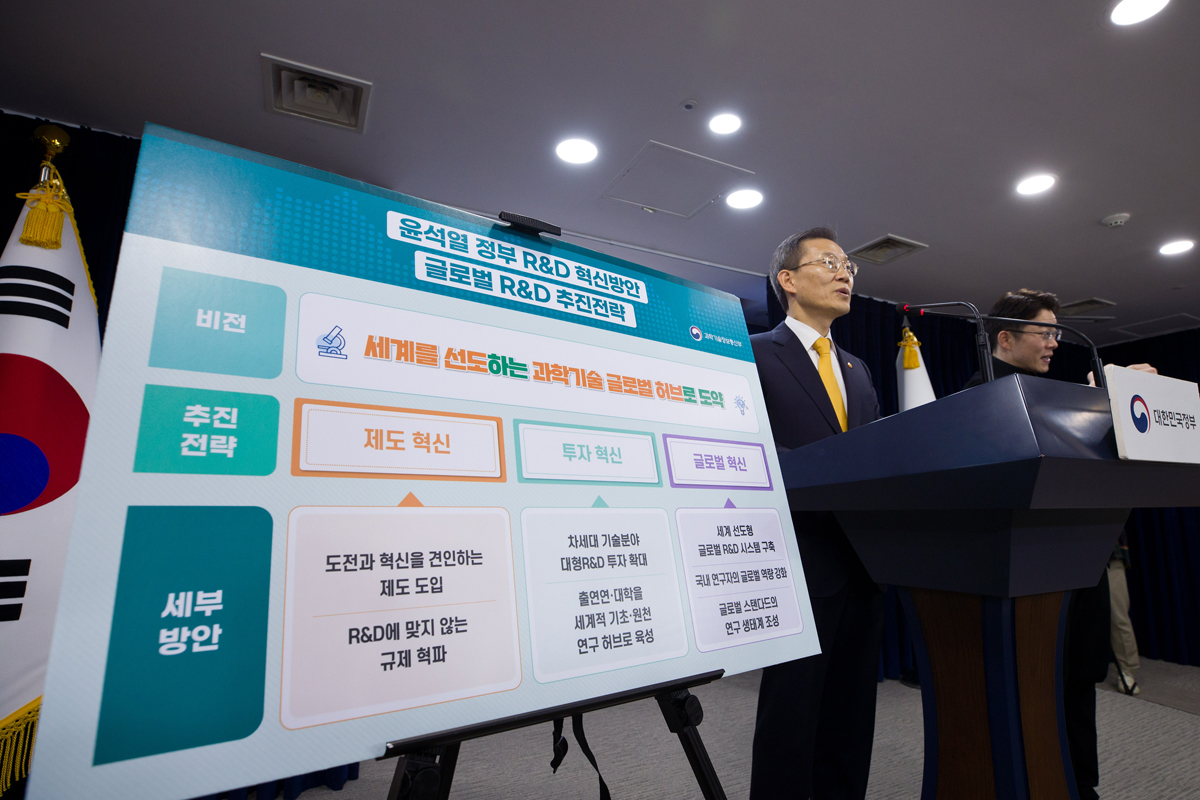
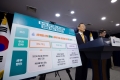
▲Minister Lee Jong-ho briefing the government on R&D innovation plans at the end of November (Photo: Ministry of Science and ICT)
Investment of 100 billion won in 3 major technologies, up 30% from the previous year
New products such as advanced packaging and on-silicon displays
In the new year of Gapjin, support for securing next-generation original technologies in the three major technology fields of semiconductors, displays, and secondary batteries is expected to accelerate.
The Ministry of Science and ICT (MSIT) announced on the 29th that it has implemented follow-up measures for detailed implementation strategies with the goal of securing world-class, super-gap technologies in three key technology fields.
The Ministry of Science and ICT plans to secure a total of KRW 100.9 billion in the 2024 budget to accelerate preemptive R&D investment based on public-private collaboration to secure ultra-gap original technologies and create new markets.
In the new year of 2024, the following will be invested: △ Core semiconductor advanced packaging technology (KRW 6.4 billion), △ Next-generation semiconductor response micro-substrate technology (KRW 6.4 billion), △ Next-generation semiconductor equipment source technology (KRW 2.5 billion), △ Future source technology for on-silicon displays (KRW 3.3 billion), △ Future display strategy research lab (KRW 3 billion), and △ Core source technology for limit-breaking secondary batteries (KRW 3.5 billion).
In accordance with the semiconductor, display, and secondary battery ultra-gap R&D strategy announced in April, the Ministry of Science and ICT is: △ launching and operating a public-private research consultative body at the inter-ministerial level; △ focusing on supporting R&D of future core technologies; △ promoting the establishment and operation of advanced research institutes and research centers;△ Training of doctoral-level personnel, strengthening of research infrastructure and international cooperation, etc. have been established.
First, the 'Inter-Ministry Public-Private Research Council' consisting of experts and organizations from industry, academia, and research was launched in the fields of semiconductors, displays, and secondary batteries between May and July, and through this, the following were promoted: △government policy suggestions, △business planning based on private demand, and △research results sharing.
In particular, while continuing to support the development of low-power, high-performance new devices, the development of next-generation compound source technologies, and the training of system semiconductor personnel, the government has launched a new 'National Semiconductor Research Lab' project and designated 19 national flagship semiconductor research labs.
In addition, in 2023, a new 'My Chip Manufacturing Service' was launched to allow undergraduate and graduate students majoring in semiconductor design to manufacture and verify chips of their own designs in order to foster design professionals.
In 2024, the company announced that it will continue to promote next-generation semiconductor human resources training to foster advanced human resources with master's and doctoral degrees in key technology fields, while establishing a human resources training project in the semiconductor advanced packaging and secondary battery fields, and strengthening the training of specialized human resources who can be immediately deployed to companies through contract departments and contract quota systems.
Accordingly, 600 million won and 1 billion won will be invested in training experts in semiconductor advanced packaging and next-generation secondary batteries, respectively.
In addition, the foundation for activating international cooperation is expected to be strengthened, and joint research with the US, EU, etc. is expected to be conducted starting in 2024. It is reported that joint research will be supported by joint funding from the US National Science Foundation (NSF) and the EU Commission, and that joint research and personnel exchanges in conjunction with global advanced fabs such as NY Creates in the US, as well as support for small and medium-sized business testing, will be promoted.
The government announced that it is focusing on developing new advanced packaging processes in conjunction with the Nanotechnology Institute, and that it is planning projects for the new year, including the △International Cooperation Development Project for Original Technologies (KRW 6.8 billion) and the △Semiconductor Global Advanced Fab Linkage Utilization Project (KRW 2.5 billion).
Minister of Science and ICT Lee Jong-ho emphasized, “It is very important to secure the original technology of the three key technologies for the future of our economy,” adding, “In the future, we will expand support for securing the next-generation original technology and training specialized personnel in key technology fields that are highly needed in the private sector but lack the capacity to invest.”